
Lack of inclusive digital safeguards fueling children’s online exploitation
Staff Reporter:
Country’s children, especially those with disabilities, are becoming increasingly vulnerable to online sexual exploitation due to the absence of inclusive safety measures on digital platforms, experts said at a national workshop in Dhaka on Monday.
Speaking at the event, specialists noted that the rapid expansion of digital access from urban to rural areas has created new opportunities but also widened exposure to online harassment and exploitation. They stressed that inclusive education on digital safety, teachers’ training, and stronger access to justice are essential to reducing risks.
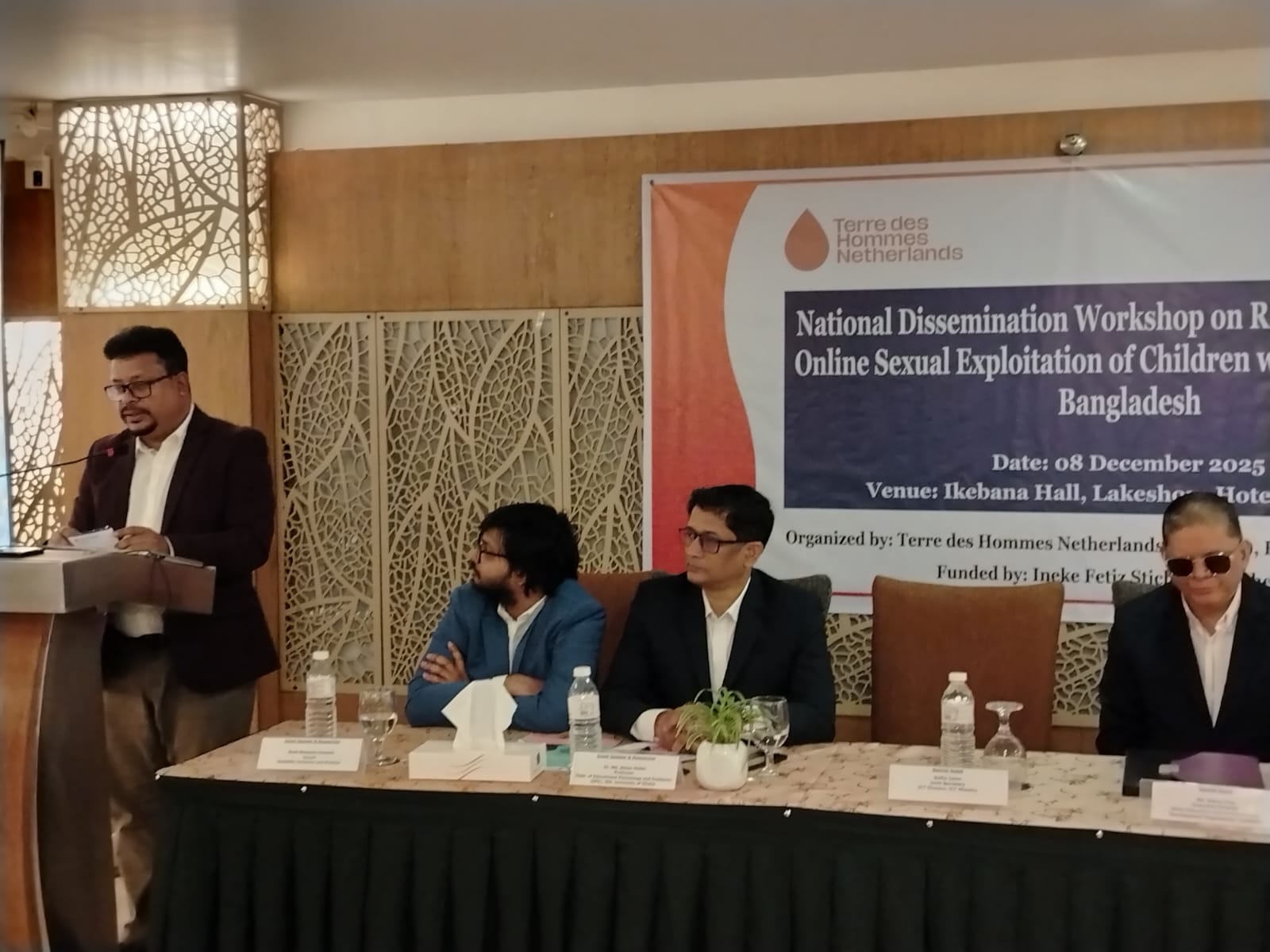
The workshop, held at a city hotel, focused on the findings of a study titled “Preventing Online Sexual Exploitation of Children and Children with Disabilities in Bangladesh,” conducted under the global VOICE Identity Project run by Terre des Hommes Netherlands (TdH-NL). The event was chaired by TdH-NL Programme Coordinator Nurul Kabir.
Senior government and civil society representatives, including Social Services Department Director General Md Saidur Rahman Khan, DMP Deputy Commissioner (Women Support and Investigation) Farhana Yasmin, BERDO Executive Director Md Saidul Haque, and Access Bangladesh Foundation Chairperson Mohua Pal, spoke at the workshop. Presenting the research data, Dhaka University Professor Dr Md Ahsan Habib said survey findings indicate that “no child is fully safe online.”
According to the study, 23 percent of children fall into a severe risk category, eight percent face moderate risk, and 69 percent remain only partially safe. Facebook poses the highest risk, with 77 percent of surveyed children exposed, followed by Instagram at 15 percent and other platforms. Habib argued that no single initiative can solve the problem: “Children must be treated as part of the solution. Their experiences, ideas, and peer networks are crucial for shaping effective strategies.”
He added that awareness campaigns and digital tools must be accessible to children with disabilities. Presenting further findings, TdH-NL’s Nurul Kabir said children with disabilities remain one of the most neglected groups globally.
While around 16 percent of the world’s population lives with some form of disability, Bangladesh’s official estimate stands at only 2.8 percent. “This gap reflects long-standing underreporting, social stigma, and invisibility,” he said.
Only about 40 percent of children with disabilities in Bangladesh are enrolled in formal education. Limited digital skills, inadequate access to devices, and the lack of disability-friendly online safety policies leave them exposed to greater online risks.
Yet, Kabir noted, the digital world can also open doors to learning, recreation, and social connection—if safety measures are strengthened. Researcher and disability specialist Shah Moazzem Hossain highlighted the structural gaps preventing equal protection.
He urged policymakers to incorporate disability-inclusive safeguards into all child protection and online safety laws. “Disability programmes, digital literacy initiatives, and child protection workers must collaborate more closely,” he said.
Development organisations, he added, should amplify children’s voices, challenge stigma, and push for community- and policy-level reforms. Social Services DG Saidur Rahman Khan underscored the urgency of addressing both physical and psychological abuse. “Children are falling into visible and invisible traps online,” he said. Community participation, along with coordinated government and NGO action, is essential.
He noted that a “National Platform for Child Protection” has already been formed to strengthen collaboration. The VOICE Identity research project aims to identify inclusive protection strategies for children facing risky online interactions, particularly those with disabilities.
Monday’s workshop brought together government officials, local and international NGOs, children with disabilities and their families, education institutions, university representatives, and community-based organisations to review the findings and finalise recommendations.