
Khaleda’s 81st birthday today
Reza Mahmud :
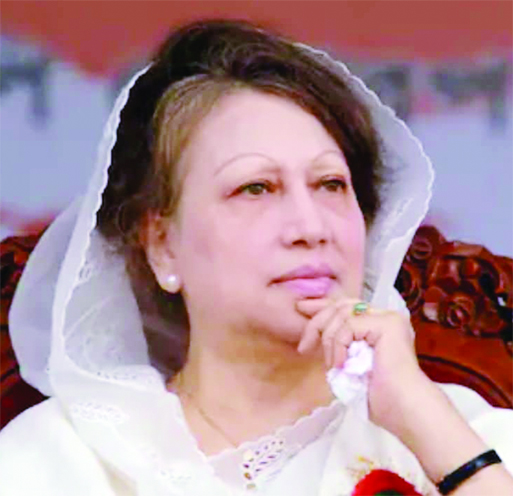
Today is the 81st birthday of BNP Chairperson Begum Khaleda Zia, the country’s highly revered and uncompromising politician and also three times former prime minister of Bangladesh.
To celebrate the occasion, the BNP has announced programs of doa mahfils (prayer gatherings) at party offices and mosques across the country this Friday.
The announcement was made by the party’s Senior Joint Secretary General Ruhul Kabir Rizvi at a press conference on Wednesday.
Rizvi urged leaders, activists, and the people of the country to pray for Khaleda Zia’s recovery. However, he stated that cutting cakes has been prohibited.
Begum Khaleda Zia was born August 15, 1945, Din?jpur. She served as the country’s prime minister from 1991 to 1996 and again from 2001 to 2006. She was the first woman to hold the office, leading the nation through a period marked by natural calamities, economic hardship, and political unrest.
The third of five children of Taiyaba and Iskandar Majumdar, a businessman, Khaleda completed the government matriculation examination in 1960 and later studied at Surendranath College in Din?jpur. In 1959 she married Zia ur-Rahman, a prominent figure in Bangladesh’s independence struggle, when it was still part of Pakistan.
During the 1971 Liberation War she was placed under house arrest, and remained largely disengaged from politics even after her husband became president in 1977.
Following his assassination by military officers in 1981, Khaleda entered politics, taking over the leadership of the Bangladesh Nationalist Party (BNP) in 1984.
She was repeatedly detained during the authoritarian rule of Hussein Mohammad Ershad in the 1980s, but in 1991 she led the opposition to victory and assumed the role of prime minister.
In her first term, Khaleda sought to address the country’s severe economic challenges by promoting privatization and encouraging private investment, while also prioritizing improvements in education and expanding economic opportunities for women.
Her plans faced major setbacks due to the devastating cyclone of 1991, which killed over 130,000 people and caused damage exceeding $2 billion.
In February 1996 she won a second term in a landslide, but the result was marred by an opposition boycott. Accusations that the election would be rigged led nearly 90 percent of voters to abstain. Widespread protests and strikes soon followed, prompting her resignation the next month.
Khaleda returned to power in 2001, pledging to root out corruption and terrorism. Both issues, however, persisted throughout her administration. She stepped down at the end of 2006, handing power to a caretaker government ahead of fresh elections.
In January 2007, amid political turmoil, a state of emergency was declared and an army-backed interim government assumed control. A sweeping anti-corruption drive was launched, and in September Khaleda was arrested on graft charges.
In 2014 she faced trial over allegations of embezzling charity funds, and in February 2018 she was convicted and sentenced to five years in prison, disqualifying her from contesting that year’s elections. Maintaining her innocence, she claimed the case was politically driven.
In October she was found guilty in another corruption case, her earlier sentence was extended to 10 years, and that same month her son was given a life sentence in absentia.
Khaleda’s health began to deteriorate in April 2019. In March 2020 she was released temporarily to receive medical treatment.