
July manifesto finalised
Staff Reporter :
The interim government has finalised the long-awaited draft of the July Declaration and is set to formally present it to the nation on Tuesday, 5 August, at 5pm. The announcement was made by the Chief Adviser’s Press Secretary, Shafiqul Alam, in a verified Facebook post on Saturday afternoon.
“The interim government has finalised the draft of the July Declaration. It will be unveiled before the nation at 5pm on Tuesday, 5 August 2025, in the presence of all parties involved in the popular uprising,” he wrote, adding that further details will be shared in due course.
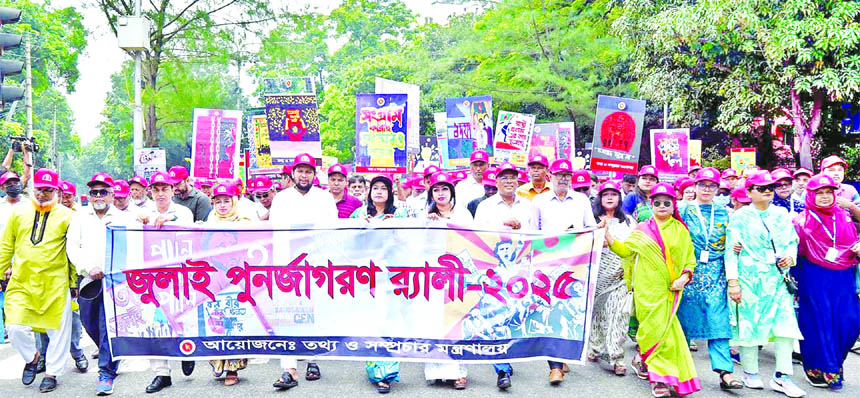
The July Declaration has been at the centre of national political discourse since the mass uprising of 2024 led to the ousting of the Awami League government. In recent weeks, the interim administration circulated the draft among major political forces – including the BNP, Jamaat-e-Islami, and the National Citizens’ Party (NCP) – in the run-up to the first anniversary of the uprising.
Comprising 26 points, the declaration provides both historical context and a framework for future governance. The first 21 points recount the political journey from the Liberation War to the 2024 movement, while the remaining five focus on democratic reform and justice.
Key proposals include the prosecution of enforced disappearances, extrajudicial killings, and crimes against humanity committed during the Awami League era, alongside commitments to uphold the rule of law, combat corruption, and establish a participatory democratic system.
In tandem, the National Consensus Commission is preparing the final draft of the proposed July National Charter, following the conclusion of its second round of dialogue with political parties last Thursday. The charter is expected to consolidate the agreements reached during both phases of the dialogue process.
Commission officials confirmed that resolutions from the first phase (held between 20 March and 19 May) have already been distributed to political parties, with the latest agreements to follow soon. Parties are expected to provide feedback or proposed amendments, based on which the final draft will be prepared and circulated for formal endorsement.
While there is broad support for the contents of the charter, questions remain over its legal enforceability. The commission is expected to issue a decision on the matter by Sunday.
Commission Vice President Professor Ali Riaz noted that a final version of the charter would be ready within days. “Once finalised, we can move forward with securing endorsements. In terms of implementation, we’ve asked all parties to continue internal consultations. The commission will act as a facilitator,” he said.
BNP Standing Committee member Salahuddin Ahmed expressed confidence that the final version of the charter would soon be ready for signature. “We are committed to the people to see this document implemented,” he said, reiterating the party’s pledge to bring forward necessary constitutional and legal amendments within two years.
Jamaat-e-Islami, while appreciative of the inclusive process, raised concerns about enforceability.
Nayeb-e-Ameer Syed Abdullah Mohammad Taher emphasised the need for a legal mechanism-be it a presidential ordinance, a legal framework order, or a national referendum-to ensure the charter’s legitimacy. “Without legal backing, the process risks falling short,” he warned.
The National Citizens’ Party (NCP) echoed similar concerns. Senior Joint Convener Ariful Islam Adib stated that the party would not endorse the charter unless a clear legal structure is established.
“Whether through a referendum, a Constituent Assembly election, or another constitutional method-we’re open to the approach, but legal recognition is essential,” he said. He also criticised the BNP’s position, claiming that political rather than constitutional recognition would be insufficient.
The Islami Andolan Bangladesh voiced dissatisfaction over the exclusion of proportional representation (PR) in the lower house from the charter discussions. At a review meeting held Friday, Secretary-General Maulana Yunus Ahmad called the omission a setback to long-term democratic reforms.