
July Charter framework ready, implementation questioned
Staff Reporter :
The National Consensus Commission has finalised a framework for implementing the July National Charter, but it remains uncertain how the next parliament will be compelled to carry out the promised constitutional reforms within the nine-month deadline being considered.
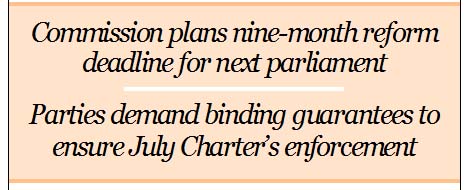
According to sources close to the commission, the current plan is to include in the forthcoming “July Charter (Constitutional Reform) Implementation Order” a clause requiring the next parliament to complete the reforms within nine months of its formation.
Under this framework, the next parliament would function simultaneously as a Constitutional Reform Council, working alongside its regular duties to amend the constitution and institutionalise the reforms proposed in the July Charter.
The commission also plans to introduce a referendum ordinance under the same order, paving the way for a nationwide vote on the reforms.
Yet the commission has not reached a decision on what would happen if parliament fails to meet the nine-month deadline—an issue that has become central to the debate over the charter’s enforceability.
The July National Charter was signed on 17 October, with 25 political parties and alliances endorsing it so far. However, five parties, including the National Citizen Party (NCP), have yet to sign.
During a meeting with the commission on Saturday, NCP representatives said they would not sign the charter unless it includes a clear and binding guarantee that the proposed reforms will be implemented.
Several other parties have reportedly raised similar reservations. Commission members now fear that without such guarantees, the fragile consensus painstakingly built over months could unravel.
The commission’s tenure expires on 31 October. Before that date, it is expected to submit a set of final recommendations to the interim government, outlining both legal and political mechanisms for implementing the July Charter.
In a long meeting held on Saturday afternoon at the Parliament Secretariat, commission members sat with a panel of legal experts to explore possible solutions.
The discussion, attended by retired judges, university professors, and senior lawyers, focused on two potential enforcement mechanisms: dissolving parliament if it fails to enact the reforms on time, or allowing the reforms to be automatically enacted after the deadline.
However, neither option received consensus support. Participants observed that dissolving parliament within a year would require fresh elections at a time when the caretaker government system has not yet been constitutionally reinstated.
That would likely mean an election under a party government—a scenario that could plunge the country back into political unrest.
On the other hand, automatic enactment was dismissed as unrealistic since the charter’s provisions, particularly those expanding fundamental rights and restructuring the executive, require parliamentary debate and ratification. Experts agreed that such reforms cannot take effect by default.
An alternative idea was floated to constitute the next parliament initially as a Constituent Assembly, allowing members to serve as regular lawmakers only after completing the reforms.
But this raised another question—who would govern the country during that interim period? Participants agreed that leaving the entire responsibility of governance to the interim administration would not be politically viable.
Some commission members suggested setting a firm but non-punitive deadline for the reforms, relying on public and political pressure to ensure compliance. Yet this approach may not satisfy parties like the NCP, which are demanding explicit legal assurances.
The commission also continues to debate the scope and authority of the proposed Constitutional Reform Council. Some members favour empowering the next parliament to amend the constitution by a simple majority, rather than the usual two-thirds majority, to expedite the process. Under this proposal, the Speaker would preside over the council’s sessions.
Saturday’s meeting was attended by Justice (retd) MA Matin, Professor Mohammad Ikramul Haque of Dhaka University, and senior lawyers Sharif Bhuiyan, Barrister Imran Siddiq, and Barrister Tanim Hossain.
Among the commission members present were Vice-Chair Professor Ali Riaz, Badiul Alam Majumdar, Justice Md Emdadul Haque, Iftekharuzzaman, and Mohammad Ayub Mia. Monir Haidar, special assistant to the chief adviser overseeing the national consensus process, also attended.
In a statement released after the meeting, the commission said it hoped to submit a “clear and comprehensive recommendation” to the interim government soon, focusing on how to legally anchor and operationalise the July Charter.
Earlier in the morning, the commission met with the NCP at the Parliament’s LD Hall. Speaking to the media, commission Vice-Chair Professor Ali Riaz said the NCP had expressed willingness to sign the charter but sought clarification on several provisions.
“The NCP’s proposals have both positive and negative aspects,” he said. “We are moving carefully, but our main goal is to ensure that all political parties come under the same umbrella.”
Meanwhile, BNP Standing Committee member Salahuddin Ahmed has called for prioritising realism over emotion in implementing the July Charter. Speaking at the fourth founding anniversary of Gono Odhikar Parishad at the Institution of Diploma Engineers in Dhaka’s Kakrail area on Sunday, he cautioned against adopting any approach that might invite future controversy.
Referring to the growing demand for issuing a constitutional order to implement the charter, Salahuddin said, “The constituent power of the people will be expressed through a referendum, and therefore, parliament cannot act beyond that mandate.
If we become emotional and rush into political referendums or orders, questions may arise later. Instead, we must ensure that the July National Charter is implemented based on a united political consensus.”
With only a few days left before its term expires, the commission faces the daunting task of transforming a broad political agreement into an enforceable legal roadmap. The unresolved question—how to guarantee that the next parliament delivers on the promised reforms—now stands as the single greatest challenge to the July Charter’s credibility.”