
JnU students, teachers continue protest for 2nd day
Md Abdur Rakib (JnU) :
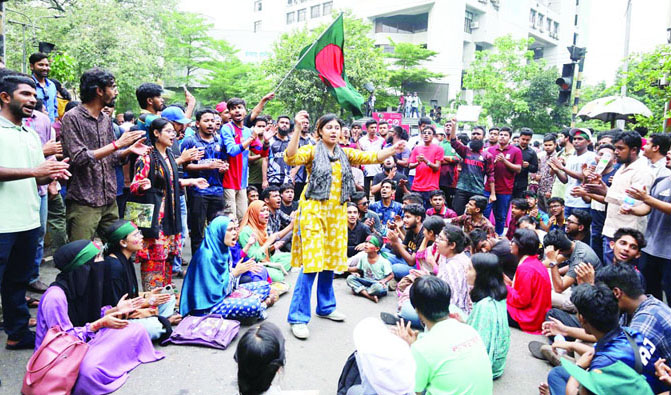
Students and teachers of Jagannath University (JnU) continued their movement for the second day on Thursday at the entrance of the road leading to Jamuna in the capital to press home their four-point demand, including seventy percent of housing scholarship for the students, and called for a complete academic shutdown until the demands were met.
 During the demonstration, General Secretary of the Teachers’ Association, Professor Dr. Rois Uddin announced the closure the varsity.
Professor Dr. Rois Uddin said, “We have come here to bring the rights of Jagannath University. We have come here to achieve the demands of Jagannath University. The police have attacked us indiscriminately.
This is complete anarchy and injustice. We have not come here to speak against anyone, we have not come here to conspire. We have come here to demand our rights and to achieve our demands. We will not return home without achieving our Rabia.
Jagannath University will continue to shut down until the demands are met. No educational examination program will be conducted at Jagannath University. We will return home after achieving our demands.”
He further said, “It will not be good if any steps are taken to remove us from here. No one will be able to hurt any of my students in front of my eyes.”
During this time, the students kept chanting slogans like “We want housing, not deprivation”, “We will not allow budget cuts”, “We want justice for the attack” etc.
Jagannath University students have been staying in Kakrail for almost 36 hours. Although many students are tired of the sit-in program, none of them have left the movement. Some have been sleeping on the streets all night and are still staying from this morning.
The students’ four-point demands are – introduction of housing scholarships for 70% of the university’s students from the 2025-26 fiscal year, approval of the full budget proposed by JnU without cuts, approval and implementation of the second campus work in the ECNEC meeting, a proper investigation into the police ambush on students on May 14 and exemplary punishment of the culprits.
The teachers and students started a long march towards the residence of the chief advisor with three-point demands on Wednesday at 11am.
The long march passed through Gulistan, Matsya Bhavan and reached Kakrail Mosque at 12.40 pm when the police fired tear gas and sound grenades at the students participating in the long march. At that time, hot water was thrown to disperse them.
When the students dispersed, the police charged the students with batons. More than a hundred people, including university teachers, students and journalists, were injured in this.
The Dhaka Metropolitan Police (DMP) has imposed an indefinite ban on all rallies, processions, demonstrations, and public gatherings in several sensitive areas surrounding key judicial institutions, citing the need to maintain public order and security.
In a public notice issued on Thursday, DMP Commissioner SM Sazzat Ali announced that the restriction will take effect from Thursday and will remain in force until further notice.
The ban covers the vicinity of the Chief Justice’s residence, Judges Complex, the main gate of the Bangladesh Supreme Court, the Jam-e-Mosque gate, the primary entrances to International Crimes Tribunal-1 and Tribunal-2, and the Bangladesh Institute of Judicial Administration (BIJA).
The decision, according to the notification, has been taken under Section 29 of the Dhaka Metropolitan Police Ordinance (Ordinance No. III/76), which empowers authorities to restrict assemblies in order to preserve public discipline during times of heightened tension.
“The ban has been imposed in the wake of the current situation and to maintain law and order,” the DMP stated, without elaborating on the specific incidents prompting the move. However, tensions have recently flared in parts of the capital amid protests over legal and political issues.
The DMP also urged citizens and political organisations to avoid blocking roads in the name of protest, warning that such actions exacerbate traffic congestion and disrupt daily life in the capital. “We once again request everyone to refrain from causing public inconvenience through road blockades,” the statement read.
While the ban does not cover all public spaces in Dhaka, it effectively cordons off major zones associated with the judiciary-sites that have often been focal points for protestors seeking legal redress or drawing attention to justice-related grievances.
The move has sparked early responses from rights activists and legal professionals, some of whom voiced concerns about the implications for freedom of assembly. Others, however, acknowledged the need for precautionary measures given the country’s volatile political climate in recent months.
Later in the night, Adviser Mahfuz Alam came to brief with the students. The students were unhappy with Mahfuz’s briefing. The students started raising slogans targeting Adviser Mahfuz. At one stage of the speech, one of the protesters threw a bottle at him. The advisor stopped the briefing and left angrily.
Meanwhile, the protesting students of Jagannath University, unhappy with Adviser Mahfuz’s speech, decided to continue their movement.