
JnU-SOU study unfolds Hilsha sex changing mystery
Md Abdur Rakib, JnU :
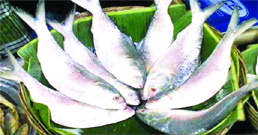
A group of researchers from the Department of Zoology of Jagannath University (JnU) and the Department of Hydro-Biology of Shanghai Ocean University (SOU), China, have jointly conducted three research projects related to the national fish of Bangladesh, Hilsa.
The three research projects are sex reversal, complete genome and population genomics of Hilsa.
The results of this exploration were presented at a seminar and press conference at the Department of Zoology of the university on 27 February. The chief guest at the seminar was the Vice-Chancellor of the university, Professor Md. Rezaul Karim.
With a view to unveiling the scientific mystery of Hilsa’s transformation from male to female, a total of 203 Hilsha fishes have been collected from six regions of the Padma, Meghna and Bay of Bengal in Bangladesh.
The reproductive tissues collected from seven Hilsa showed coexistence of sperm and eggs in a single body , which bears evidence of sex change. From the overall results of the study, it can be inferred that Hilsa fish reproduce as males in the first year of their life and migrate to the sea in search of food. While there, the Hilsa gradually transforms into females and returns to the river for reproduction in the second year. Scientists hope that this study will serve as a crucial milestone in revealing the complete life cycle, reproductive strategy and mystery of sex change of Hilsa.
Unraveling the mystery of the first chromosome-level genome and reproductive power of Hilsa:
This study is said to be the first time that the complete life mystery or genome sequence of Hilsa has been revealed, which is more complete than the previous ones (1 from India and 2 from Bangladesh).
In this study, along with the genome sequence, RNA was collected and sequenced using nine different types of tissues from each of the 14 Hilsa from the sea and rivers. This revealed the mystery of Hilsa being oily or delicious. All the DNA and RNA of this research project are stored in the NCBI public database.
Single population of Hilsa, existential crisis:
The results of this study show that only one population of the fish has been found in Bangladesh. Which is a great threat to the existence of this population. Because if a weather or pollution disaster occurs, if this one population cannot survive, then there will remain no Hilsa fish in Bangladesh. If there were multiple populations, some or the other population would have survived even in tough situations.
In addition, the genetic variation of the fish is very low, which has made the fish adaptively weak. Currently, increased Hilsa production may satisfy us, but the fish is in a terrible existential crisis and adaptively weak condition. Integrated management and public awareness are very important to protect the fish.
Meanwhile, one of the researchers Dr. Kishore Kumar Sarkar, a lecturer at Shanghai Ocean University in China, said, “Researching this breeding of Hilsa was an interesting fact for us. Hilsa breeding works separately in the river and the sea.”
In this regard, Professor Dr. Chinhongli, a teacher at Shanghai Ocean University, joined online and said, “This research on Hilsa has been going on for a long time. This research has been fruitful as a result of the hard work of many. Thank you all.”
At the seminar, the Vice Chancellor said , “The way our researchers have started research activities on Hilsa fish is truly commendable. Hopefully, these exceptional studies on Hilsa fish will play a role at the national level.”