
Jamaat says election field bumpy, calls for plebiscite on PR system
Staff Reporter :
In a pointed challenge to the interim government’s handling of Bangladesh’s transition toward elections, the Islamist political party Jamaat-e-Islami on Friday accused sections of the administration — including senior civil servants and even some advisers to the interim authority — of bias, claiming that a “level playing field” for all political groups remains elusive ahead of the national polls expected in February.
At a rally following Friday prayers near Baitul Mokarram National Mosque in Dhaka, the party’s secretary-general, Professor Mia Golam Parwar, charged that certain officers and advisers were working under political pressure to influence the coming vote.
Without naming individuals, he said that the actions of some officials, from police superintendents to deputy commissioners and local administrators, as well as unnamed advisers to the interim government, had “become questionable before the nation.”
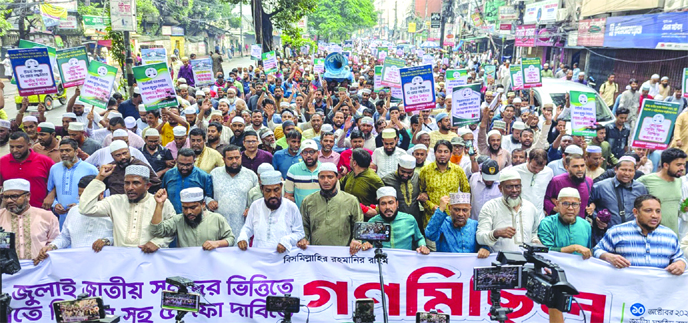
The demonstration — organized jointly by Jamaat’s Dhaka metropolitan north and south units — was framed around a five-point list of demands, foremost among them the introduction of a proportional representation, or PR, electoral system.
Parwar said Jamaat would accept the verdict of the people on the issue through a referendum. “If the nation decides in favor of proportional representation, everyone must accept it,” he told the crowd. “If they oppose it, we will withdraw our demand. But no one has the right to mock or dismiss such an important proposal for national reform.”
The secretary-general also urged the interim government and the National Consensus Commission — a body working to finalize the so-called July Charter of political and electoral reforms — to settle the PR question before the charter is signed on October 15. The July Charter, backed by several left, centrist, and Islamist parties, seeks to lay the groundwork for what they describe as a “humanitarian Bangladesh” through free and fair elections.
Jamaat leaders argued that some reforms proposed by different political groups had already been dropped to foster national unity, but they warned against allowing any individual or party interest to disrupt the collective effort toward electoral inclusiveness. “The sacrifices of those killed and injured in the July uprising must not go in vain,” Parwar said, referring to the mass protests that led to the ouster of Sheikh Hasina’s government in 2024.
As the rally concluded, thousands of Jamaat activists marched from the mosque’s south gate to Kakrail, chanting slogans such as “Referendum now!” and “No election without PR and reforms!”
Other Islamist groups joined the chorus of demands. Maulana Mamunul Haque, the chief of Bangladesh Khelafat Majlis, addressed a separate gathering at the north gate of the mosque, warning that if the interim authorities failed to implement the July Charter through presidential order and referendum before the elections, his group would launch a nationwide protest campaign.
“Those who oppose the July declaration stand with the remnants of the fascist order,” he said, invoking the now-defunct Awami League and its 14-party coalition, which was banned from politics following last year’s uprising.
Adding to the growing chorus for electoral reform, Mufti Syed Muhammad Rezaul Karim, better known as the Pir of Charmonai and the Amir of Islami Andolan Bangladesh (IAB), on Friday called for the upcoming national election to be held under a proportional representation (PR) system, arguing that the current majority-based voting method fails to reflect the true will of the people in the Parliament.
Speaking as chief guest at a large workers’ rally at Suhrawardy Udyan in Dhaka, organized to mark the anniversary of Islami Shramik Andolan Bangladesh, the IAB chief said that a PR system was essential to ensure “fair and inclusive representation” in the country’s democratic politics.
“The existing winner-takes-all system allows dominance by a few parties and leaves large sections of the electorate unrepresented in Parliament,” Rezaul Karim told the gathering. “As a result, inequality, instability and unjust influence have come to define our national politics.”