
Iran-Israel clash enters day 3 amid ceasefire calls
NN Report :
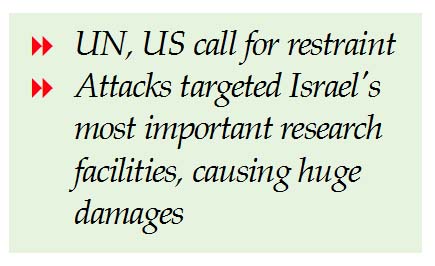
Amid intensifying conflict between Iran and Israel, now in its third consecutive day, the international community – including the United States – has called for an immediate ceasefire to prevent further loss of life on both sides.
US President Donald Trump urged both countries to pursue a negotiated settlement, stating that the war “could be ended easily” if the parties reach a deal. While advocating for diplomacy, Trump also warned Tehran of a “full-strength” response if American interests were targeted. Iraq, maintaining close ties with both nations, has called for de-escalation to avoid regional destabilisation.
Iranian Foreign Minister Abbas Araghchi indicated a willingness to halt hostilities if Israel ceases its military operations against Tehran. “Our response is legitimate and proportional to aggression. If Israeli attacks stop, Iran’s retaliatory strikes will also cease,” Araghchi said in a televised statement.
In the early hours of Sunday, Iranian missile strikes targeted several sites in Israel, including the Weizmann Institute of Science in Rehovot.
The attack resulted in significant damage to research facilities, including a cancer research centre, and triggered fires across parts of the campus. At least 13 people, including three minors, were killed in Israel, with hundreds more injured – seven of them critically – following a barrage of over 200 rockets and missiles launched from Iranian territory.
The Weizmann Institute – one of Israel’s most prominent scientific research centres with a legacy dating back to 1934 – was among the most seriously hit. The facility, which houses more than 30 laboratories and serves as a hub for national defence research, sustained extensive structural damage. One side of a cancer research centre was reportedly destroyed in the attack, with the building engulfed in flames.
Air-raid sirens rang across Israel from 4 pm on Sunday, with fresh explosions heard in Tel Aviv. Among the other affected areas were Bat Yam, where one woman was killed, and Tamra, a northern town where three additional fatalities were reported.
These attacks come in retaliation for recent Israeli strikes on Iranian nuclear and military assets, further escalating tensions in the region. Iran’s state news agency, IRNA, announced the launch of a “new wave of missiles” towards Israel on Sunday afternoon, with the situation continuing to deteriorate.
Speaking at a diplomatic briefing in Tehran, Foreign Minister Araghchi underscored Iran’s reliance on its own defence capabilities. “The latest developments reaffirm the correctness of our strategy of self-reliance,” he said, adding that Iran had taken “all possible diplomatic steps” in response to what it calls Israeli aggression.
Araghchi confirmed that Iran had formally requested an emergency session of the UN Security Council. While the session was held, Iran criticised the outcome, claiming US intervention blocked any meaningful resolution. Tehran has also sought an urgent meeting of the International Atomic Energy Agency’s (IAEA) Board of Governors to address Israel’s actions.
In a further escalation, Yemen’s Iran-aligned Houthi rebels launched missile attacks on Israel, while Israeli defences intercepted seven drones. Israel reportedly expanded its retaliatory strikes to target Iranian air defence systems and fuel storage facilities, including two depots in Tehran.
Meanwhile, both China and Russia have condemned Israel’s recent military actions, accusing Tel Aviv of violating Iran’s sovereignty and territorial integrity.
The conflict, marked by unprecedented missile exchanges and widening regional involvement, has prompted growing concern over the prospect of a full-scale war in the Middle East.