
LDC Graduation: Institutional gaps could derail import liberalisation
Staff Reporter :
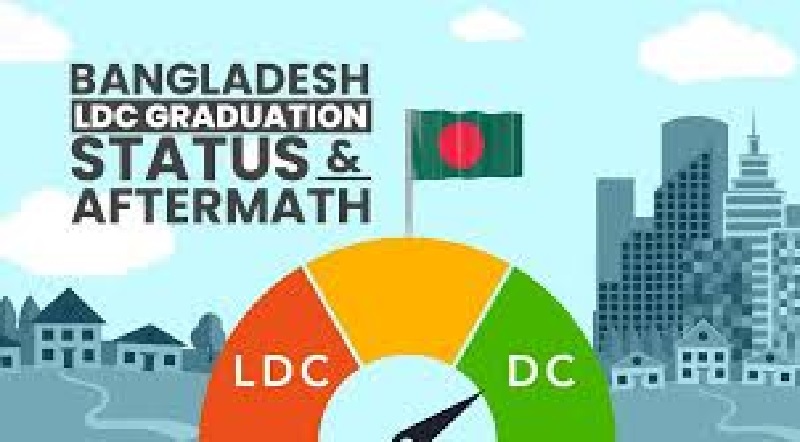
After graduating from Least Developed Country (LDC) status, Bangladesh will encounter major challenges in its export-driven economic development, economists have warned.
They stressed that without addressing the country’s high import tariff structure, further progress will be difficult.
These observations were made on Monday during a discussion at the Conference on Recommendations by the Taskforce on Restrategising the Economy, organised by the Centre for Policy Dialogue (CPD).
Experts cautioned that import liberalisation must be carefully planned, ensuring that institutional capacity is strengthened beforehand.
CPD’s Distinguished Fellow, Dr Mustafizur Rahman, highlighted contrasting examples of import liberalisation-Singapore and Haiti.
“Singapore has robust export and institutional capacity, making liberal imports beneficial to its economy, whereas Haiti presents the opposite scenario,” he explained.
Dr Rahman warned that Bangladesh faces significant institutional weaknesses in areas such as revenue collection, policy formulation, and implementation.
“If these gaps are not addressed, import liberalisation could pose risks,” he cautioned.
He also pointed out that while the average import tariff in the US and Europe is below 4 per cent, these markets impose tariffs of 11-18 per cent on apparel imports.
Since Bangladesh is not exporting high-value products that attract lower tariffs, he urged the country to focus on strengthening its export strategy.
Dr Selim Raihan, Executive Director of the South Asian Network on Economic Modelling (Sanem), stated that Bangladesh
lacks a coordinated and effective industrialisation and investment strategy.
He attributed this shortcoming to disjointed policies and efforts, which have prevented the country from fully capitalising on its economic potential.
Former Commerce Minister Amir Khosru Mahmud Chowdhury underscored the need for a fundamental economic recalibration. He criticised past government policies, which, he said, were overly focused on revenue collection rather than sustainable development.
“Revenue should primarily come from large-scale businesses in a well-developed private sector, rather than relying on VAT and other regulatory duties,” he stated.
Commerce Adviser Sheikh Bashiruddin highlighted corruption and money laundering in the banking and infrastructure sectors during the previous government’s tenure, noting the immense strain these issues placed on the macroeconomy.
Economist Dr Abdur Razzaq, Chairman of the Research and Policy Integration for Development (RAPID), noted that Bangladesh’s Ready-Made Garment (RMG) sector has benefited significantly from duty-free access to global markets-an advantage that will no longer be available after LDC graduation.
He stressed the urgent need to negotiate with the European Union to maintain trade benefits beyond December 2027.
Furthermore, he criticised Bangladesh’s failure to establish bilateral free trade agreements (FTAs) and called for swift action to sign an FTA with Japan.
To ease macroeconomic pressure, Dr Razzaq urged a strategic re-evaluation of exports and remittances. He noted that among countries with a large population of 18-20-year-olds, only Ethiopia and Pakistan have lower export levels than Bangladesh.
At present, 30-40 per cent of government incentives are allocated to companies producing for the local market, while 30 per cent of revenue comes from high import tariffs, he stated.
Dr Razzaq further highlighted that 75 per cent of Bangladesh’s total exports rely on LDC trade benefits, which will be lost post-graduation. Additionally, export subsidies will no longer be permissible.
He pointed out that Bangladesh has not undertaken any major trade policy reforms since the 1990s and stressed the urgent need for well-planned reforms to ensure economic stability.
FICCI President and Unilever Bangladesh Chairman and MD, Zaved Akhtar, illustrated the challenges faced by investors, citing Unilever’s commitment to achieving net-zero emissions globally.
Meanwhile, Abdullah Hil Rakib, Managing Director of Team Group, called for a comprehensive strategy aligning Bangladesh’s export goals with global market demands.
He stressed that leading exporters like his company would adhere to such a roadmap, but the government must establish the necessary conditions to encourage private sector investment.