
‘Information now strategic weapon in nat’l security’
Staff Reporter :
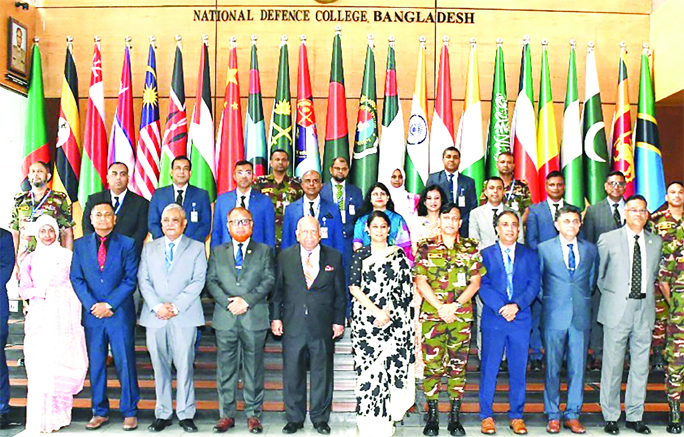
Syeda Rizwana Hasan, Adviser to the Ministry of Environment, Forest and Climate Change and the Ministry of Water Resources, has emphasized that national security today hinges not only on military strength but increasingly on the integrity of information and public perception. Speaking as the chief guest at a seminar held at the National Defence College (NDC) in Mirpur—jointly organized by NDC and the Bangladesh Institute of Peace and Security Studies (BIPSS)—Rizwana warned that misinformation has become a “psychological weapon” capable of undermining national resilience.
“To counter misinformation, we must build a culture grounded in truth, trust, and information-based awareness,” she said. “A united nation is essential to face these emerging threats.”
Drawing a parallel with history, Rizwana cited the 1757 Battle of Plassey as a cautionary tale, stating that misinformation and conspiracy played a decisive role in the downfall—much like the contemporary dangers posed by rumors and disinformation spread via social media.
She stressed the importance of transparency in governance, asserting, “Public projects are funded by taxpayers, and the public has the right to know. Without access to accurate information, citizens cannot make informed decisions, and society becomes vulnerable to rumors.”
Addressing climate change, Rizwana identified it as Bangladesh’s greatest long-term security challenge. She warned that rising sea levels and global warming threaten to submerge one-third of the country’s landmass, and urged policymakers to take a security-first approach to environmental issues.
Highlighting the relevance of indigenous knowledge, she noted that rural communities often forecast environmental changes more accurately than modern technologies. Rizwana also revealed that the United Kingdom has expressed interest in supporting Bangladesh through satellite-based data and capacity-building training.