
Honesty Is the Core of Journalism: BFUJ Secretary General Kader Gani Chowdhury
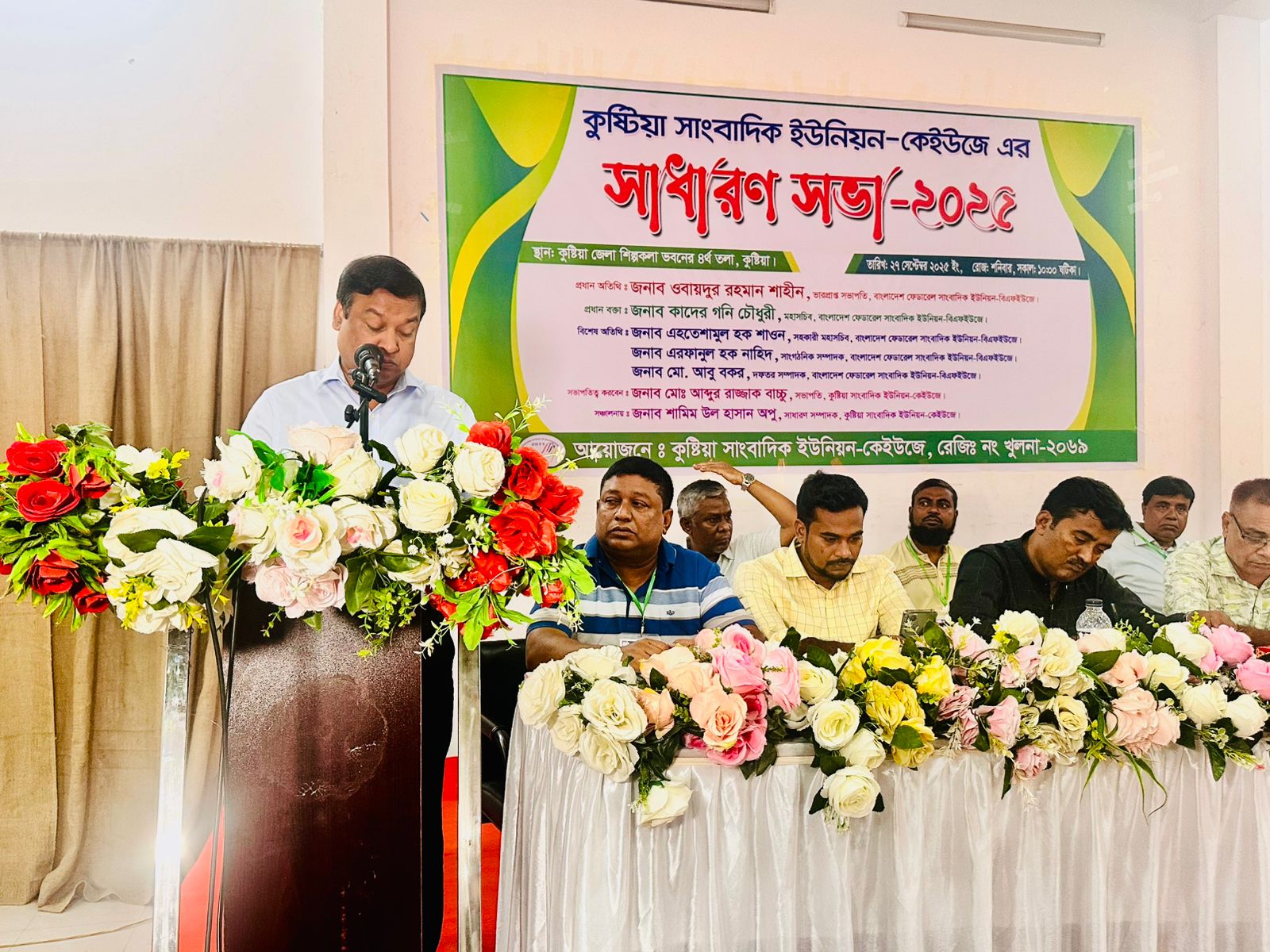
Kushtia, Bangladesh:
Journalism must be built on honesty and integrity, said Bangladesh Federal Union of Journalists (BFUJ) Secretary General Kader Gani Chowdhury, stressing that truth and impartiality remain the lifeblood of the profession.
“The foundation of journalism is honesty. A good journalist never spreads lies or bias. Their main duty is to verify the truth and report it from a neutral standpoint,” Chowdhury said while addressing the general meeting of Kushtia Journalists’ Union at the Kushtia Shilpakala Academy auditorium on Sunday afternoon.
 The meeting was presided over by Kushtia Journalists’ Union President Abdur Razzak Bacchu and conducted by General Secretary Shamim Ul Hasan Apu. BFUJ Acting President Obaidur Rahman Shaheen, Office Secretary Abu Bakar, and several senior journalists including Nurunnabi Babu, M.A. Jihad, Al Mamun Sagarmo, Bakul Ali, Ibrahim Khalil, Khalid Hasan Sipai, Abdum Munib, Mostafizur Rahman Monju, Mir Al Arefin Babu, Haidar Ali, Mujibur Sheikh, Mahfuzur Rahman, Sihab Uddin, and Tarekul Islam Tarek also took part in the discussion.
Credibility as the Greatest Asset:
Chowdhury emphasized that credibility is the greatest asset of any media outlet. “The more credible a news outlet is, the greater its acceptance among readers, listeners, and viewers,” he said, adding that journalists must constantly practice ethics in their daily work.
He warned that a lack of objectivity is the biggest obstacle to journalism. “Objective and neutral reporting brings peace to society, but falsehoods breed chaos and conflict,” he said.
Journalists as the Nation’s Conscience:
The BFUJ leader described journalists as the “conscience of the nation” and “watchdogs of society and the state.” He invoked Mark Twain’s famous analogy of the press as a “second sun” that illuminates society, and cited Henry Ward’s belief that newspapers are more valuable than gold.
“Through tireless effort and sacrifice, journalists bring the truth to the nation. They must remain vigilant, for their role is to expose injustice, corruption, and exploitation while serving as the true voice of the people,” Chowdhury said.
Challenges in Bangladeshi Media:
Chowdhury criticized the increasing dominance of corporate and political interests in Bangladesh’s media landscape, noting that many outlets operate without genuine institutional practices. “Editors are often turned into corporate managers, while journalists implement corporate policies under the name of editorial policy,” he said.
He also condemned “sycophant journalism” during the previous government, where many journalists acted as political workers rather than professionals. “Some even fled or were arrested during the mass uprising of August 5, while others lost their positions. These are consequences of their blind loyalty,” he remarked.
Journalism as a Risky Profession:
Highlighting the dangers of the profession, Chowdhury said:
Over the past two decades, 68 journalists have lost their lives in Bangladesh.
Hundreds more have been injured or harassed.
Journalists face threats, lawsuits, and at least 20 restrictive laws that stifle press freedom.
He demanded strong legal protections for journalists, including workplace security, fair wages, accident insurance, healthcare, and safeguards against arbitrary dismissal. He also urged reforms in advertising rates, taxes, and newsprint import duties to help newspapers survive financially.
Call for Ethical Journalism:
Concluding his speech, Chowdhury said:
“Journalism is the pursuit of truth. Journalists must remain fearless, ethical, and dedicated to the public interest. Only then can they light the lamp of truth in society and uphold the honor of being called the guardians of the people.