
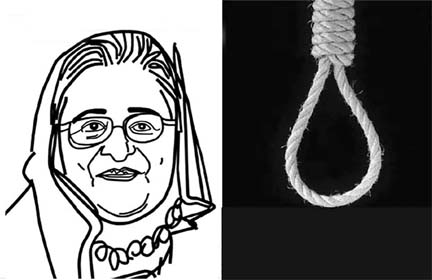
Verdict countdown begins: ‘Hasina’s death penalty sought’
Abu Jakir :
The International Crimes Tribunal-1 (ICT) is expected to fix today the date for announcing its verdict in a high-profile crimes against humanity case against former prime minister Sheikh Hasina and two of her close associates.
Tribunal Chairman Justice Md Golam Mortuza Mozumder recently concluded the trial proceedings in the case after both the prosecution and defence completed their final arguments.
The court will now set the date for the judgment, which many observers expect to be delivered before the upcoming 13th parliamentary election scheduled for early February 2026.
Attorney General Md Asaduzzaman earlier urged the tribunal to hand down the highest punishment to the accused, arguing that the prosecution had proven the charges beyond a reasonable doubt. “The evidence and witness testimonies clearly establish the chain of command and direct responsibility,” he told the court during summation.
Chief Prosecutor Tajul Islam echoed the argument, reiterating that the crimes alleged under international law were “clearly substantiated” by material evidence. He dismissed the defence arguments as “legally untenable” and insisted that the victims of the alleged crackdown deserved justice.
The case involves charges of crimes against humanity, including murder, abduction, and torture, linked to an alleged security operation in Dhaka’s Chankharpool area in 2013, where six civilians were reportedly killed.
Hasina, 78, and former home minister Asaduzzaman Khan Kamal are being tried in absentia, while a third accused, Mamun, has turned approver after pleading guilty and providing testimony against his former superiors.
According to tribunal officials, the prosecution has submitted more than 100 documents and produced 23 witnesses to support the charges.
The defence presented written submissions and argued that the accused were being tried for “political vengeance” rather than for legally established offences.
Hasina, who left Bangladesh on 5 August 2024 following the mass uprising that toppled her government, has not returned since. She is believed to be residing in India. The tribunal has appointed defence counsel to represent her in absentia, as per the rules of procedure.
Observers note that the verdict, once delivered, could have significant political and symbolic implications. “This is the most politically charged trial in Bangladesh’s recent history,” said a senior legal analyst.
“Regardless of the outcome, it will shape how the nation approaches justice and accountability after the regime change.”
Meanwhile, law enforcement agencies have been placed on high alert across the country as the banned Awami League announced a “Dhaka lockdown” programme for November 13.
The government has already declared the programme illegal, warning that it will not tolerate any attempt to disrupt public order or create unrest.
In response, several political groups have announced counter programmes, vowing to resist what they termed “fascist attempts” to destabilise the country.
Jamaat-e-Islami and seven other Islamist parties, together with the Nationalist Citizen’s Party (NCP), have announced a series of protests under the banner of the July revolution alliance.
The parties say their demonstrations are intended “to resist sabotage and conspiracies of fascist forces” and to uphold the people’s mandate achieved through the uprising earlier this year.
At a press conference in Dhaka on Tuesday, Jamaat Nayeb-e-Ameer Mujibur Rahman said, “Our movement is not against peace but against those who are trying to return the country to the dark days of fascism.
We call on all patriotic and anti-fascist citizens to join hands to protect the gains of the July revolution.”
A parallel student-led platform, July Oikya, also announced protest programmes at a separate press conference at Dhaka University’s Modhur Canteen.
Its chief coordinator and DUCSU literature secretary, Mosaddeq Ali Ibn Mohammad, said the organisation would hold sit-ins at key intersections across the country on November 13.
“The banned Awami League, its Jubo League, and its student wing have been carrying out arson and bomb attacks in different parts of the country,” Mosaddeq alleged.
“The administration’s silence has only encouraged these elements. We will not allow them to create anarchy again.”
In another statement, Islami Andolan Bangladesh Ameer and Chormonai Pir Mufti Syed Muhammad Rezaul Karim denounced the Awami League’s “lockdown” call as “a fresh manifestation of fallen fascism.” He urged all political parties to remain united in resisting any attempt at violence or disorder.
“The monstrous forces of destruction have resurfaced. These elements must be resisted collectively,” he said. “We may have differences over issues like the legal framework of the July Charter or the timing of the referendum, but we must stand united in the face of fascism.”
Since early Wednesday morning, security forces have been deployed at key points across Dhaka, including Mirpur, Farmgate, Shahbagh, Minto Road, and Hatirjheel.
Checkpoints have been established in several areas, and vehicles are being searched as part of heightened security measures.
Traffic in the capital was lighter than usual on Wednesday, with fewer private cars on the roads amid concerns of possible unrest. However, buses, motorcycles, and CNG-run auto-rickshaws continued operating, and public transport movement remained largely normal.
Officials confirmed that any attempt to enforce the banned party’s “lockdown” would be dealt with “firmly.” “We are on maximum alert,” said a senior police officer.
“No one will be allowed to disrupt public life or spread panic.”
With both the political standoff and the tribunal’s impending verdict converging on the same date, November 13 has become a day of critical significance for Bangladesh’s interim administration.
Analysts say how the government manages the twin challenges—ensuring justice while maintaining order—will be seen as a key test of its stability and authority in the months leading to the next general election.