
Hasina to be tried in-person or in absentia
Staff Reporter :
Bangladesh’s interim leader, Professor Muhammad Yunus, has vowed that former ousted Prime Minister Sheikh Hasina will stand trial for crimes against humanity, marking a decisive turn in the country’s ongoing political upheaval.
Hasina, who was ousted amid mass protests and is currently in exile in India, faces allegations of overseeing widespread human rights violations during her tenure.
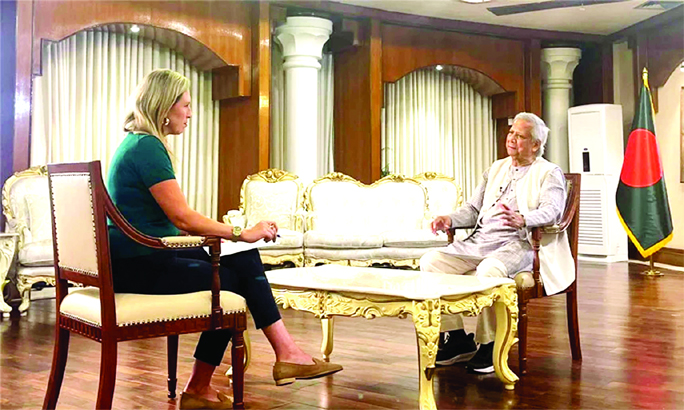
In an interview with the UK-based Sky News recently, Yunus said the legal process would not only target Hasina but also extend to her family members, associates, and others linked to the alleged abuses. “A trial will be taking place.
Not only her, but also all the people who are associated with her – her family members, her clients or associates in-person or in absentia,” he stated.
The Bangladesh government has issued two arrest warrants for Hasina and sent formal extradition requests to India, but Yunus noted that there had been “no official response” from New Delhi.
Hasina is accused of orchestrating a system of enforced disappearances and extrajudicial killings under the pretext of national security.
Human rights groups and international observers have reported that during her rule, political opponents were abducted, detained in secret facilities, and subjected to torture.
One such facility, referred to as the ‘House of Mirrors,’ has been at the center of these allegations. Professor Yunus, who recently visited the site, described it as a scene of “indescribable horror.”
“This is just the ugliest thing that you can see, you can feel, or you can observe,” he said, adding that the scale of the crimes is only beginning to be fully uncovered.
Hasina’s administration, along with security forces, is also accused of cracking down on protests in July and August of last year, resulting in the deaths of an estimated 1,400 people, according to a United Nations report.
Sheikh Hasina has denied all allegations, calling the charges politically motivated. Since her removal from power, she and several top aides have fled Bangladesh.
The interim administration, however, insists that justice will be served, even if the trials must be conducted in absentia.
Professor Yunus acknowledged that the legal process would be complex, given the sheer number of individuals implicated. “Everybody was involved in it all,” he said.
“The whole government was involved in it. So you cannot distinguish who was really and enthusiastically doing it, who was doing it under orders, and who was not quite supportive but carrying out those kinds of things.”
Apart from addressing past human rights violations, Yunus’s administration is also grappling with a series of anti-corruption investigations targeting figures linked to Hasina.
Among them is British Labour MP Tulip Siddiq, Hasina’s niece, who is under scrutiny for allegedly amassing significant wealth in Bangladesh.
Siddiq resigned from her position as the UK’s anti-corruption minister in January after being named in the probe, though she has denied any wrongdoing.
Meanwhile, the ongoing Rohingya refugee crisis poses an additional challenge for Bangladesh’s leadership.
With escalating violence in Myanmar, more Rohingya refugees have been crossing the border into Bangladesh, exacerbating conditions in Cox’s Bazar, home to the world’s largest refugee camp. Professor Yunus has initiated discussions with Myanmar’s rebel factions to establish a “safe zone” that would facilitate the eventual repatriation of refugees.
As Bangladesh heads toward possible elections later this year, Yunus cautioned that the road to justice would not be swift. “Some will get punished, some will still be under the process, some will still be untraceable,” he said.
For a nation still reeling from political turbulence, his words signal both a commitment to accountability and recognition of the long and difficult path ahead.