
Growing frequency of earthquakes grip people
Al Mamun Harun Ur Rashid :
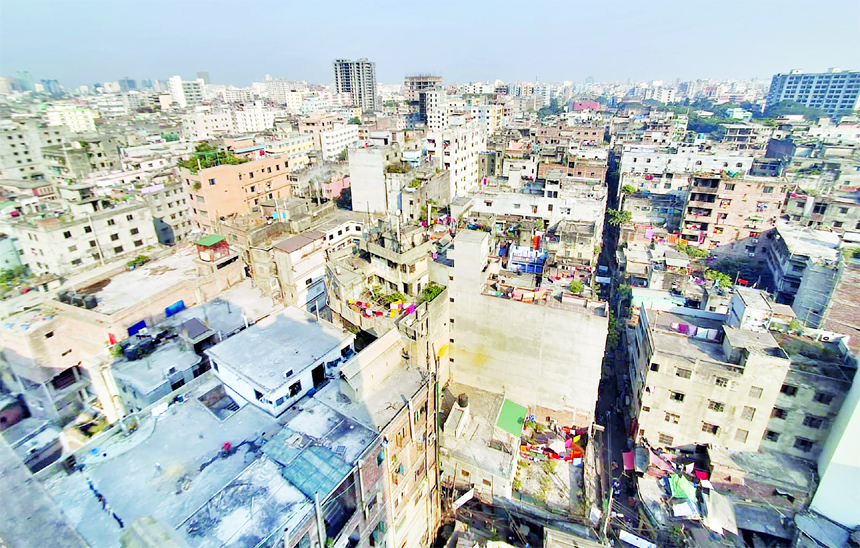
The growing frequency of earthquakes has left people across the country on edge, especially in Dhaka, where dense clusters of buildings and an enormous population leave almost no room to manage a major disaster.

Every tremor now triggers fear of what might follow, because the capital especially the Old Dhaka simply isn’t built to absorb a large-scale shock.
After Friday’s earthquake, people on Saturday felt shocks which had left people in fear as the epicenters were both in the middle of the country.
The Bangladesh Meteorological Department reported that the earthquake felt in the capital Dhaka in the morning measured 4.3 on the Richter scale.
Earlier, the department had initially stated the magnitude to be 3.7. The tremor lasted around 12 seconds.
The second quake, felt at 6:04 pm, had its epicentre in Dhaka’s Badda area, according to a message from the Meteorological Department.
Rubayet Kabir, acting officer of the Earthquake Research Centre, said the Saturday incident was an aftershock of Friday’s quake, which originated
in Madhabdi. Aftershocks, he noted, can occur 10 to 20 kilometres from the original epicentre.
“Dhaka faces a serious risk, saying the capital hasn’t seen a quake like Friday’s in at least a century,” Kabir warned.
The impact has already been severe. Ten people, including a child, died and more than six hundred were injured during Friday’s quake.
Many were struck by falling debris or hurt while trying to flee buildings. Across the country, more than four hundred people sustained injuries.
Rajuk Chairman Md Riazul Islam visited Old Dhaka’s Koshaituli on Saturday morning, where a railing collapse killed three people.
“If Friday’s quake had continued for just another 10 seconds, the entire city could have faced catastrophic damage,” he said.
He stressed that identifying and assessing damaged buildings is now the most urgent task. According to him, 142 government school, college and hospital buildings are already considered vulnerable.
Rajuk has requested all relevant documents from the owner of the collapsed building in Old Dhaka and warned that if the papers are not provided within seven days, action will be taken under existing regulations.
According to experts, Bangladesh is divided into three earthquake risk zones. Zone 1, the highest-risk area, covers several northern and south-eastern districts including parts of Sylhet, Mymensingh, Tangail, Gazipur, Narsingdi, Kishoreganj, Brahmanbaria, Khagrachhari and Rangamati. Zone 3, with the lowest risk, includes regions such as Khulna, Jashore, Barishal and Patuakhali.
Historical data shows that between 1976 and 2015, at least five major quakes were felt in Bangladesh, most originating around Sylhet, Moulvibazar, Rangamati, Bandarban and Cox’s Bazar.
Experts believe these areas remain highly vulnerable. Bangladesh also sits near several major fault lines, including the Dawki Fault and the Madhupur Fault, which increase the likelihood of significant future seismic activity.
Meanwhile, the government has provided financial assistance to the families affected by Friday’s quake.
Each family of the deceased received Tk 25,000, and each injured person was given Tk 15,000 through district administrations.
The Ministry of Disaster Management and Relief activated an emergency response centre shortly after the quake, using the number 02-58811651 to gather preliminary data from district officials.
Initial reports of casualties and damage have come from Dhaka, Narayanganj, Gazipur, Narsingdi and Magura.
The tremors are still arriving and the fear is rising with them. And the country knows it needs to move fast, because the next big one may not give a warning.
“If any big scale earthquake takes place in Bangladesh, it would be devastating.
It would be difficult to tackle the disasters after post earthquake,” Dr Subrota Kumar Saha, Professor and Chairman of Department of Geology, Dhaka University told the New Nation.
Highlighting the importance of open space, he said, “We don’t have enough open space. If any disaster happens it would be beyond thinking how to address the post disaster management.”