Enforced Disappearances: Govt enacts death penalty law
Abu Jakir :
The interim government has approved a landmark ordinance introducing the death penalty for the crime of enforced disappearance — a move that marks both a reckoning with the country’s troubled past and a bold effort to confront one of its most painful human rights legacies.
The Prevention, Remedy, and Protection against Enforced Disappearance Ordinance, 2025 received its final approval on Thursday at a meeting of the Council of Advisers, chaired by Chief Adviser Professor Muhammad Yunus.
The law, year’s in the making and fiercely debated, prescribes severe punishment — including capital punishment — for perpetrators of enforced disappearances, a crime that has long haunted the nation’s political and security landscape.
Announcing the decision at a press briefing at the Foreign Service Academy in Dhaka, Chief Adviser’s Press Secretary Shafiqul Alam said the ordinance “has been approved after extensive debate.”
He noted that the law defines enforced disappearance as a continuing offence and criminalises both the establishment and use of secret detention centres, locally known as Ayinaghar or “mirror houses,” where detainees were allegedly tortured during past regimes.
The ordinance empowers both the National Human Rights Commission and a new commission to receive and investigate complaints related to disappearances.
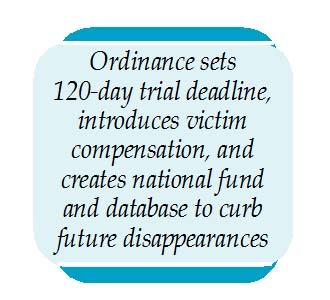
It also mandates that trials must be completed within 120 days of charge framing, guarantees compensation and legal protection for victims and witnesses, and establishes a national fund and database to prevent future disappearances.
The enactment comes amid a flurry of legal action surrounding allegations of state-sponsored abductions and extrajudicial killings during the Awami League’s rule.
Just days earlier, the International Crimes Tribunal issued arrest warrants for former Prime Minister Sheikh Hasina, her security adviser Major General (retd.) Tarique Ahmed Siddique, and 28 others in two cases related to enforced disappearances.
The tribunal, led by Justice Md Golam Mortuza Majumder, accepted the charges following a detailed hearing. Former Home Minister Asaduzzaman Khan Kamal, ex–Inspector General of Police Benazir Ahmed, and former Rapid Action Battalion (RAB) Director General M. Khurshid Hossain are also among the accused.
According to tribunal sources, the charges allege that Hasina and her associates oversaw a campaign of enforced disappearances targeting opposition activists, many of whom were detained and tortured at the secret Taskforce Interrogation (TFI) cell.
Ilias Ali Case Resurfaces
During arguments before the tribunal recently, Chief Prosecutor Mohammad Tajul Islam disclosed that investigators have identified those responsible for the enforced disappearance of Bangladesh Nationalist Party (BNP) leader Ilias Ali, whose abduction in 2012 shocked the nation.
Ilias Ali, a former BNP lawmaker, was picked up from Banani, Dhaka, on April 17, 2012, and has remained missing since. The chief prosecutor stopped short of naming the individuals behind his disappearance but said, “The investigation has revealed their identities.”
He went on to allege that Sheikh Hasina personally ordered enforced disappearances and extrajudicial killings during her time in office.
“She would even call to inquire whether the methods of torture used in the secret detention centre known as Ayinaghar were applied to the victims,” Tajul told the tribunal, asserting that the former premier had “firsthand knowledge” of every such incident.
Trials and Testimonies
In recent weeks, several current and former army officers accused of involvement in enforced disappearances have been brought before the tribunal under heavy guard.
Witnesses said a green prison van carrying the officers arrived at the old High Court compound shortly after dawn. In total, 32 individuals — including 25 army officers — face charges across three cases.
Two of those involve enforced disappearances and torture, while the third concerns crimes against humanity committed during the July uprising in Dhaka’s Rampura and Banasree areas.
Political Fallout
BNP secretary general Mirza Fakhrul Islam Alamgir has hailed the government’s move as “a step toward justice,” while reiterating his call for accountability for the country’s past abuses.
Speaking at a human chain organised by Maayer Dak — a platform representing families of victims of enforced disappearances — on Manik Mia Avenue, Fakhrul said, “It has now been proven that Sheikh Hasina is responsible for these killings and disappearances. She must be tried and face the maximum punishment.”
The rally, attended by relatives of more than a hundred victims, underscored the depth of public demand for justice after years of silence and fear. “People’s movements never fail,” Fakhrul declared, addressing the crowd.
A Turning Point For Bangladesh, the new ordinance represents both a legal milestone and a moral reckoning.
It seeks to confront the horrors of a past defined by fear and secrecy, and to rebuild trust in institutions long accused of enabling abuse.
But as trials begin and names from the country’s political elite surface in court, the question remains whether justice will be delivered evenly — or whether Bangladesh’s pursuit of truth will itself be tested in the process.
As one senior adviser observed privately after the meeting, “This law is not just about punishing the guilty. It is about ensuring that such darkness never returns.