
Govt aims to keep load shedding tolerable
Staff Reporter :
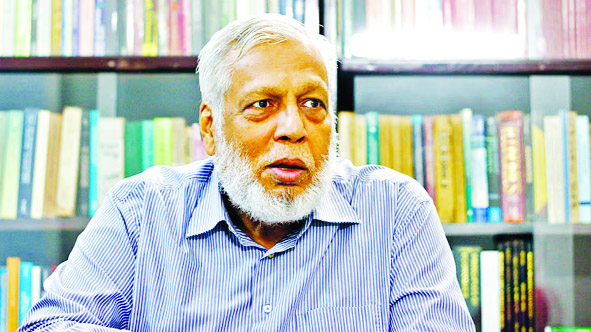
Muhammad Fayzul Kabir Khan, Adviser to the Ministry of Power, Energy, and Mineral Resources, has stated that efforts are underway to keep load shedding at a limited and manageable level during the upcoming summer months.
“Our projection is to reach 18,000 megawatts. We are hopeful that we will be able to manage the situation to a large extent. Load shedding will remain at a tolerable level.
We will try to keep it manageable during the summer, although it will not be completely load-shedding-free,” he remarked.
The Adviser made these comments on Saturday at a seminar titled ‘Energy Crisis: Way Forward’, organised by the Forum for Energy Reporters Bangladesh (FERB) at Bijoy Hall of the Power Building.
Mr Khan further mentioned that there would be coordination between rural and urban areas to ensure an equitable electricity supply. He also confirmed that energy imports would continue to support supply stability. “This is a short-term government.
In the energy sector, everything takes time. We are not embarking on any initiatives that we cannot manage. Our priority is to clear outstanding payments. No country will continue business if bills are not paid,” he said.
He emphasised the need to reduce system losses by 50 per cent within the next two months. Measures are being taken to repair existing line leakages and to combat gas theft. In addition, the government has decided to import LNG through public-private partnership initiatives.
The seminar was presided over by FERB’s Md Shamim Jahangir. Special guests included Md Rezanur Rahman, Chairman of Petrobangla, and Md Rezaul Karim, Chairman of the Bangladesh Power Development Board (BPDB).
Energy experts such as Shamsul Alam, Energy Adviser of the Consumers Association of Bangladesh (CAB), and Khondaker Golam Moazzem, Research Director at the Centre for Policy Dialogue (CPD), also participated.
Dr Ijaz Hossain, energy and sustainable development expert and former professor at Bangladesh University of Engineering and Technology (BUET), presented the keynote paper.
Mr Khan outlined that current power production stands at 16,000 megawatts, with around 179 megawatts of load shedding. The target is to increase capacity to 18,000 megawatts.
He reiterated the government’s commitment to equitable power distribution, ensuring rural and urban areas receive fair treatment.
“Our economy was previously on a downward trend, but that is no longer the case.
We are optimistic that we can manage the situation,” he said, while also cautioning that unexpected technical issues, such as major power plants going offline, particularly during the summer, could create sudden challenges.
In his keynote presentation, Dr Hossain highlighted Bangladesh’s growing gas crisis, warning that domestic reserves could be exhausted by 2031 unless new sources are discovered. “Currently, we produce 2,000 MMCFD, but we must triple our reserves. Companies like Chevron should be allowed to expand operations,” he advised.
Meanwhile, CPD’s Khondaker Golam Moazzem stressed the urgent need for comprehensive energy policy reform. He argued that Bangladesh’s energy transition goals must be clearly defined, with strategic planning extending to 2041.
He cautioned against an overreliance on LNG imports, suggesting that excessive promotion of LNG could deter investment in domestic gas exploration.
“Our long-term energy projections must be updated,” Moazzem said, urging immediate policy-level discussions between the Planning and Finance Ministries.
He proposed that a three- to five-year financial recovery plan should be considered to revitalise the gas sector.
In his presentation, Moazzem outlined several short-term priorities for the energy sector, including: establishing regasification terminals with a capacity of 2,000 MMCFD (up from the current 1,100 MMCFD); improving the LPG distribution network and facilitating the import of 4-5 million tonnes of LPG for urban households and transportation; prioritising domestic coal mining or securing low-cost coal supplies, even if it requires purchasing mines abroad; and increasing the share of renewable energy from the current two per cent to at least 10 per cent by 2030.