
Global commodity price drop, but BD sees little relief
Business Report:
Global commodity prices have been declining since the start of 2025, mainly due to falling fuel prices, according to the World Bank’s Commodity Markets Outlook: October 2025. Other contributing factors include slower oil demand growth in China and increased global supply, which have pushed oil prices down. While food prices have gradually eased, adverse weather in the first half of the year caused a temporary spike in beverage prices. Meanwhile, gold prices reached record highs in the latter half of 2025 as investors sought a safe haven amid political and economic uncertainty.
Energy prices remain the main driver of global commodity prices. According to the World Bank, Brent crude averaged $81 per barrel in 2024 but may drop to $68 in 2025 and fall further to $60 in 2026, with a slight rebound expected in 2027. Slower growth in oil consumption is attributed to lower demand from China, rapid adoption of electric and hybrid vehicles, and rising global supply. Global oil supply increased significantly in 2025 and is expected to rise further in 2026, nearly 65 percent higher than the 2020 peak.
Agricultural commodities are projected to remain relatively stable. Crop prices are expected to decline slightly by 2 percent in 2026 and 1 percent in 2027. Prices for food items, including grains, edible oils, and protein products, are expected to remain near current levels, with occasional minor fluctuations. Soybean prices are likely to fall in the remainder of 2025 due to reduced Chinese imports from the United States amid trade tensions, but prices should stabilize in 2026-2027. Fertilizer prices rose about 21 percent this year due to higher demand, trade restrictions, and supply shortages. They may drop 5 percent over the next two years but remain above historical averages.
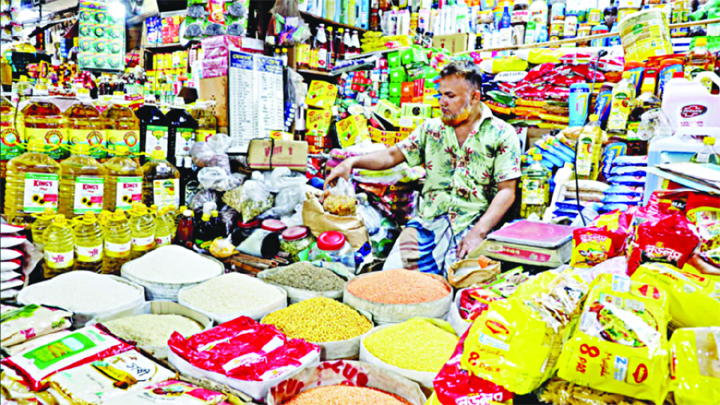
Despite falling global prices, domestic markets in Bangladesh have seen limited relief. Experts point to the depreciation of the taka, high import tariffs, and inefficiencies in market management and supply chains. Delays in imports and reduced letters of credit have further constrained supply. Dhaka University economics professor Selim Raihan noted that high fuel and transport costs, taxes, opaque wholesale-to-retail practices, and political uncertainty keep local prices elevated.
High inflation has persisted in Bangladesh over the last three years. The 2024-25 fiscal year saw average inflation at 10.03 percent. Although it eased slightly in recent months, September 2025 recorded 8.36 percent, up from 8.29 percent in August, highlighting ongoing challenges in controlling price increases.