
US Trade Delegation due on Sunday: Further tariff cut expected: Experts
Reza Mahmud :
A high-level United States trade delegation is scheduled to arrive in Dhaka on Sunday, for a two-day mission aimed at advancing negotiations on tariff reductions for Bangladeshi exports to the American market.
The visit comes at a critical time, as Bangladesh intensifies its diplomatic and economic outreach to secure greater access to the US market and strengthen bilateral trade ties.
Experts said Bangladesh has huge potentials to further lowering US imposed reciprocal tariff as some other countries including Pakistan gets lower additional levy then it.
They said several European, Latin, East Asian and African countries have got lower reciprocal tariff facilities than Bangladesh from 10 to 19 pc levies.
Most of these countries got 15pc tariff like Ghana, Chad, Iceland, Afghanistan and many others while Brazil, Falkland Islands and some others got 10pc tariff only.
Besides, Pakistan, Indonesia and Malaysia got 19pc tariff facilities to export goods to the USA.
In these view, Bangladesh also can get such lower tariff facilities by skillful bargaining, said experts.
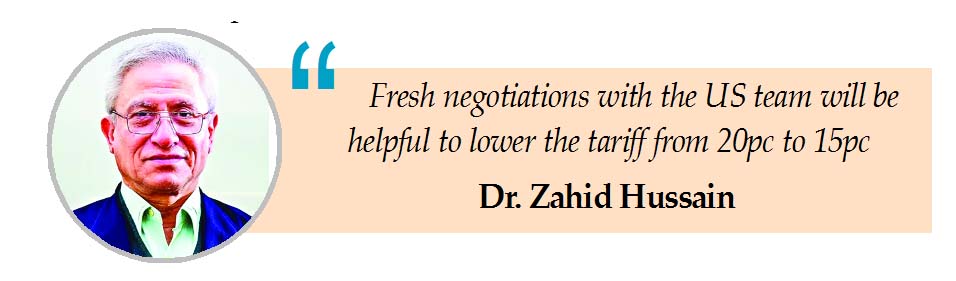
When contacted, Dr. Zahid Hussain, former Lead Economist of the World Bank Dhaka Office told The New Nation on Thursday, “We can hope that the fresh negotiations with the US team will be helpful to lower the US reciprocal tariff through skilful bargaining.”
The eminent economist said the USA previously has asked Bangladesh to amend labour law, intellectual property law; non tariff barriers and such others.
“Bangladesh team has to show its development of such amendment and bargain for lowering the tariff,” he said.
Dr. Zahid also said that it depends on the bargaining capacity of our discussants on the issue.
Earlier, Commerce Secretary Mahbubur Rahman confirmed to reporters on Thursday that discussions during the visit will focus on achieving a further reduction of the 20 percent reciprocal tariff currently imposed on Bangladeshi goods entering the US market.
The delegation will be led by Brendan Lynch, Assistant US Trade Representative (USTR) for South and Central Asia, who is expected to hold multiple rounds of meetings with senior officials of the Commerce Ministry, Chief Adviser Muhammad Yunus, Foreign Affairs Adviser Md Touhid Hossain, and Foreign Secretary Asad Alam Siam.
The push for tariff reduction has been ongoing for months. On 7 August, Washington agreed to lower the tariff on Bangladeshi exports to 20 percent from the previous 35 percent, following intense negotiations between Dhaka and Washington.
While the cut was welcomed as a significant step forward, Bangladeshi officials argue that the new rate remains high compared to tariffs enjoyed by other developing countries that benefit from preferential US trade schemes.
Consequently, Dhaka has been pressing for the duty to be brought down further to 15 percent, with the aim of concluding a comprehensive bilateral trade deal.
Commerce Adviser Sheikh Bashir Uddin and National Security Adviser Khalilur Rahman earlier indicated that both sides were “actively engaged” in working out a pathway for reducing the reciprocal duty from 20 percent to 15 percent.
To this end, the Commerce Ministry has already prepared a draft trade agreement based on earlier rounds of talks with USTR officials.
Sources at the ministry say that if the upcoming discussions show substantial progress, the draft will be finalized after necessary revisions.
Bangladesh’s pursuit of lower US tariffs comes against the backdrop of shifting global trade dynamics.
Washington has recently taken a tougher approach to trade with several partners, most notably India. In mid-2024, the US imposed additional tariffs on a range of Indian goods, including steel and aluminum products, citing concerns over India’s trade barriers and industrial subsidies.
These measures were seen as part of Washington’s broader strategy to recalibrate its trade relations in South Asia, ensuring “fair and reciprocal” terms. The tariffs strained US-India trade relations, though both sides have since opened discussions to ease the tensions.
Against this backdrop, Bangladesh’s ability to secure concessions from the US is viewed by analysts as a diplomatic success. The August tariff reduction was seen as a gesture of goodwill, reflecting Washington’s interest in strengthening economic ties with Dhaka at a time when Bangladesh is navigating significant political and economic transitions following the upheavals of 2024.
The upcoming USTR mission will therefore serve as a litmus test for the future of Bangladesh-US trade cooperation. If Dhaka can persuade Washington to agree to a 15 percent tariff, it would not only boost the competitiveness of Bangladeshi exports-particularly ready-made garments, which dominate the country’s export basket-but also signal a deepening of strategic economic ties between the two nations.
For now, all eyes are on the two days of intensive negotiations in Dhaka, which could determine whether Bangladesh secures a more favorable tariff regime and lays the groundwork for a long-term trade partnership with the United States.