
Frequent earthquakes seized people
Staff Reporter :
The frequent earthquakes in the country have seized people across the country especially those living in the densely populated desert of concrete Dhaka with a population of more than 3.66 crore.
Within a gap of 13 hours, people across the country in Teknaf, Sylhet and Narsingdhi felt the tremor that gripped people in the anticipation of bigger earthquakes.
Experts have repeatedly said that frequent mild tremors always led to bigger earthquakes while the Bengal earthquake has completed the cycle of 100 years.
A mild tremor with a magnitude of 3.6 in the Richter scale jolted Narsingdhi, Dhaka and adjacent areas at around 4.15pm on Thursday, with its epicenter in Ghorashal of Narsingdhi.
According to Rubaiyat Kabir, acting head of the Earthquake Monitoring Centre at the Bangladesh Meteorological Department, another earthquake was felt across various parts of the country, including the capital.
It occurred at 4:15 pm, with a magnitude of 3.6. This was a low-magnitude earthquake, and its epicenter was in Ghorashal, Narsingdi.
However, many did not feel the mild tremor but when the news spread among people it became the center of discussion.
People recently felt the 5.7 magnitude of tremor in Narsingdhi on Nov 21, which claimed at least 10 people and more than 600 people injured.
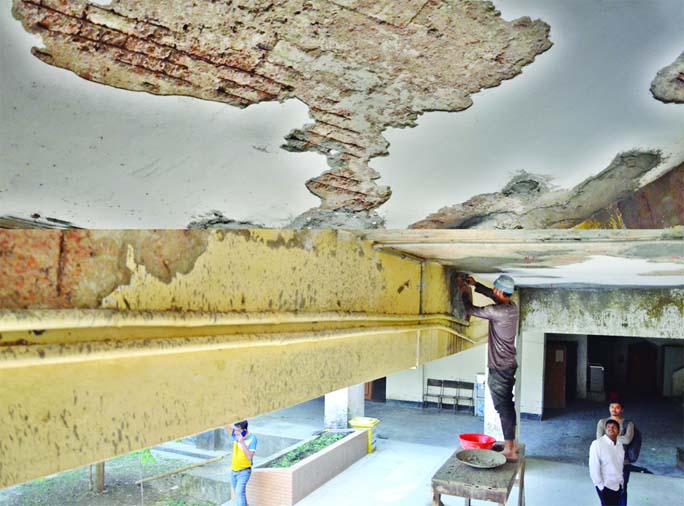
Many houses and buildings were damaged and cracks were seen in buildings including a newly constructed building in the Secretariat.
Meanwhile, an earthquake, with a magnitude of 4, originated 118 kilometers from Teknaf at 3:29 am.
The tremor, which occurred in the Bay of Bengal, was felt in the Teknaf town of Cox’s Bazar district.
According to the earthquake monitoring website Volcano Discovery, the tremor was so mild in Teknaf that most people did not feel it.
Although Volcano Discovery did not provide information on the depth of the earthquake’s origin, the EMSC (European-Mediterranean Seismological Centre) stated that it occurred at a depth of 10 kilometers beneath the surface.
Shortly after, at 3:30 am, a mild earthquake with a magnitude of 3.4 was felt in Sylhet. Due to its mild intensity, many people did not feel it.
This was confirmed by Shah Md. Sajib Hossain, a meteorologist at the Sylhet Weather Office. Every tremor now triggers fear of what might follow, because the capital especially the Old Dhaka simply isn’t built to absorb a large-scale shock.
Experts said that Dhaka faces a serious risk, saying the capital hasn’t seen a quake like the earthquake on 21 Nov in at least a century.
After the frequent earthquakes, the interim government led by Prof Muhammad Yunus has talked with the experts and sought suggestions and recommendations to reduce the damages if any big earthquake takes place.
The government has also urged the people not to be panicked rather people should remain alert.
The Fire and Defence Service has recently issued 10-point recommendations what to do during and after the earthquake.
According to experts, Bangladesh is divided into three earthquake risk zones. Zone 1, the highest-risk area, covers several northern and south-eastern districts including parts of Sylhet, Mymensingh, Tangail, Gazipur, Narsingdi, Kishoreganj, Brahmanbaria, Khagrachhari and Rangamati. Zone 3, with the lowest risk, includes regions such as Khulna, Jashore, Barishal and Patuakhali.
Historical data shows that between 1976 and 2015, at least five major quakes were felt in Bangladesh, most originating around Sylhet, Moulvibazar, Rangamati, Bandarban and Cox’s Bazar.
Experts believe these areas remain highly vulnerable. Bangladesh also sits near several major fault lines, including the Dawki Fault and the Madhupur Fault, which increase the likelihood of significant future seismic activity.
The tremors are still arriving and the fear is rising with them. And the country knows it needs to move fast, because the next big one may not give a warning.
“If any big scale earthquake takes place in Bangladesh, it would be devastating.
It would be difficult to tackle the disasters after post earthquake,” Dr Subrota Kumar Saha, Professor and Chairman of Department of Geology said.
The government also feels the necessity of open spaces for tackling any bigger natural disaster like earthquakes.
The reality is that Dhaka is losing is existing open spaces for unplanned urbanization and encroachment of other spaces.
The pressure of people and vehicles are increasing every day. Still there is no visible human management model for the capital as these growing people would be managed in a small land.