
Fiscal focus turns to public welfare, not GDP: Finance Adviser
Staff Reporter :
The interim government has signalled a notable shift in fiscal priorities for the upcoming financial year, moving away from the pursuit of high GDP growth to focus more keenly on public welfare.
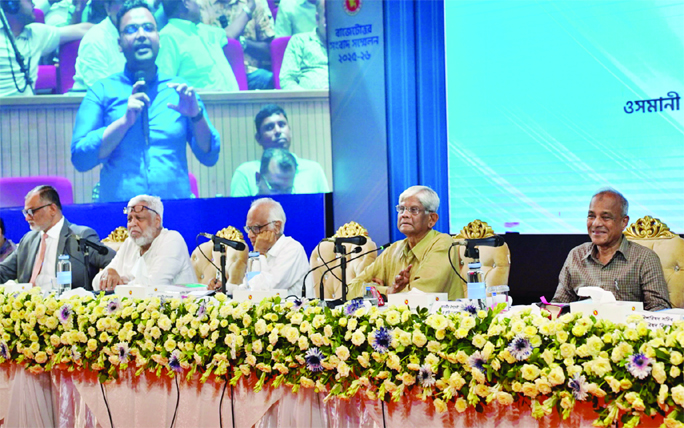
This change was highlighted by Finance Adviser Dr Salehuddin Ahmed during a post-budget press conference held on Tuesday.
“For years, successive administrations have emphasised ambitious GDP targets – but who has truly realised such exceptional growth?” Dr Ahmed remarked. “This time, the focus is on improving the quality of life for citizens, reforming governance, and creating a more conducive environment for business.”
He noted that, for the first time, the proposed budget for the fiscal year 2025-26 will remain the same size as the previous year’s – a move reflecting fiscal caution and realism. “Given our limitations, it is difficult to meet every public expectation within the scope of the budget,” he admitted.
Dr Ahmed also stressed the government’s commitment to sustainable debt management and reducing reliance on foreign loans. “While some traditional elements remain, the budget introduces key reforms, particularly in the tax structure,” he added.
Commerce Adviser Sheikh Bashir Uddin, also speaking at the briefing, said the current revenue policy does not offer preferential treatment to any specific institution – a practice he said was common under the previous government. “This is a foundational step, and future administrations are expected to build upon it,” he stated.
Addressing the issue of money laundering, Dr Ahmed acknowledged the growing complexity of such financial crimes. “The number of individuals involved in money laundering is rising, and the techniques used are increasingly sophisticated,” he noted. “Recovering these funds is a slow and challenging process. For example, it took Nigeria two decades to repatriate its stolen assets.”
He argued that had even a portion of the laundered funds been recovered, the government might not have needed budgetary support from development partners or institutions like the IMF.
On the topic of regularising undeclared income – often labelled as ‘black money’ – the Finance Adviser clarified that not all such funds are illicit.
“In many cases, it is income that has not been declared for a variety of reasons. The provision to declare such funds in this budget aims both to legitimise them and to enhance tax revenue,” he said.
“This measure will continue to be reviewed as part of the wider budgetary process.”
Planning Adviser Dr Wahiduddin Mahmud described the proposed budget as pragmatic and frugal. “The aim is to break the vicious cycle of borrowing and repayment – though that cannot be achieved through a single budget,” he cautioned.
He acknowledged criticism that the budget lacks significant strategic shifts, with some commentators describing it as conventional and insufficiently focused on reducing inequality.
“Almost all projects included in this budget were initiated by the previous administration – many based on political considerations rather than financial viability,” he noted. “Out of 1,300 projects, only 20 to 30 are new – and even those were listed in the prior fiscal year. These are, in effect, inherited initiatives.”
The proposed budget reflects a careful recalibration of national priorities, aiming for fiscal sustainability while laying the groundwork for broader reforms in governance and economic management.