
First US wheat shipment arrives
Staff Reporter :
Bangladesh has officially started importing wheat from the United States under a government-to-government (G2G) arrangement — a first in the country’s history.
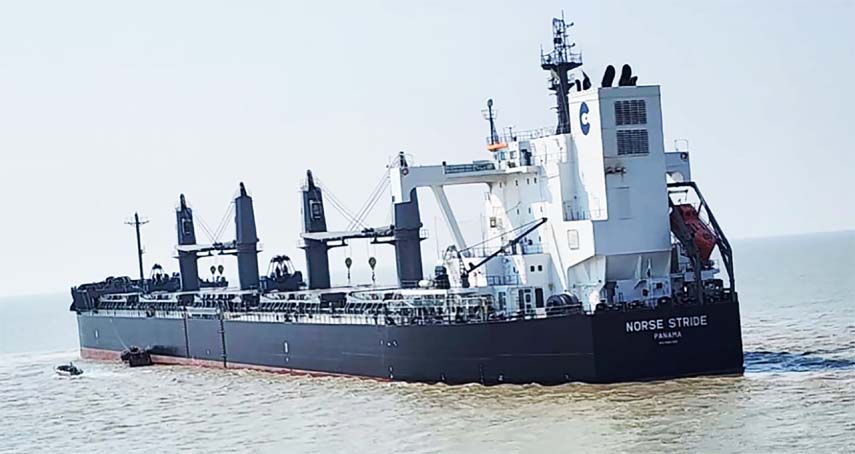
The inaugural shipment, carrying 56,959 metric tonnes of high-quality wheat aboard the vessel MV NORSE STRIDE, reached the outer anchorage of Chattogram Port on Saturday.
The consignment marks the beginning of a broader import plan under a memorandum of understanding (MoU) signed between the Government of Bangladesh and the Government of the United States.
According to a press release from the Ministry of Food, the agreement outlines the supply of a total of 440,000 metric tonnes of wheat to
Bangladesh in several phases.
The import process is being implemented through the Directorate General of Food (DGF) under the Ministry of Food, in cooperation with the US Department of Agriculture (USDA).
Officials said the shipment’s wheat is now undergoing sampling and quality testing at the port. Once laboratory results confirm compliance with the agreed standards, authorities will begin unloading operations without delay.
Of the current shipment, 34,170 metric tonnes will be discharged at Chattogram Port, while the remaining 22,789 metric tonnes will be offloaded at Mongla Port.
Officials from the Food Ministry said this initiative is part of a broader effort to diversify Bangladesh’s grain import sources and strengthen food security amid rising global prices and supply disruptions caused by the Russia–Ukraine conflict.
The MoU with the United States also aims to reduce Bangladesh’s trade imbalance and promote closer economic ties between the two nations.
Through this G2G deal, Bangladesh expects to ensure a steady supply of high-quality wheat at competitive prices while expanding agricultural trade cooperation with the US.
The government hopes that the successful implementation of this agreement will pave the way for future agricultural imports under similar bilateral arrangements.
With this first shipment now at Chattogram Port, Bangladesh’s wheat import diversification strategy has entered a new phase — strengthening both food security and bilateral trade relations with one of the world’s largest grain producer.