
February polls chance for truly representations Fakhrul
Staff Reporter :
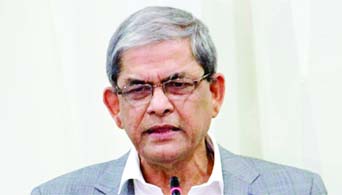
BNP Secretary General Mirza Fakhrul Islam Alamgir on Thursday said the upcoming national election, scheduled for February 2026, presents an opportunity to form a truly representative parliament – one that will address the people’s unresolved issues and chart a clear roadmap for the nation’s future.
“I want to stress that differences of opinion will naturally exist. The Chief Adviser’s speech may seem acceptable to many, but differing perspectives are inevitable,” he said.
Speaking at an electoral dialogue, Fakhrul noted that the interim government has already announced the February 2026 election to elect a parliament genuinely representing the people.
“The key point is that this parliament must engage in meaningful discussions, resolve outstanding national issues, and outline a defined plan for the country’s progress within a specific timeframe,” he added.
Fakhrul said that since the people are the true owners of the state, their elected representatives must guide the nation forward.
“If we fail to form such a representative parliament and instead a handful of individuals or intellectuals attempt to impose their views, we must question how acceptable that will be to the people.”
The dialogue, titled “National Parliamentary Election 2026: The Necessity for National Unity,” was organised by the Foundation of Strategic and Development Studies at a city hotel.
Reflecting on Bangladesh’s long struggle for democracy, Fakhrul said the nation has paid a heavy price for it but has rarely been able to practise democracy in its true sense.
“Since the Pakistan era, our democratic process has been repeatedly interrupted and weakened.
This lack of genuine democratic practice has bred mistrust, anxiety, and instability in society,” he said.
Paying tribute to those martyred in the July movement who gave their lives resisting autocracy, Fakhrul said, “We are indebted to the martyrs who have given us the chance to institutionalise democracy.”
He emphasised that building democratic institutions is now essential to overcoming the political crisis.
“I believe our foremost duty, wherever we stand, is to contribute to the institutionalisation of democracy,” he added.
Fakhrul said forming an elected government through a fair election at the earliest would mark the beginning of a renewed democratic journey.
“I see no reason for despair. I’m not disheartened – rather, I believe the growing national dialogue on democracy signals a new wave of hope, a refreshing breeze that can lead Bangladesh toward a new democratic order,” he said.
Warning that the proportional representation (PR) system remains unfamiliar to most citizens, he said, “We cannot simply impose complex systems on people who are not prepared for them.
The PR system is still largely misunderstood by the public. We must explain and familiarise the people with it before implementation.”
He reiterated that the BNP has long sought unity among forces that stood against fascism.
Fakhrul reaffirmed his party’s proposal to form a national government after the election with those political parties and groups that joined the anti-fascist movement.
“This reflects our sincere intention to unite the nation on core issues and move forward together,” he said.
“If we can collectively understand and embrace this spirit, I am confident we can succeed. I want to reiterate – elections are the only path to restore democracy.”