
Extreme heat hits BD economy
Tasnuba Akhter Rifa :
Severe impacts of climate change hits Bangladesh with rising temperature that is increasingly crossing tolerable limits.
Such warming caused national economic loss of Tk 21,000 crore annually in agriculture, industrial and other sectors, sources said.
Experts said, government’s weakness in coordinated efforts of providing real-time data has become a barrier to getting international funds over the impact of climate change.
They said resilience and adaptation plans are imperative but fund crises making those difficult.
Source said, in the capital Dhaka, and other major cities, severe heat waves have become a regular disaster, posing serious health, economic, and environmental challenges.
Global warming inflicted major damage on Bangladesh agriculture and industry, and caused an estimated economic loss of Tk 21,000 crore about 0.4 per cent of the country’s GDP.
In the face of global warming experts asked the government to take effective measures including well prepared plans to resilience and adaptation in face of climate change.
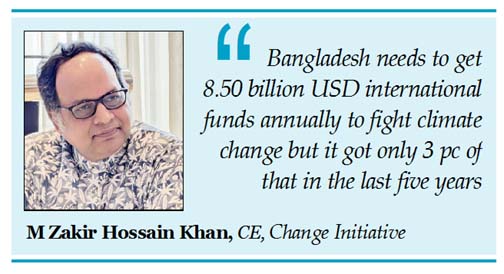
When contacted, M Zakir Hossain Khan, Chief Executive of Change Initiative told The New Nation on Friday, “There are huge weaknesses of the Bangladesh government over getting international climate funds as it failed to prepare realtime data over the rough impacts of climate change.”
“Bangladesh needs to get 8.50 billion USD international funds annually to fight climate change but it got only 3 pc of that in the last five years,” Zakir Hossain Khan said.
He said, Bangladesh has taken $12.78 billion in climate debt against multiple climate projects.
It carries one of the world’s highest per-capita climate debts at USD 79.6. The experts suggested taking Jakat, Commercial Social Responsibility (CSR) and different national and international charity funds on adaptations and resilience issues.
According to the World Bank, around 250 million workdays were lost due to heat-related disruptions during that period. Data from Climate Central shows that nearly 60 million people suffered from dangerously high temperatures between June and August.
Experts warn that the urban population is increasingly at risk. About 78 per cent of Dhaka’s residents face direct exposure to extreme heat, while Chattogram experiences an average of 59 heat wave days each year.
They said, high humidity has further intensified the crisis.
During the summer, humidity ranges between 70 and 90 per cent, and during the monsoon, between 80 and 99 per cent.
This prevents sweat from evaporating, leading to overheating, dehydration, and a higher risk of heatstroke. As a short-term coping mechanism, many urban residents are turning to air conditioners (ACs).
Experts caution that this disparity is exacerbating productivity losses and widening socioeconomic inequality.
Environmentalists and urban planners are now urging the government to formulate a Heat Action Plan to protect vulnerable populations.
India’s Ahmedabad has successfully implemented such a plan, significantly reducing heat wave-related deaths through early warning systems, public awareness campaigns, and hospital preparedness.
Specialists also recommend microclimate initiatives such as tree planting, green roofs, green walls, and the conservation of open water bodies to help lower city temperatures.
Singapore has already demonstrated success with these methods, reducing the Urban Heat Island effect.
Another proven solution is the use of Cool Roofs, where rooftops are coated with reflective white or light-colored paint.
Studies show this can reduce indoor temperatures by 4–5°C and lower electricity consumption. This approach has proven effective in warm regions like California, Florida, and Ahmedabad.
Architects also suggest revisiting traditional building designs that support natural ventilation and passive cooling, such as shaded verandas and water-based layouts.
These cost-effective solutions could be particularly useful for rural and low-income communities.
Experts further emphasize the need to adjust work schedules during extreme heat.
Prohibiting outdoor work during peak midday hours and shifting tasks to mornings or evenings could help prevent heat-related illnesses and improve productivity.
Gulf countries, for example, restrict outdoor labour between 12 PM and 4 PM, a model that could be adapted in Bangladesh.
Ultimately, climate experts agree that Bangladesh needs low-cost, locally adaptable solutions such as rooftop gardens, greening projects, water body conservation, and community awareness programs.
Coordinated planning and continuous research are essential to implement these measures effectively.
Climate-induced heat is no longer a seasonal discomfortit has become a fight for survival.
Without immediate and responsible policy action, experts warn, the country’s health, economy, and environment will remain at grave risk.