
Exporters Protest 80% Hike in Container Handling Charges Effective September
Business Report
The Bangladesh Inland Container Depots Association (BICDA) has announced that from September 1, container handling charges at inland container depots (ICDs) will increase by 20% to 80%. Exporters Andrew and freight forwarders warn the move will severely impact the export sector, raise costs, and further intensify the ongoing foreign currency crisis, with negative consequences for the national economy.
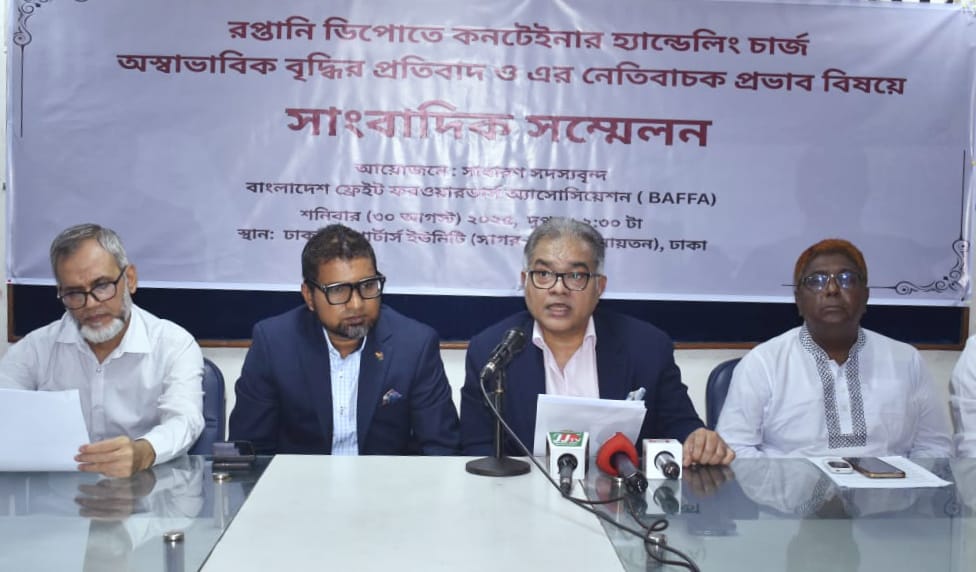
At a press conference held yesterday at the Sagor-Runi Auditorium of Dhaka Reporters Unity, members of the Bangladesh Freight Forwarders Association (BAFFA) strongly protested the hike, calling it “abnormal and unjustified.”
Exporters complained that ICD charges are already nearly double those at seaports, yet service quality has not improved. Without consultation with users, charges have once again been raised sharply, they said. With rising costs of electricity, fuel, transport, and raw materials, as well as U.S. tariff measures, the export sector is already under stress. The new ICD charges, they argued, will worsen the situation.
Under the revised schedule, the handling charge for a 20-foot export container will rise from Tk 6,187 to Tk 9,900; for a 40-foot container from Tk 8,250 to Tk 13,200; and for a 45-foot high-cube container from Tk 8,250 to Tk 14,900. Charges for empty containers, lift-on/lift-off operations, documentation, and ground rent are also being raised. For instance, ground rent for a 20-foot empty container will rise from Tk 115 to Tk 150, and for a 40-foot container from Tk 230 to Tk 300. Lift-on/lift-off charges will increase from Tk 512 to Tk 750 for 20-foot containers and Tk 700 for 40-foot containers, while documentation fees will rise from Tk 276 to Tk 450.
Reading out a written statement, BAFFA member Abrarul Alam said:
“During this period of global economic downturn, domestic economic and political uncertainty, retaliatory U.S. tariffs, and shrinking markets, raising ICD charges is a highly counterproductive move. It will erode Bangladesh’s competitiveness in international markets, discourage buyers, and put small and medium-sized exporters at risk.”
He warned that many exporters may be forced to scale back or shut down operations due to higher costs. BAFFA demanded immediate withdrawal of the new tariff structure.
In response to a question from journalists, Abrarul Alam added that existing charges are already sufficient to cover operational needs. “Previously, it took three to four days to load a container at ICDs, and it still takes the same time. Claims of labor shortages or capacity constraints do not justify such a hike. Instead of raising charges, the focus should be on improving services, ensuring transparency, and enhancing operational efficiency.”
BAFFA members presented several demands to BICDA, including reducing cargo unloading time, hiring sufficient skilled workers, and deploying modern equipment to improve services without raising costs.
Currently, 93% of Bangladesh’s export goods are processed through 19 ICDs in Chattogram before being shipped abroad. In addition, 65 categories of import cargo are delivered through ICDs after clearance from Chattogram Port. The depots provide 16–17 different services—ranging from container handling to documentation and equipment use—against which they charge fees.
Other BAFFA members present at the press conference included Anwar Hossain, Adnan Iqbal, Hasnat Abdullah, Munim Mahfuz, and Shamsul Haque.