
Dengue Turns Endemic: Experts warn of deepens health crisis
Staff Reporter:
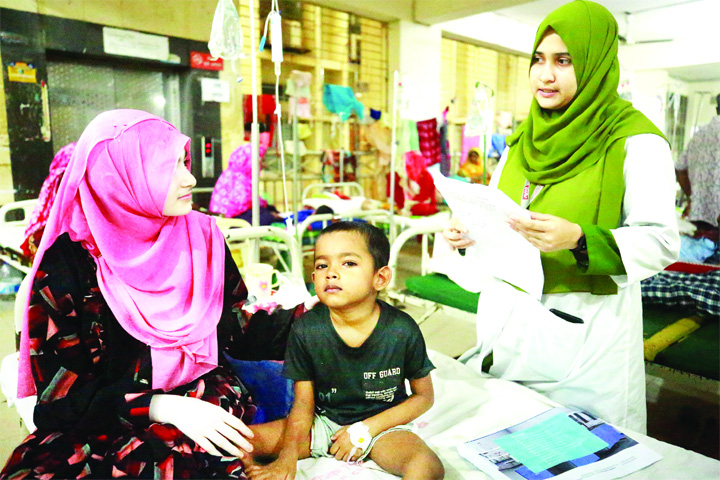
Dengue fever, once a seasonal outbreak, has now entrenched itself as a permanent public health concern in Bangladesh, with infections reported in 63 out of 64 districts this year. Experts warn that the situation is spiraling beyond control due to poor coordination between government agencies and the absence of year-round preventive measures.
According to the Directorate General of Health Services (DGHS), as of October 20, more than 60,791 people have been hospitalised and 249 have died from dengue in 2025 alone. Only the northern district of Joypurhat remains officially free of cases, though local health authorities confirmed detections last year.
The southern district of Barguna has emerged as a new hotspot, with over 8,000 hospitalisations and 14 deaths—the highest outside Dhaka. Public health experts believe this pattern shows that Aedes mosquitoes, the carriers of the virus, have spread nationwide, turning dengue into a persistent, countrywide threat. “Aedes mosquitoes are found all over the country, and their density is extremely high,” said Professor Kabirul Bashar, entomologist of Jahangirnagar University.
Bangladesh experienced its worst dengue outbreak in 2023, when over 300,000 people were infected and 1,705 died.
Yet, experts say, there has been no visible change in mosquito control measures. Despite two decades of recurring outbreaks, the Ministry of Health and the Ministry of Local Government continue to shift responsibility for mosquito control. The health ministry claims it is fully prepared to treat patients but insists that vector control is the local government’s job. Meanwhile, the local government ministry says anti-mosquito drives are ongoing, though experts describe these as largely ineffective. “The government doesn’t care. People may fall sick or die; it makes no difference to them. Dengue has now become a permanent concern—and the signs suggest it will get even worse,” said Dr. Abu Jamil Faisel, a public health expert.
In Dhaka, bank employee Jasim Uddin Khan contracted dengue this month despite taking precautions both at home and work. “I think I was bitten by a mosquito in Karwan Bazar,” he said.
“I’ve been bedridden since the start of October—I don’t know when I’ll be fit to return to work.” Many others share similar experiences, with patients from rural districts flocking to Dhaka for treatment amid doubts about healthcare quality in their local areas. A 2019 study by Dhaka University found that treatment costs ranged from Tk 5,000 in public hospitals to as high as Tk 150,000 in private ones, placing a heavy financial burden on thousands of families.
Experts have long warned that ignoring integrated mosquito control could make dengue uncontrollable. In 2017, a WHO consultant drafted a prevention plan combining mosquito control with disease management, but the local government never implemented it. The Institute of Epidemiology, Disease Control and Research (IEDCR) now warns of rapidly changing dengue variants (serotypes) that make reinfections more likely and more dangerous. “The dengue variants are changing fast. After one strain spreads, it’s returning much sooner—increasing the risk of multiple infections,” said Professor Tahmina Shirin, Director of IEDCR. Currently, DEN-2 and DEN-3 are the dominant strains nationwide, with DEN-2 particularly widespread in Barguna.
Public health experts stress that dengue can no longer be tackled through short-term or seasonal measures. “There’s no shortcut or piecemeal way to control mosquitoes or dengue anymore,” said public health expert Mushtuq Hossain. “It has to be a year-round, nationwide effort with community participation and strong political commitment.” Without sustained and integrated mosquito control, Bangladesh risks seeing dengue evolve into a permanent, endemic crisis—one that could grow deadlier and costlier each year.
Meanwhile, four more people died of dengue in the 24 hours till Tuesday (21 October), raising the number of fatalities from the mosquito-borne disease to 251 this year. During the same period, 814 new patients were hospitalised with viral fever, pushing the total number of infections to 56,257 in 2025, according to the DGHS.
New cases were reported as follows: 126 in Barishal Division (outside city corporations), 114 in Chattogram Division, 124 in Dhaka Division, 170 in Dhaka North City Corporation (DNCC), 107 in Dhaka South City Corporation (DSCC), 41 in Khulna Division, 46 in Mymensingh Division, 40 in Rajshahi Division, 41 in Rangpur Division, and five in Sylhet Division.