Endless yellow mustard fields enchant nature lovers

Ishwardi, Pabna Correspondent :
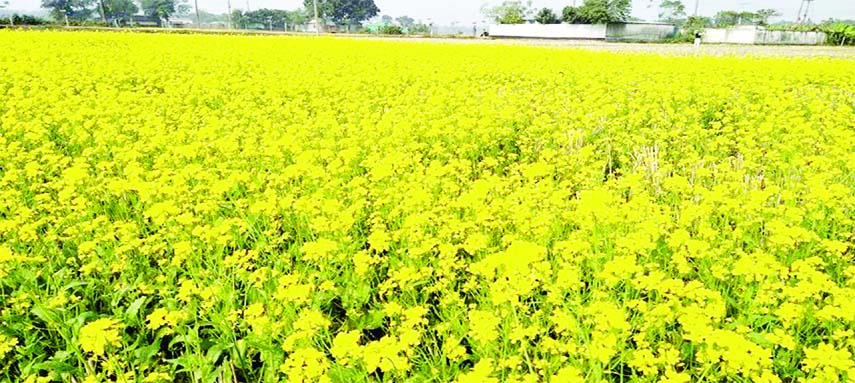
In Ishwardi upazila, vast stretches of mustard fields have now been filled with the brilliant yellow bloom of flowers.
With the sweet fragrance of mustard blossoms and the soothing yellow glow that pleases the eyes, nature seems to have dressed itself in a new attire.
To enjoy this breathtaking sight, nature lovers are flocking to the fields every day. Bees are buzzing around the mustard flowers, and taking advantage of this, beekeepers have become busy collecting honey.
Ignoring the biting cold and dense fog, beekeepers from different areas are setting up rows of beehives beside the mustard fields to harvest honey.
On-the-spot visits reveal that extensive mustard cultivation has taken place across the fields of Muladuli, Laxmikunda, Sahapur, Salimpur unions, as well as the municipal areas of Ishwardi.
Everywhere there are waves of yellow flowers-as far as the eye can see-filling the mind with the beauty of nature.
According to the Department of Agricultural Extension, due to favorable weather conditions and proper care, there is a strong possibility of a bumper mustard harvest this season.
Mustard harvesting is expected to begin by the end of February. As mustard cultivation requires relatively low cost and labor but yields higher profit, farmers’ interest in growing mustard is increasing day by day.
In the 2021-22 season, mustard was cultivated on 680 hectares of land in Ishwardi, whereas in the current 2025-26 season, the area has increased to 1,575 hectares.
Farmers report that high-yielding varieties such as BARI-14, BARI-17, along with local varieties, have been cultivated extensively. With favorable weather, they are hopeful of achieving yields better than the target.
Farmers are spending busy days taking care of their fields. Meanwhile, nature enthusiasts are visiting the mustard fields in the morning, afternoon, and evening to enjoy the scenery and take photographs.
Beekeepers have started collecting honey by placing beehives around the mustard fields. They say mustard flower honey is of very high quality.
Each kilogram of honey can be sold for 250 to 350 taka. Although the profit is fairly good, severe cold and fog sometimes create difficulties.
Abdul Matin, a farmer from Muladuli, said, “The profit from cultivating mustard on three bighas of land is higher than many other crops.
I have cultivated the BARI-14 variety. The plants have grown very well, and I hope the yield will also be good.”
Mizanur Rahman, a farmer from Naodapara, said that after harvesting Aman paddy, he cultivated mustard as a companion crop during the months of Magh and Falgun instead of leaving the land fallow.
This will bring him additional income. He added, “Mustard cultivation does not require much labor, and the cost is low. It costs about 4,000-5,000 taka per bigha, and it can be sold at a good price.”
Upazila Agriculture Officer, Agriculturist Abdul Momin, said that incentives have been provided to encourage farmers, and field-level agricultural officers are giving regular advice. He further said, “The soil of Ishwardi is highly suitable for mustard cultivation. Cultivation has increased, and the weather is also favorable-overall, we are hopeful of a good harvest this year.”