
‘Economy stabilises amid rising poverty’
Staff Reporter :
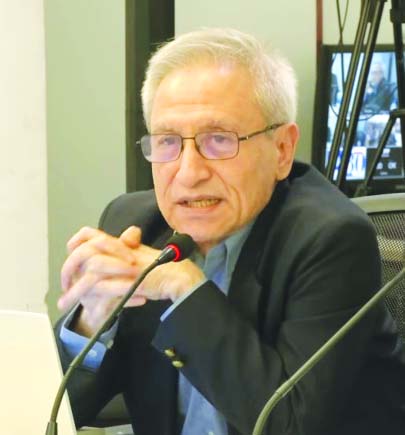
Bangladesh’s economy has returned to a state of stability, with economic activities improving compared to the fiscal year 2022-23, said Zahid Hussain, former lead economist at the World Bank’s Dhaka office, on Saturday.
“Despite this progress, the condition of households has worsened-poverty and inequality are both on the rise,” Zahid remarked while delivering the Moazzem Hossain Memorial Lecture organised by the Economic Reporters Forum (ERF) in Dhaka.
Moazzem Hossain, the late editor of the English daily The Financial Express, was also the founding president of the ERF.
According to Zahid, the renewed stability largely stems from the removal of actors who had previously fueled instability. “Money laundering has come to a halt, hundi transactions have dropped significantly, and foreign currency inflows have improved.
At the same time, plundering inside the banking sector has ceased. However, the sector’s fundamentals remain
weak, as non-performing loans continue to climb,” he explained.
He further pointed to supportive global factors, particularly the sharp fall in the US dollar’s value, which has worked in Bangladesh’s favour.
Speaking on the role of policy, Zahid argued that policy measures themselves have not been the main driver of stability. “What has changed is the approach to economic management-discipline has increased.
But that does not mean all government decisions are necessarily right.”
He also observed that trade tariffs introduced during the Trump administration have created opportunities for Bangladesh.
“Tariffs on Indian and Chinese products have opened up room for Bangladesh to expand its exports to the US by nearly $205 crore in FY2025-26. Since India faces duties almost 30% higher than Bangladesh, our potential export advantage lies between $120 crore and $207 crore.
Similarly, higher tariffs on China could yield an additional $7 million to $25 million in exports from Bangladesh,” Zahid explained.
Still, he cautioned that Bangladesh remains stuck in the middle-income trap. “The biggest hurdles are the persistent power and energy shortages, the fragile state of the banking sector, weaknesses in logistics, skill gaps in the labour market, and deep-rooted institutional decline.”
On reforms, Zahid stressed that political will alone cannot ensure success. “What is required is the capacity to implement. Effective reform demands cooperation among the Council of Advisers, the administration, the private sector, and civil society. Without joint efforts from these four pillars, reforms risk losing momentum.”
He described the present Council of Advisers as “earnest and bold in some respects, yet constrained or uncertain in others.”
The programme also heard from businessman Mahbubur Rahman, a trustee of The Financial Express, who voiced frustration that the changes expected after the July uprising have not materialised and that inequality has, in fact, deepened.
The session was chaired by ERF President Doulot Akter Mala and moderated by General Secretary Abul Kashem.