
Economists call for urgent reforms, new political deal
Staff Reporter :
Economists and policy experts warn that Bangladesh’s growth is being hindered by elite dominance, calling for urgent reforms and restructuring to ensure fair power distribution, accountability, and inclusive development.
At a discussion in Dhaka on Saturday, speakers said Bangladesh’s economic future depends not only on policy reforms but also on a fairer distribution of power, stronger accountability, and the creation of a more competitive economy.
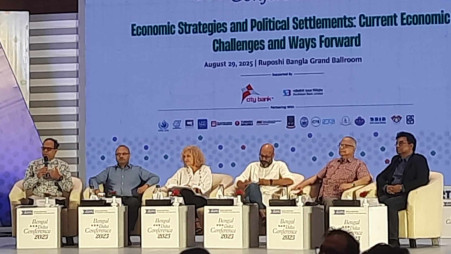
The discussion, “Economic Strategies and Political Settlements: Our Current Economic Challenges and Ways Forward,” was part of theBengal Delta Conference 2025: Bangladesh at the Crossroads, organised by the Dacca Institute of Research and Analytics (DAIRA) at the InterContinental Dhaka.
Keynote speaker Mushtaq Khan, professor of economics at SOAS University of London, said Bangladesh’s growth in the 1980s-2000s was driven by a broad base of entrepreneurs.
But in recent years, power has shifted to a narrow elite, leading to inflated infrastructure costs, costly power projects, and widespread corruption in the banking sector.
“Breaking the control of these oligarchs requires strong measures-prosecuting large-scale corruption, recovering stolen assets, and enforcing competition laws similar to the US Sherman Act,” Khan said.
He stressed that sustainable industrialisation depends on growth driven by middle-class enterprises.
SelimRaihan, executive director of the South Asian Network on Economic Modelling (Sanem), said the country’s economic challenges come from weak institutions, informal power networks, and state capture.
He pointed to flawed elections since 2013, loss of political legitimacy, and heavy reliance on large infrastructure projects often negotiated without transparency.
He called for reforms in taxation, banking, trade, and public spending, particularly in health and education, where quality has declined due to underfunding.
Nuria Lopez, chairperson of the European Union Chamber of Commerce in Bangladesh, said that concentrated economic power has reduced competitiveness.
She pointed to unreliable energy supplies, high borrowing costs, and logistics expenses that are at least 10 percent higher than in neighboring countries.
She stressed the urgency of reforms and suggested that Bangladesh consider extending its LDC graduation timeline to prepare a strong roadmap for sustainable growth.
Economist MahbubUllah said the rise of oligarchs dates back to the early years after independence in 1971. He warned that reforms based on weak socio-economic foundations could lead to unrest. Instead, he called for promoting small and medium enterprises (SMEs) to build a new productive entrepreneurial class and ensure long-term stability.
Imran Matin, executive director of the BRAC Institute of Governance and Development, highlighted the lack of accountability in the social sector.
He said Bangladesh needs more community-based monitoring systems to improve services, especially in an environment with weak rule of law.
Closing the session, M Zakir Hossain Khan, CEO of Change Initiative, said Bangladesh’s deltaic environment demands adaptive and inclusive policies.
He stressed that reforms must be dynamic, forward-looking, and sustainable across generations.