
Dublar Char remains deserted look
Khulna Bureau :
At the end of October, as the monsoon winds change direction, new life awakens in the silent Sundarbans.
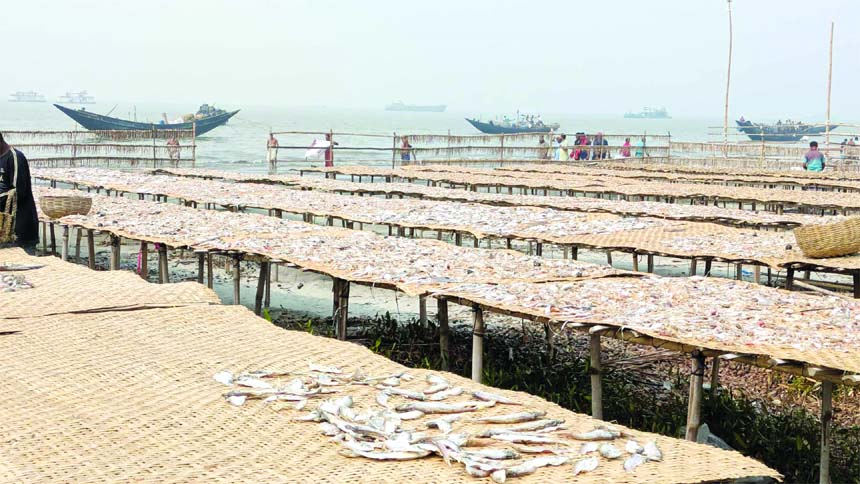
Dublar Char, which had been deserted for seven months of the year, suddenly turned into a temporary town-where the entire sandbar came back to life with the footsteps of thousands of fishermen, workers, traders, suppliers and buyers.
It was like a floating city built deep in the forest. In just five months, markets, shops, workshops, jetties, fishing piers were built here-all in all, a temporary social system.
In the words of the fishermen, “These five months are our life for the whole year.” Because during this time, about 30-35 crore taka of dried fish is produced, and the government receives 6-8 crore taka of revenue.
Not only the economy, this five-month town is a major pillar of the lifestyle and food security of thousands of families in the southwestern region.
When you go to the shore, you see-small tube wells dug out of sand are the main source of life here. People cook, drink, wash, and mop with that salty water.
Abdul Hai, a fisherman in Koyra, Khulna, says as he draws water from the well, “Our life runs on this water. Even if it is salty, there is no other way than this water.”
Lack of electricity has been a reality here for a long time. A few solar panels and a roaring generator are the last hope of light.
Even amidst that noise, shops, mobile charging, welding-all kinds of work continue. Still, people smile. Because suffering is not a complaint here-it is a part of life.
The activity begins even before the sun rises. Some are landing fish caught from the deep sea, while others are preparing to wash and dry them.
The 65,000 quintals of dried fish produced here in five months are sold in almost all the major markets of the country, including Chittagong, Khulna, and Dhaka. Not just fish-dried fish transportation, sale, packaging, shipping-all of these create a huge economic cycle during these five months.
Kamrul Islam of Rampal, who has been associated with this village since the 1988 floods, says, “If you get good fish, it’s a different joy. If you don’t, the net is empty, but the next day you have to go back to the sea again.”
Child labor was widespread in the dry fish village of Dublar Char. Fishermen say it has decreased a lot now.
Still, it hasn’t completely stopped. Economic hardship has forced many families to send their children to this seasonal war.
Yasin, a teenager from Koyra, says, “I don’t know how much salary I’ll get, but everyone is good. I’m learning the job.”
Sabbir, who studied up to the fifth grade, is now a worker in a dry fish drying room. Sun, salt, sand-all are now part of his growing up.
Every night in Dublar Char is spent in fear. November means memories of cyclones-the burning memories of Sidr, Aila, Mohsen are still alive.
Siraj of Rampal said, “When the tide comes, the house is submerged. If there is no signal, I can’t tell if the storm is coming. Still, it has to come.
The income from these five months lasts for the remaining seven months.”
During storms, the forest department keeps miking, patrols, and emergency boats ready.
However, according to fishermen, while precautions are good, it is necessary to further increase infrastructural security.
The ‘New Market’ built in the middle of the char is like a mini city. All daily necessities are sold-vegetables, fish, dry food, spices, clothing, repair materials.
Vendors come from different parts of the country and set up shops here for five months.
Samiran Das of Talar, Satkhira, said, “We do business in the village for seven months, and five months in this char. This char is our life.”
Divisional Forest Officer of the Sundarbans East Division Md. Rezaul Karim Chowdhury said that in the last season (2024-25), the revenue from the dry fish farms of Dublar Char was more than Tk 6 crore. The target for the 2025-26 season is Tk 8 crore.
He said, “Tourism, safety in fishermen, dry fish production-all are being carried out more systematically this time. We are also strict in protecting the environment.”
Every year, thousands of tourists flock to Dublar Char to celebrate the Katla festival. The combination of art, nature, and fishing life gives visitors a unique experience.
Farzana Rahman Moyna, a tourist from Khulna, said, “I have been here before, but this time the experience is completely different-everything is very tidy.
The entire island is very clean. There is not a single fly in the dry countryside-it is truly amazing.”
Dublar Char is not just a story of economy; it is a unique history of human adaptation, patience, and survival by fighting nature.
Storms, salty water, suffering-in the midst of everything, new light of hope, new dreams are born here every day.
This floating town, built from a small sandbar, proves that the coastal people of Bangladesh have the strength not only to survive, but also to survive.