
DIU chair advocates for global south partnerships
City Desk :
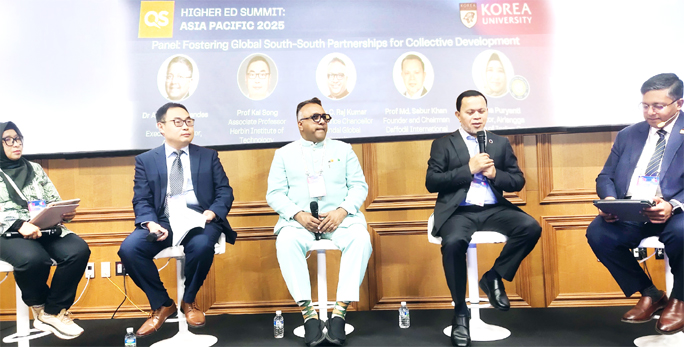
Dr. Md. Sabur Khan, Founder and Chairman of Daffodil International University (DIU) and President of the Association of Private Universities of Bangladesh (APUB), delivered a compelling vision for Global South-South collaboration as a featured speaker at the QS Higher Ed Summit: Asia Pacific 2025.
The panel discussion, titled “Fostering Global South-South Partnerships for Collective Development,” was hosted by Korea University from November 4-6, 2025. The session explored how universities in the Global South can transcend traditional donor-recipient models to build equitable, reciprocal alliances rooted in shared innovation and cultural strength. Dr. Khan emphasized the need to reposition higher education as a form of soft power and a catalyst for sustainable development, reports press release.
From Knowledge Consumers to Innovation Producers
A central theme of Dr. Khan’s address was the urgent need for Global South institutions to transition from being knowledge consumers to innovation producers. “At Daffodil International University, we have built a multi-layered ecosystem where students launch ventures, not just complete degrees,” Dr. Khan stated.
“Our Capstone Projects are aligned with the UN Sustainable Development Goals, transforming final-year projects into real businesses. This is not theory; this is South-South development in action.”
A Concrete Framework for Collaboration
Dr. Khan outlined a practical, action-oriented framework for partnership, built on four key pillars:
1. Technological Sovereignty: Highlighting DIU’s AI-driven personalized education ecosystem and in-house digital platforms like GoEdu and Skill.jobs, which foster digital self-reliance.
2. Embedded Entrepreneurship Ecosystem: Showcasing DIU’s Department of Innovation & Entrepreneurship-the first of its kind in South Asia-which has generated over 200 startups directly from classroom projects.
3. Reciprocity and Mutual Growth: Emphasizing partnerships that treat all institutions as knowledge producers. Dr. Khan cited DIU’s “Jeebika” rural entrepreneurship model, a replicable framework now being studied by universities in Nigeria, Indonesia, and Cambodia.
4. Global South IP and Startup Corridor: Proposing the creation of a “Global South IP Bank” to facilitate patent-sharing, cross-border incubation, and the commercialization of student and faculty innovations across regions.
Announcing DIU’s Commitments: From Vision to Action
To translate dialogue into tangible outcomes, Dr. Khan announced three key commitments from DIU for the next 12 months:
1. Launch of the “Global South Employability Fellowship”: Offering 50+ hybrid fellowships for students from Asia, Africa, and Latin America to co-develop solutions using DIU’s platforms.
2. Establishment of a “Global South Research Lab”: A shared lab focused on AI for education and climate-smart innovations, open for joint research and IP-sharing.
3. Activation of the DIU Dubai Campus as a Global Exchange Hub: Launching an “Innovation Semester Abroad” program to serve as a nexus for co-creation and learning for students across the Global South.
“The youth are not the future-they are the present. But they need tools, trust, and territory to grow,” Dr. Khan remarked. “Our collective goal must be to move beyond MOUs to co-funded, co-created, and co-governed initiatives. Let’s walk together-from Global South to Global Strength.”
The QS Higher Ed Summit: Asia Pacific is a premier gathering of university leaders, policymakers, and education experts, providing a critical platform for shaping the future of higher education in the region.