
Dhaka wants duty free access to Pakistan market
Diplomatic Correspondent :
Bangladesh and Pakistan have revived their economic partnership after two decades, with a series of concrete decisions and a renewed pledge to deepen bilateral cooperation.
The breakthrough came at the 9th Meeting of the Bangladesh-Pakistan Joint Economic Commission (JEC), held in NEC Conference Room at Sher-e-Bangla Nagar, Dhaka on Monday, the first such meeting was held in 2005.
The meeting, co-chaired by Bangladesh’s Finance Adviser Dr Salehuddin Ahmed and Pakistan’s Minister for Petroleum Ali Pervaiz Malik, produced tangible outcomes across multiple sectors including trade, agriculture, education, energy, and transport.
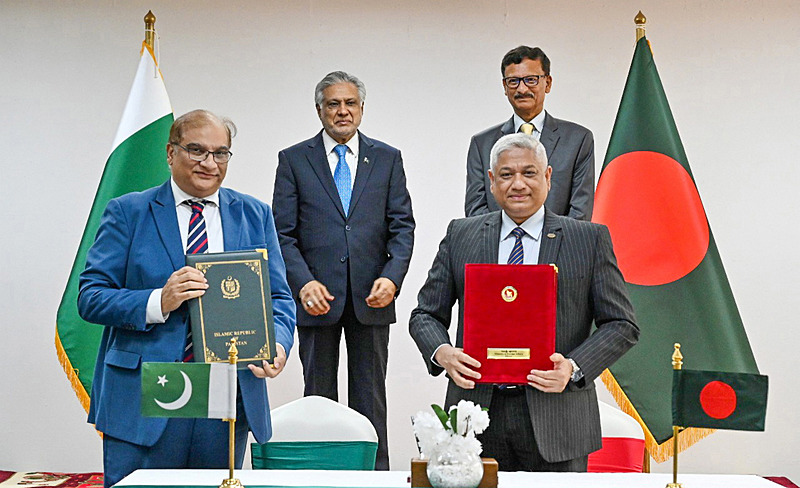
The most notable achievement was the signing of a Memorandum of Understanding (MoU) between the Bangladesh Standards and Testing Institute (BSTI) and the Pakistan Halal Authority (PHA) to promote cooperation in halal trade. Under this agreement, halal meat and other halal-certified products can now be imported and exported between the two countries.
Maqsura Noor, Additional Secretary of the Ministry of Industries, signed the MoU on behalf of Bangladesh, while Pakistan’s High Commissioner to Bangladesh, Imran Haider, signed on behalf of his government.
Officials described the deal as a gateway to boosting bilateral trade and ensuring smoother certification and regulation for halal products – an area with strong commercial potential in both countries.
In another major step, Pakistan agreed to allow Bangladesh the use of Karachi Port. The move is expected to cut logistics costs and strengthen regional connectivity by facilitating direct shipping links.
Both sides also agreed to explore the resumption of direct air services to improve people-to-people and business contact.
Pakistan expressed interest in importing jute from Bangladesh, calling it an area of “mutual benefit.”
Jute, often referred to as the “golden fibre,” remains one of Bangladesh’s key export commodities, and the new interest from Pakistan could give a boost to its export sector.
As part of its push to expand ties, Pakistan proposed offering 500 new scholarships to Bangladeshi students. The country also expressed willingness to establish a campus of one of its universities in Bangladesh.
Additionally, Pakistan showed interest in participating in international tenders related to the printing of banknotes, prize bonds, and other security materials used in Bangladesh.
It also offered technical training in the banking and financial sector, furthering cooperation in human resource development.
Both delegations emphasised the need to strengthen collaboration in energy, agriculture, IT, and food processing.
Pakistan’s Petroleum Minister Ali Pervaiz Malik said discussions on these areas would help build stronger ties between the peoples of the two countries.
He also noted that trade volume between Bangladesh and Pakistan remains below one billion dollars, leaving “enormous untapped potential.”
While talking with the journalists, Finance Adviser Salehuddin Ahmed described the meeting as “highly significant and meaningful,” saying it would give “new momentum” to relations between the two countries.
He added that both sides discussed each key sector separately – from agriculture and trade to science and technology – with the shared goal of ensuring benefits for their people.
He also said stronger cooperation through the JEC could bring wider regional benefits if effectively integrated into South Asian trade frameworks.
“We once hoped SAARC would play that role, but it remains weak. This renewed engagement could fill that gap,” he noted.
Ali Pervaiz Malik said, “People-to-people relations would be cemented through this meeting. The bilateral relations would be strengthened. Today, we have talked on multiple issues including jute, pharmaceuticals to be imported to Pakistan.”
Both countries reaffirmed their resolve to deepen cooperation and agreed that the 10th JEC meeting will be held in Islamabad at a mutually convenient time.
The Economic Relations Division (ERD) confirmed that Bangladesh was represented by a 16-member delegation led by Dr Salehuddin Ahmed, while Pakistan’s delegation, led by Minister Malik, included 14 members.
Since the political transition in Bangladesh in 2024, bilateral visits and exchanges have intensified, reflecting a mutual willingness to turn the page on past hesitations and move toward pragmatic cooperation.
As both countries sign agreements and open new trade and education channels, officials say this renewed partnership could mark the beginning of a sustained economic collaboration – one that benefits not only Bangladesh and Pakistan, but also strengthens South Asia’s economic fabric.