
Dhaka seeks 10pc tariff cap in US trade talks
Staff Reporter :
Bangladesh has formally submitted a counter-proposal to the United States Trade Representative (USTR), seeking revisions to the draft Reciprocal Tariff Agreement aimed at ensuring more equitable trade terms.
At the centre of Dhaka’s response is a demand to cap reciprocal tariffs at 10 per cent, in contrast to the US proposal allowing tariffs as high as 37 per cent, and a clause requiring Bangladesh to adopt aspects of American trade law – terms which Bangladesh argues breach international trade norms.
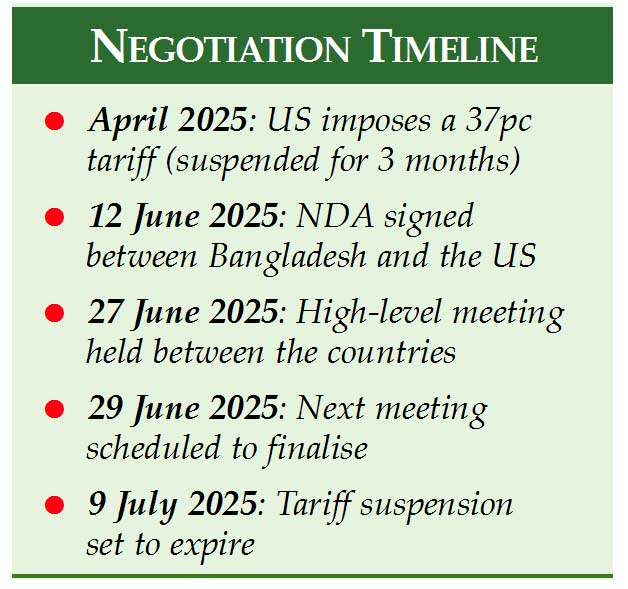
The latest round of negotiations follows the initial imposition of a 37 per cent tariff on Bangladeshi goods by former US President Donald Trump, which was temporarily suspended for three months.
High-level discussions took place on Friday between Bangladesh’s National Security Adviser and chief negotiator, Khalilur Rahman, and USTR officials. A final round of talks is scheduled for 29 June, potentially paving the way for the agreement’s signing.
This development comes after both countries signed a bilateral non-disclosure agreement on 12 this month, restricting the public release of negotiation details. While Bangladesh had proposed a full Free Trade Agreement (FTA) in response to verbal assurances from US officials, Commerce Adviser Sk Bashir Uddin confirmed that Washington has not yet committed to such a framework.
In a show of goodwill, Bangladesh has taken steps to strengthen economic ties with the US. These include scrapping a planned wheat import deal with Ukraine in favour of American suppliers, increasing LNG purchases from US-based firms, and developing proposals to acquire aircraft from Boeing. Since April, the majority of spot LNG approvals have gone to American providers.
Commerce Secretary Mahbubur Rahman reaffirmed Bangladesh’s proactive engagement with USTR, stating that Dhaka has responded to every communication and submitted corrections to several disputed figures – most notably the US assertion that Bangladesh imposes tariffs as high as 74 per cent on American goods. Updated trade data and budget projections were shared to clarify the actual position.
Despite these efforts, anxiety is mounting among business leaders as the temporary tariff suspension is due to expire on 9 July. Exporters fear a return to the punitive rate could damage trade volumes.
President of the Bangladesh Garment Manufacturers and Exporters Association (BGMEA), Mahmud Hasan Babu, emphasised the need for a fair and transparent resolution, warning that Bangladesh should not be subjected to steeper tariffs than its global competitors. He also confirmed that BGMEA had raised concerns directly with the US Ambassador and the Ministry of Commerce.
Business figures, including Bangladesh Chamber of Industries President Anwar-Ul-Alam Chowdhury (Parvez), have called for the immediate appointment of a US-based lobbying firm to support Bangladesh’s position, citing a lack of transparency and urgency in the final stages of negotiation.
Nevertheless, commerce ministry officials remain optimistic, stating that Bangladesh is ahead of regional competitors such as India and Vietnam, having already signed one foundational agreement and actively pursued follow-up discussions.
Officials also pointed to efforts to balance the trade deficit through increased imports of US goods, particularly LNG, cotton, wheat, and aviation products.
In 2024, Bangladesh exported $8.36 billion worth of goods to the United States, compared to $2.21 billion in imports – highlighting a significant trade imbalance that Dhaka hopes to address through the reciprocal trade framework.