
Despite Huge Budgets: Dhaka residents still wade thru knee-deep water
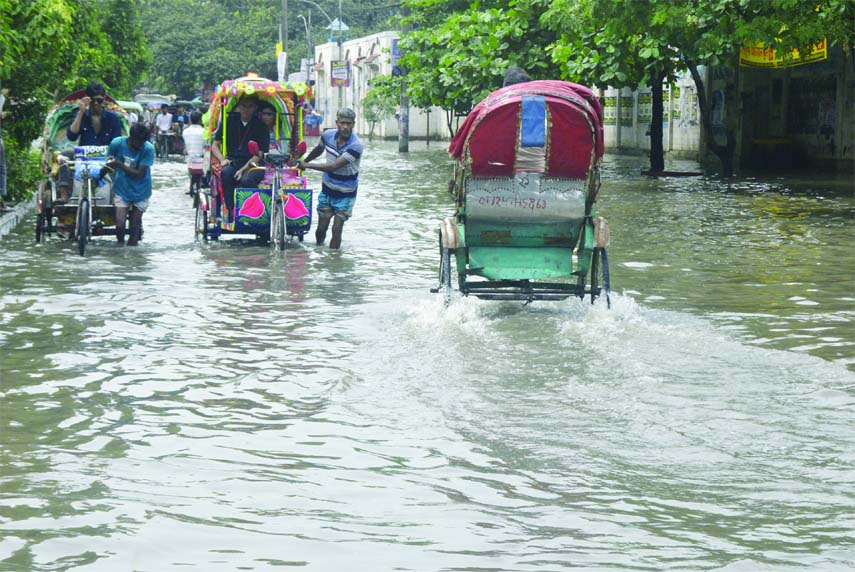
Abu Jakir :
Every monsoon, as the skies open over Dhaka, the streets of one of the world’s most densely populated cities turn into shallow canals.
Cars stall mid-road, rickshaw pullers wade through knee-deep water, and commuters trudge across flooded intersections — scenes that have long become an annual ritual.
But this year, the deluge has lingered even into the autumn rains, underscoring the city’s deepening infrastructure crisis and the apparent futility of its billion-taka budgets.
For the 2025–26 fiscal year, Dhaka’s two city corporations — the Dhaka North City Corporation (DNCC) and Dhaka South City Corporation (DSCC) — announced budgets totalling nearly 10,000 crore taka combined. Yet, for most residents, even basic civic services remain elusive.
DNCC, which governs the city’s northern half, approved a 6,069 crore taka budget, allocating more than three-quarters — about 4,624 crore — to development expenditure. Of this, 2,032 crore was earmarked for roads and infrastructure, 436 crore for waste management, and 187 crore for mosquito control.
DSCC, overseeing the southern half of the capital, passed a 3,841.38 crore taka budget, including 1,469 crore in development expenditure.
Among its key priorities: 365 crore for road and traffic infrastructure, 115 crore for canal development and waterlogging relief, and another 57 crore each for waste management and public health measures.
But the figures, while impressive on paper, have done little to ease the city’s chronic dysfunction.
A Recurring Urban Nightmare Even moderate rainfall now brings large swaths of Dhaka to a standstill. In the recent week, a three-hour downpour brought 71 millimetres of rain, flooding over a hundred locations across the city. In some neighbourhoods, the water rose to waist level.
Farmgate, Nakhalpara, Mirpur, Kalshi, Uttara, and even the airport road were submerged for hours. In the south, areas like Green Road, Azimpur, and New Market turned into makeshift ponds, where stagnant water lingered for nearly half a day.
“The main roads and alleys here now go underwater after every rainfall,” said Nasir Hossain, a resident of Farmgate. “It takes five to seven hours for the water to drain. Every year the city corporation promises a solution, but nothing changes.”
Residents say the misery extends beyond inconvenience. Dirty, foul-smelling water overflows onto streets, mixing with waste and sewage. The floodwater hides open manholes, posing constant risks of injury or even electrocution.
At Kalshi, in Mirpur, Mozammel Haque said, “Every time it rains, our area floods. Then city corporation workers come with pumps, but there’s never a permanent fix. It’s ordinary residents like us who suffer. We just want relief from this nightmare.”
Experts blamed less reform and lack of coordinated and adequate long-term plans behind the severe state of water logging in the city.
When contacted, Bangladesh Institute of Planners (BIP) President and urban planner Adil Muhammad Khan on Saturday told The New Nation, “There are lack of adequate plans and coordinated efforts to respite the people from huge sufferings of water logging.
A master plan was compulsory to interconnect all drainage systems with the canals and outfalls. But it was delayed after taking the responsibility from Dhaka WASA by the city corporations.”
Besides, keeping the canals and drainage clean is yet a far cry as the unaware people used to throw all of their household garbage including dysfunctional furniture and other solid wastes to the canals and drainages which is mostly responsible for water logging.
Officials from both corporations insist they are working to address the issue. DNCC’s public relations officer, Zobayer Hossain, said the corporation began waterlogging preparations three months before the monsoon and has been cleaning drains, canals, and stormwater lines in flood-prone areas.
Md. Jahirul Islam, Chief Executive Officer of DSCC on Saturday told The New Nation, ”waste management and emergency response teams in each ward are active, but blamed high water levels in rivers and canals for slowing drainage.
Portable pumps, they said, are deployed when necessary. A high-pressure vertical pump was recently installed in Kamalapur to speed up water removal.”
Still, the explanations have failed to convince residents. “New Market has been flooding for years,” said Akash Chowdhury, a local shop owner. “The market is lower than the road, so rainwater flows inside, ruining goods. Yet every year, the city corporation spends hundreds of crores on drainage here. We see no result.”
Bureaucratic Blame and Public Negligence Officials often point fingers at public behaviour, citing garbage — plastic bottles, polythene, household waste — dumped into drains and canals, which clogs the water flow.
But urban planners argue that the real issue lies in poor coordination between city agencies and outdated drainage infrastructure that has failed to keep pace with Dhaka’s rapid, unplanned urban expansion.
DNCC Administrator Mohammad Ejaz said that significant progress has been made since he took office. “We have cleaned many canals and drains, and waterlogging on main roads has reduced noticeably,” he told reporters.
“But fixing the whole city requires long-term planning and time. The main road waterlogging issue-that’s what we’ve already addressed in large part over the past few months. Now we’re working on a permanent solution,” he said.