
Dhaka inks NDA, wheat MoU as Trump tariff deadline nears
Reza Mahmud :
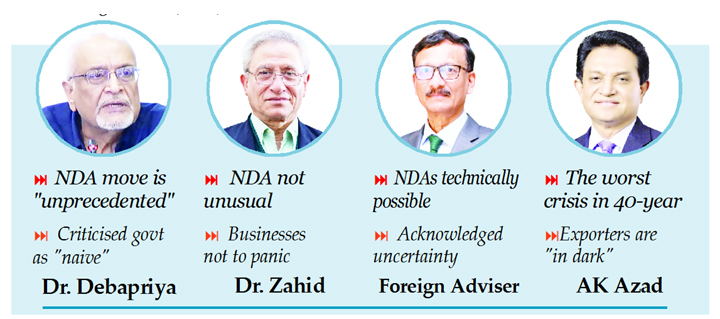
The Bangladesh government has signed a non-disclosure agreement (NDA) with the United States as part of ongoing negotiations to reduce steep tariffs recently imposed on its exports, Dr Debapriya Bhattacharya, Distinguished Fellow at the Centre for Policy Dialogue (CPD), revealed at a roundtable event in Dhaka on Sunday.
In addition to the NDA, Bangladesh has also signed a Memorandum of Understanding (MoU) to import 700,000 tonnes of wheat annually from the United States over the next five years.
These developments come as Dhaka seeks to resolve issues surrounding a new 35 per cent US tariff on its exports, set to take effect from 1 August.
While the rate is a slight reduction from an earlier proposal, it remains significantly higher than those applied to regional competitors such as Vietnam (20 per cent) and Indonesia (19 per cent).
Dr Bhattacharya described the signing of the NDA as “unprecedented” in Bangladesh’s trade negotiation history, noting that such matters are typically addressed through informal non-papers.
“Turning this into a formal NDA introduces binding constraints,” he warned. “Even if Bangladesh engages lobbyists, critical information cannot be disclosed due to the confidentiality clauses of the agreement.”
The economist also voiced concern about the capability of the current interim government to manage the evolving situation.
“We are navigating these turbulent waters with a government that is both inexperienced and unprepared,” he said, calling for urgent reforms in economic diversification, productivity, and institutional strength.
Commerce Secretary Mahbubur Rahman confirmed that Bangladesh is also looking to reduce its $6 billion trade deficit with the United States through the planned purchase of 14 Boeing aircraft.
Meanwhile, business leaders have expressed deep concern over the potential impact of the tariff. At the same roundtable, AK Azad, Managing Director of Ha-Meem Group and a former president of the Federation of Bangladesh Chambers of Commerce and Industry (FBCCI), described the crisis as the most severe in his four-decade career. “Buyers are already lobbying in Washington.
One recently asked me how much of the tariff I would absorb. I export $80 million annually but make just $1.37 million in profit. If I have to absorb 35 per cent, there’s nothing left.”
Syed Nasim Manzur, President of the Leather Goods and Footwear Manufacturers and Exporters Association, said the private sector remains largely in the dark. “We have no idea what strategy the government is pursuing,” he stated.
Despite growing unease in the export sector, some experts remain cautiously optimistic. Dr Zahid Hussain, former lead economist at the World Bank’s Dhaka office, noted that NDAs are not unusual in such contexts.
“The private sector need not panic-negotiations are ongoing, and several countries, including Thailand, Cambodia, Laos, Pakistan, and Myanmar, are facing similar or worse trade barriers,” he said.
He added that Bangladesh could stand to benefit from broader developments, pointing out that former US President Donald Trump may soon issue communications to 150 countries, possibly including Bangladesh, regarding the tariffs.
In a related development, the MoU on wheat imports was signed at the Ministry of Food in Dhaka by Md Abul Hasanath Humayun Kabir, Director General of the Directorate General of Food, and Joseph K. Sowers, Regional Vice President of the US Wheat Associates.
The signing ceremony was attended by US Ambassador Tracey Ann Jacobson, Food Adviser Ali Imam Majumder, and other senior officials.
Food Adviser Majumder remarked that the deal would enhance bilateral trust and strengthen trade cooperation between the two nations.
As Bangladesh prepares for a third round of talks, Commerce Adviser Sheikh Bashir Uddin expressed hope that a resolution could be reached before the 1 August deadline.
Foreign Affairs Adviser Md Touhid Hossain also confirmed the technical feasibility of NDAs in international negotiations but acknowledged that the outcome remains uncertain as the Commerce Ministry leads the process.
With major export industries hanging in the balance, observers say the coming weeks will be critical in determining Bangladesh’s future position in global trade.