Dhaka Fighter Jet Crash 2025: A Storm of Rumors, Stories of ‘Body Hiding,’ and the Government’s Silent Role
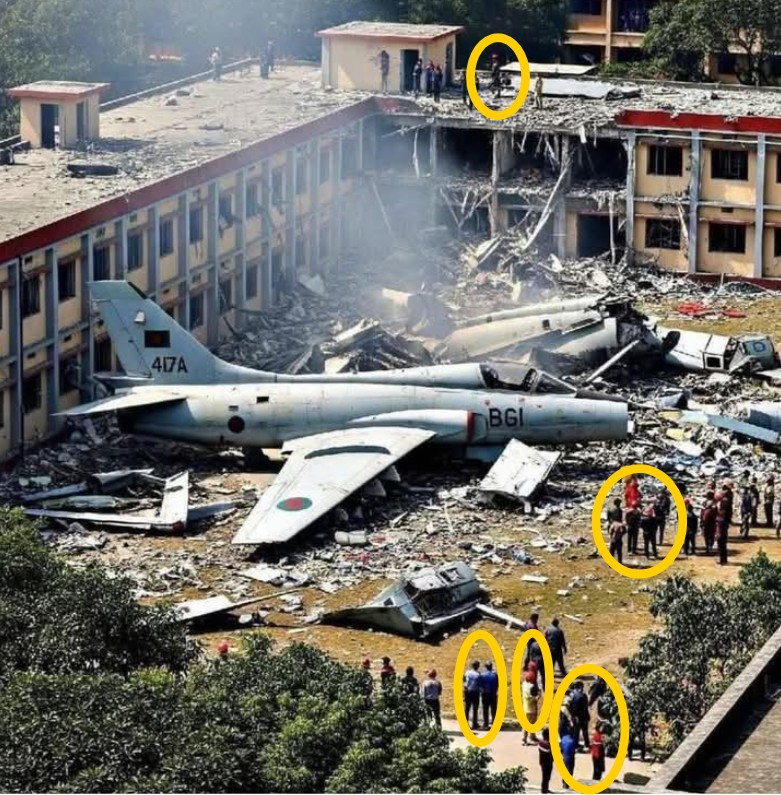
Md Mojahidul Islam Dheow:
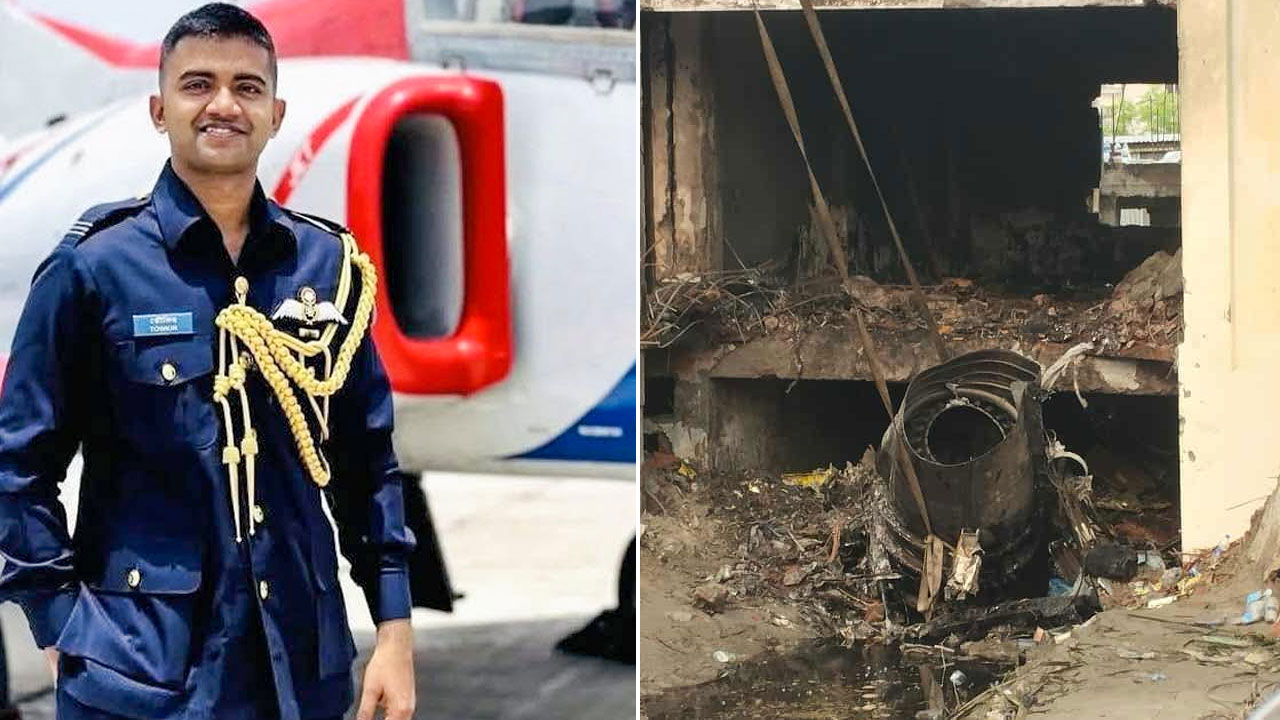
Twenty-four days after the tragic Bangladesh Air Force jet crash into Milestone School and College on July 21, another victim has died. Mahfuza, 45, a teacher at the institution, succumbed to her injuries while undergoing treatment at the National Institute of Burn and Plastic Surgery in Dhaka at 12:45 p.m. on Thursday.
Residential Physician Dr. Shawon Bin Rahman confirmed the news, stating that Mahfuza had suffered 25% burn injuries. Currently, 23 patients remain under treatment at the burn institute.
Following the crash, social media platforms—particularly Facebook—were flooded with rumors and misinformation. The resulting wave of panic, suspicion, and anger was fueled by sensational claims, ranging from “bodies being hidden” to allegations that the death toll was being deliberately understated. Journalists at the crash site faced hostility, raising questions about the government’s effectiveness in countering false narratives.
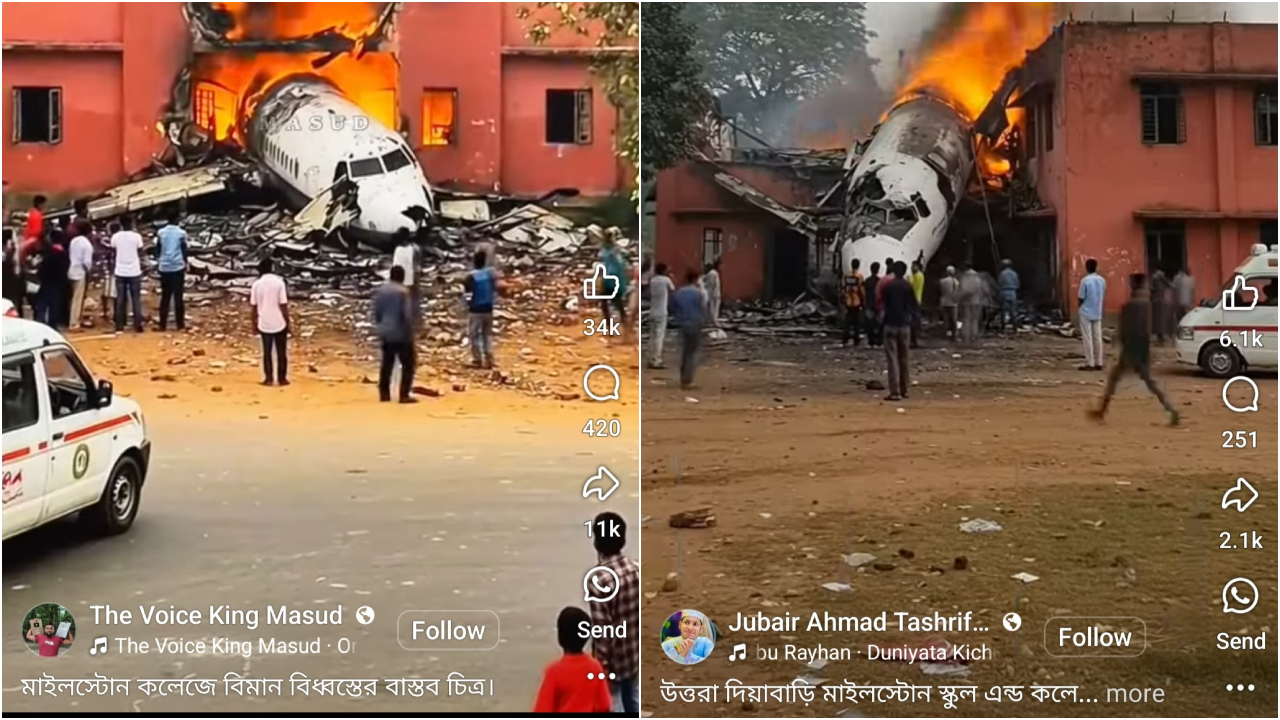
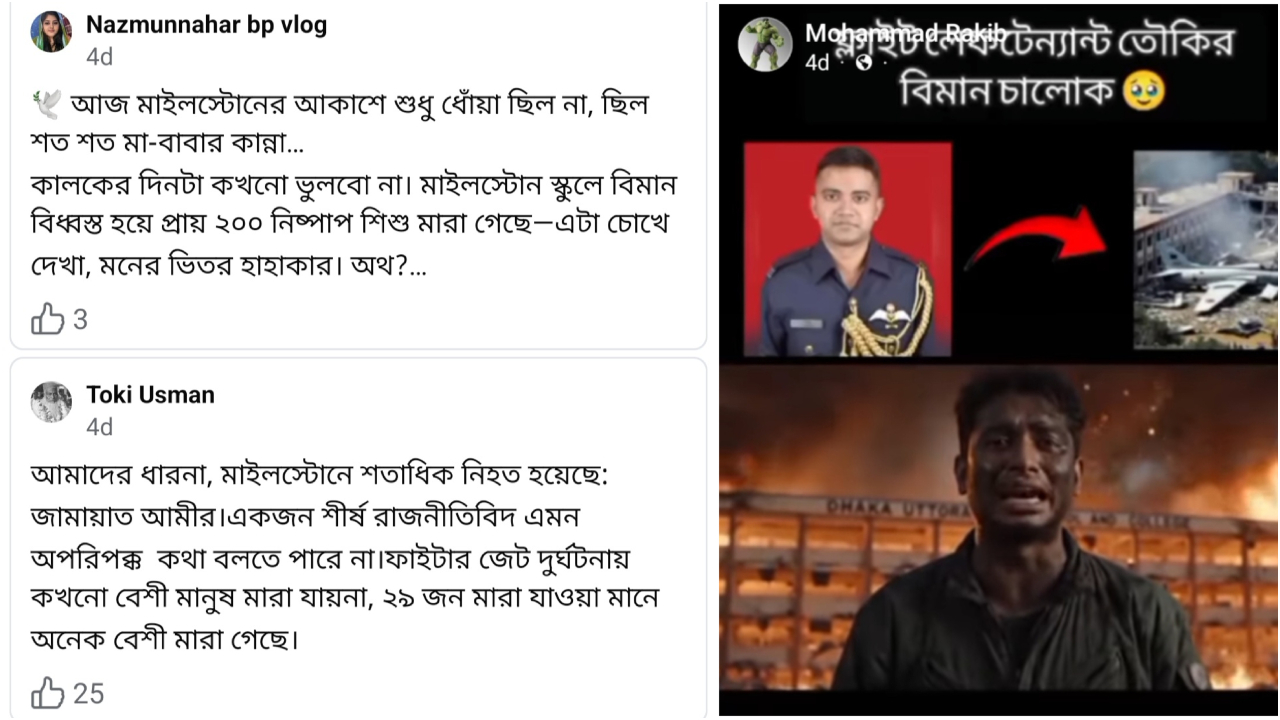
The most persistent rumor revolved around the number of casualties. In various Facebook groups, hundreds of posts cited wildly inflated figures—some claimed 200 deaths, others over 150—while the confirmed toll remains at 34. Alongside these inflated numbers, baseless stories about “hidden bodies” and “political conspiracies” circulated widely.
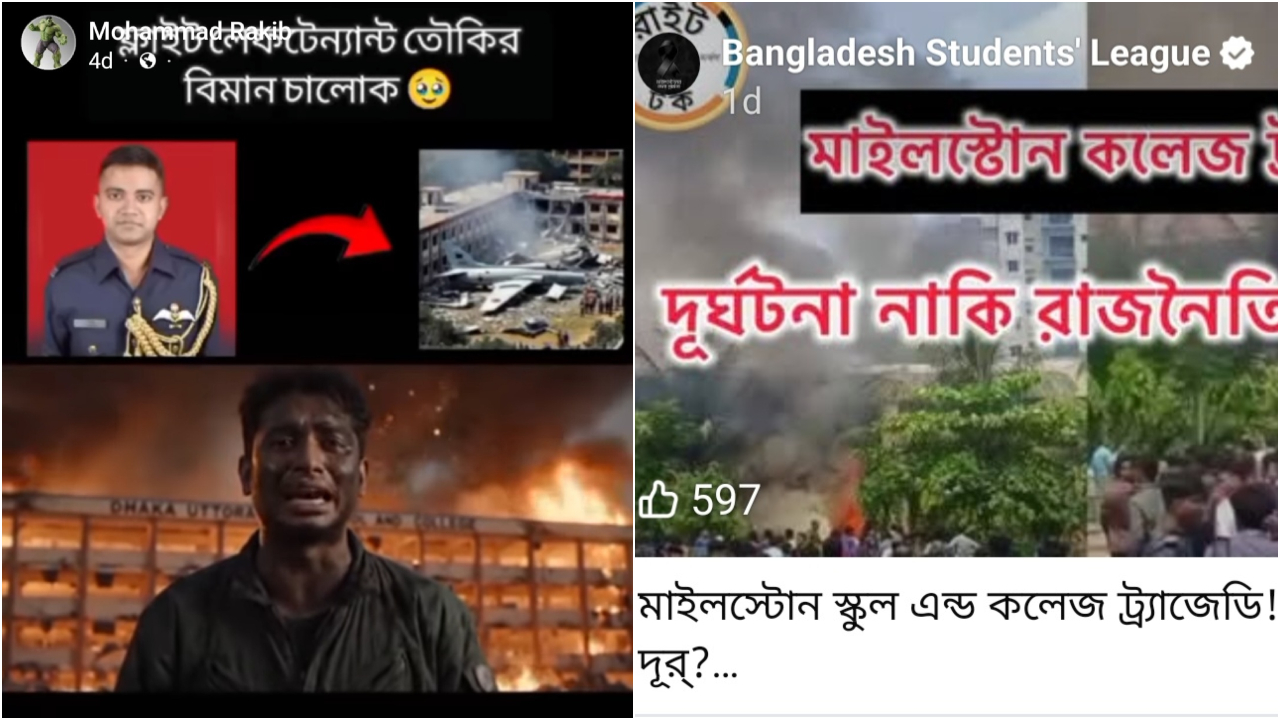
Analysis shows that within the first 24 hours after the crash, at least a dozen “sensitive” posts went viral. These included AI-generated fake images, alleged photos of the pilot’s body and final conversation, reports of students being beaten, and accusations that the college authorities were concealing the truth. No immediate government response was issued.
On the day of the crash, July 21, a man named Dewan Zahid wrote on Facebook that he had personally witnessed more than 40 bodies being recovered:
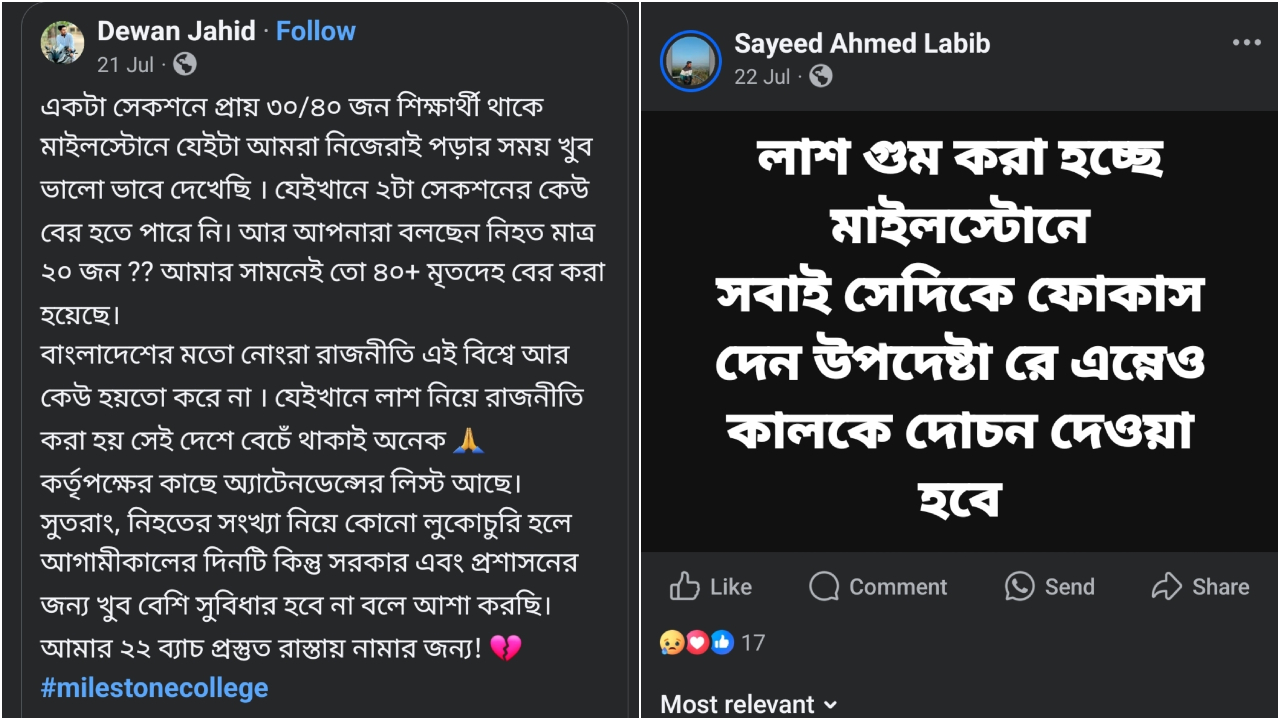
“In one section, there are about 30 to 40 students—something we all knew well when we studied there. In two sections, no one could get out. And you’re telling us only 20 died! I saw 40+ bodies with my own eyes. The authorities have the attendance list, so if there’s any cover-up of the death toll, it will not be good for the government tomorrow.”
The next day, July 22, Rubel Ahmed claimed in a Facebook group that several of his former colleagues at Milestone College told him nearly 200 students, teachers, staff, and guardians had died—while “the government is showing only 27 deaths.” He questioned, “Why this secrecy over the bodies?” and alleged that students were holding advisors hostage and preparing for protests.
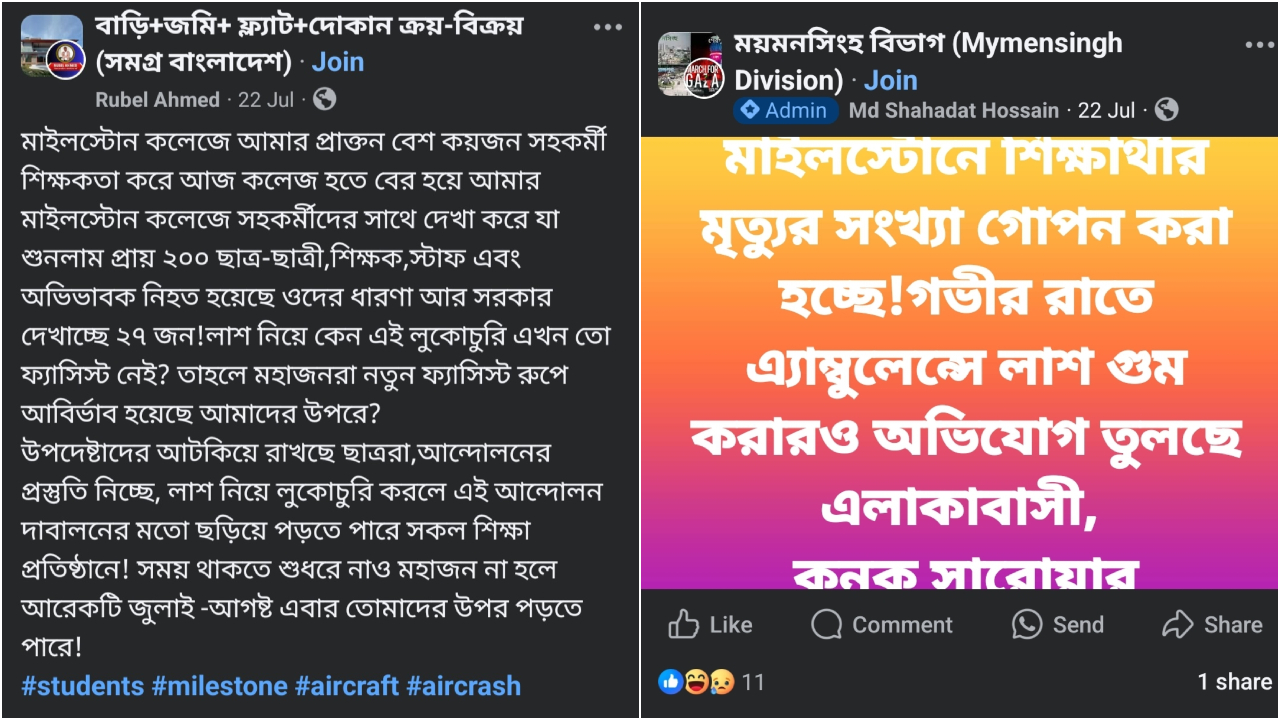
That same day, Shahadat Hossain alleged in another post that the number of student deaths was being concealed, adding that residents claimed bodies were secretly removed in ambulances late at night. Another man, Sayeed Ahmed Labib, wrote, “Bodies are being hidden at Milestone—everyone focus there.”
Verification of these posts showed that none of the claims were confirmed by any official or credible source. Still, within hours, they had spread to millions through shares, comments, and screenshots—further fueling public unrest.
Hostility Toward Journalists
The day after the crash, journalists visiting the Milestone College campus encountered hostility. On at least two occasions, attempts were made to expel them from the premises. At one point, individuals identifying themselves as “protesting” students and guardians surrounded reporters. As tensions escalated, many journalists left in haste.
On July 22, a crowd of agitated students gathered in front of Building No. 5, insisting, “The real number of bodies is being hidden, and many bodies have been removed. TV channels aren’t telling the truth.”
Journalists repeatedly explained that evidence would be verified and published if provided, but inflating the death toll without confirmation from credible sources would violate journalistic ethics.
By afternoon, tensions deepened. Even without proof, many continued to insist that “bodies were hidden.” Some pointed fingers at journalists and made threatening gestures. Reporters from at least five private TV channels gradually withdrew for safety.
A senior reporter from a private TV station, speaking anonymously, recalled:“When we arrived, we realized the situation was extremely volatile. Some students, some guardians, and some unfamiliar faces surrounded us, shouting, ‘You’re agents of the government, covering up the body-hiding news, not telling the truth.’ We calmly said, if you provide evidence, we’ll do the story, but increasing the death toll without a credible source goes against journalistic principles.”
He added:“Even after our explanation, they didn’t listen, and the tension escalated. The situation reached a point where we feared for our safety. Many didn’t even dare to take photos or videos. Rumors were being spread and blindly believed, making it practically impossible to present the truth.”
Confusion Over the ‘Anonymous’ Page Post
One of the most widely discussed rumor sources was a Facebook page called Anonymous. Immediately after the crash, the page claimed it had predicted the incident a day earlier, hinting that “a plane would crash into a school or college.” This fueled speculation that the disaster was pre-planned or foreseen.
However, technology experts revealed the post was actually older and had been edited later to make it appear as though it was published before the incident. Facebook metadata can reveal exactly when a post was first published and how many times it has been edited—a technique often exploited to spread disinformation.
Tech expert Tanvir Hassan Zoha told The New Nation:“Posts like these have no scientific basis—they’re just made to stir chaos and grab attention on social media.”He noted that the page was initially active from outside Bangladesh using a VPN, but within half an hour of authorities starting to track it, all activity stopped.
Zoha added that the government could have quickly requested information from Facebook, as it had in past cases, to identify the source of the rumors. No such request was made in this case.
He confirmed that although “body hiding” claims were widely circulated, no evidence was ever found. No one came forward to report a missing relative or a hidden body, nor were there posters or public demands. In the end, the story appeared entirely baseless, designed only to provoke unrest.
Zoha further explained that while the Cyber Security Ordinance is currently in effect, it has not yet been passed into law due to the dissolution of parliament—limiting enforcement. He noted some recent legal action against misinformation, such as the conviction of a man named Bulbul from Gaibandha, and expressed hope that exemplary punishments might deter future falsehoods.
Government Silence in Containing Rumors
The spread of rumors during the Milestone College incident—and the apparent failure of digital security measures—has placed the government’s role under scrutiny.
On July 30, through Public Relations Officer Muhammad Jasim Uddin, four specific questions were sent to Faiz Ahmad Taiyeb, Special Assistant to the Chief Adviser in charge of the Ministry of Posts and Telecommunications and ICT:After the crash, when misleading information, images, and videos went viral on Facebook, did the government take any initiative to spread accurate information and curb the rumors?
What role did the Department of Digital Security, BTRC, or the cyber monitoring team play in stopping the rumors?Was any platform asked to remove content?What shortcomings existed in the government’s monitoring system?Despite repeated contact over nine days, no answers were received.
When asked whether the Bangladesh Telecommunication Regulatory Commission (BTRC) had taken any action, Chairman Major General (Retd.) Muhammad Emdad-Ul-Bari stated on August 9 that such measures are typically handled by law enforcement agencies. If they deem certain content a threat to national security, they request the BTRC to act.
“We get all kinds of requests,” he said. “We act on the ones that law enforcement considers important for the country’s security.”