
Dhaka denies UN deal as parties condemn ‘Imperialist agenda’
Staff Reporter :
The interim government is facing growing political backlash over a purported agreement to allow a humanitarian corridor through its territory to facilitate aid into Myanmar’s conflict-ridden Rakhine State, even as it insists no such decision has been made.
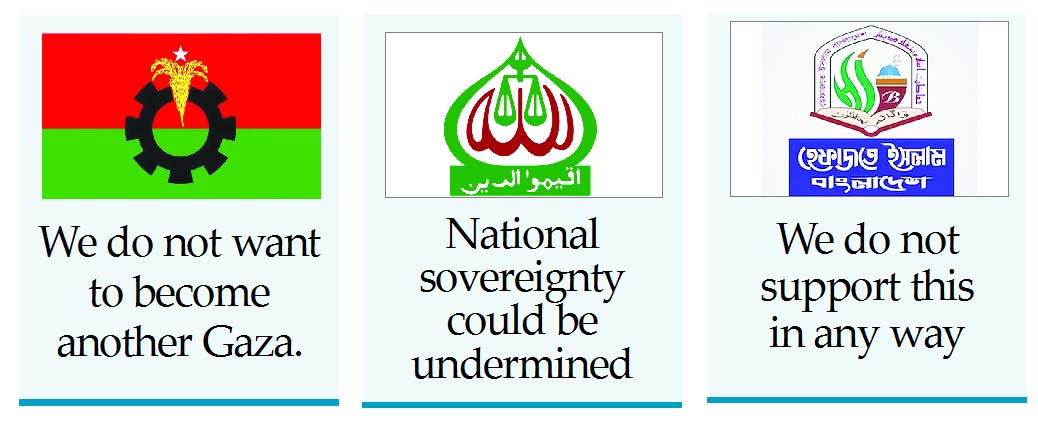
Hefazat-e-Islam Bangladesh on Tuesday vehemently opposed the idea of allowing aid passage through Bangladesh, warning that the move would compromise national interests.
Speaking at a press conference in Dhaka, Hefazat’s Joint Secretary General Mamunul Haque accused foreign powers of using Bangladesh as a pawn in a larger geopolitical agenda.
“Imperialist forces are trying to use Bangladesh to implement their agenda,” Haque said at the Jamia Islamia Makhzanul Uloom Madrasa in Khilgaon. “As a patriotic force, we do not support this in any way. We strongly condemn this decision.”
His remarks came amid widespread speculation following earlier comments by Foreign Affairs Adviser Touhid Hossain, who indicated that Bangladesh had “agreed in principle, subject to conditions,” to a United Nations proposal to establish a humanitarian corridor through Cox’s Bazar to Rakhine State.
The idea, according to Hossain, was to ensure an urgent humanitarian relief supply to communities affected by renewed violence in Myanmar.
However, the government moved swiftly to downplay the report. In a statement posted on Facebook, Chief Adviser’s Press Secretary Shafiqul Alam said no formal discussion or agreement had taken place.
“We want to make it categorically clear that the government has not discussed the so-called ‘humanitarian corridor’ with the UN or any other entity,” Alam said.
While acknowledging that Bangladesh was “agreeable in principle to provide logistics support” should a UN-led initiative take shape, he stressed that “no decision has been made” and consultations with domestic stakeholders were ongoing.
The ambiguity in the government’s messaging has triggered a torrent of criticism from across the political spectrum.
Opposition Bangladesh Nationalist Party (BNP) Secretary General Mirza Fakhrul Islam Alamgir has also expressed grave concern over the potential implications of the corridor, drawing parallels with international conflict zones.
“We do not want to become another Gaza,” Fakhrul said. “We do not want to get involved in another war. We are already in a serious problem with the Rohingyas. So, we think there should have been a discussion in this regard before deciding on the passage.”
Echoing similar sentiments, Bangladesh Jamaat-e-Islami also issued a statement opposing the reported decision, arguing that national sovereignty and internal security could be at risk if the corridor is established without broad consensus.
The controversy has erupted at a time when Bangladesh remains burdened by the ongoing humanitarian crisis stemming from the Rohingya influx in 2017, which has placed immense strain on resources and diplomacy. Nearly one million Rohingya refugees are now living in congested camps in Cox’s Bazar, near the Myanmar border.
Hefazat is preparing for a mass gathering at Suhrawardy Udyan on May 3, which it says will serve as a platform to voice the people’s “religious and national concerns.”