
Dhaka-Beijing trade talks open new investment era
Diplomatic Correspondent :
Bangladesh’s deepening bilateral relations with China are poised to provide a significant boost to key sectors of the economy, including jute, textiles, agro-processing, leather, and others.
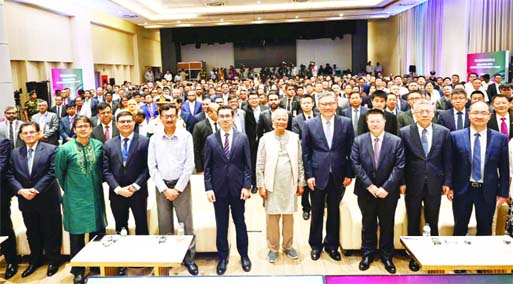
The optimism was reinforced during the China-Bangladesh Conference on Investment and Trade, held at the Bangladesh Investment Development Authority (BIDA) in Dhaka.
Speaking at the event, Chief Adviser to the Interim Government, Professor Muhammad Yunus, urged visiting Chinese investors to make Bangladesh their investment destination and production base, highlighting the potential for transformative economic change.
“I encourage Chinese investors to consider Bangladesh as their home and manufacturing hub. Large-scale investment from China could shift the trajectory of our economy. Our young workforce is ready to rise to the challenge,” he said, addressing more than 250 Chinese business delegates.
The delegation, led by Chinese Commerce Minister Wang Wentao, is on a landmark visit aimed at exploring trade and investment opportunities in Bangladesh – marking a new chapter in bilateral economic engagement.
Professor Yunus placed particular emphasis on reviving Bangladesh’s traditional jute industry, describing it as both an economic opportunity and a cultural legacy.
“Bangladesh is a unique producer of natural fibre. With your cooperation, we can return jute to its rightful place in our economy,” he said. “Chinese interest could reignite global demand for eco-friendly fibres and revitalise our jute sector.”
Jute, once known as the “Golden Fibre”, was Bangladesh’s leading export in the mid-20th century, supplying about 80 per cent of the world’s raw jute. Today, exports generate between $800 million and $1 billion annually, with products ranging from traditional sacks and yarns to geo-textiles and eco-friendly bags.
Professor Yunus welcomed China’s growing interest in the sector, adding that it could lead to enhanced market access and potentially duty-free entry for Bangladeshi jute and agricultural products in the Chinese market.
He also called for renewed investment and innovation in traditional fabrics such as muslin and Jamdani, describing them as heritage assets with global appeal. “Muslin, Jamdani and other indigenous textiles are part of our cultural identity. It is time we revived these industries through modern partnerships,” he stated.
The Chief Adviser acknowledged President Xi Jinping’s positive response to his earlier appeal for greater Chinese investment during a visit to Beijing. “I had urged President Xi to encourage investment in Bangladesh. This business delegation is a strong sign of that commitment,” he said.
Reaffirming the government’s dedication to economic reform, Professor Yunus noted that efforts were underway to reduce bureaucratic hurdles and ensure a transparent, investor-friendly climate.
“We failed to attract adequate foreign investment in the past due to misrule and corruption. The July Uprising led by the youth has turned the page. We are building a new Bangladesh.”
Highlighting recent developments, he pointed to a $100 million investment commitment made by a leading Chinese textile firm during the April Investment Summit. “Our strategic South Asian location and young, skilled workforce make us an ideal destination for export-led growth,” he added.
Chinese Ambassador to Bangladesh, Yao Wen, expressed similar optimism, describing the conference as a key platform for strengthening China-Bangladesh trade ties. “This forum will facilitate cooperation and yield tangible outcomes for both business communities,” he said.
According to BIDA, the event drew representatives from 143 Chinese companies and six Fortune 500 firms, alongside Bangladeshi business leaders.
Key participants included the Hongdou Group and Shandong Weiqiao (textiles), Meide Group (industrial fluid products), Huantai Energy (solar power), and PowerChina and China Road and Bridge Corporation (infrastructure development).Agribusinesses such as Sichuan Xinhe and Laiwu Manhing were also present, reflecting broad interest across sectors.
Delegates from four major Chinese trade chambers-CCCME, CICCPS, CFNA, and CCCT-also attended.
Over 100 B2B and B2G meetings were held, fostering discussions on joint ventures and investment prospects. Several memorandums of understanding are expected in the coming days as part of ongoing negotiations.
A notable outcome of the conference was the signing of an MoU between the Bangladesh Economic Zones Authority (BEZA) and PowerChina International Group Ltd. to develop a Chinese-backed agrivoltaics economic zone in Matlab Uttar, Chandpur.
BIDA described the event as a milestone resulting from sustained government efforts, including the Chief Adviser’s China visit and the April Investment Summit – signalling a new era of collaboration between Bangladesh and China.