
30 years of Trust: Dhaka Bank pursues paperless, people-first banking
As Dhaka Bank PLC marks its 30th founding anniversary today, the bank reflects on three decades of consistent progress and steadfast commitment to Bangladesh’s banking industry. Since its inception, the bank has carved out a distinguished space through innovation, ethical leadership, and a strong customer focus. In an exclusive interview with The New Nation (NN), founding Chairman and also current Chairman of the bank, Abdul Hai Sarker, discusses the journey, present priorities, and future ambitions of this banking enterprise.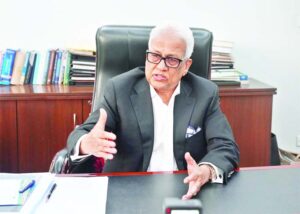
Abdul Hai Sarker, who also serves as Chairman and CEO of Purbani Group – one of the country’s oldest textile conglomerates – and heads the Bangladesh Association of Banks (BAB), shared his insights on the bank’s strategic outlook and sector-wide developments.
Muhid Hasan :
NN: Dhaka Bank is celebrating 30 years of operations. How do you evaluate this milestone?
Abdul Hai Sarker:
The journey began in 1984 when, under the Ershad administration, the government invited applications from the private sector for banking licences. Among the 41 applications submitted, Dhaka Bank was one.
The subsequent BNP government approved seven banks in phases, and Dhaka Bank was among them. In this regard, I would like to express my sincere gratitude to the then Finance Minister, M. Saifur Rahman, and Member of Parliament, Mirza Abbas.
The bank was established with a mission to provide high-quality customer service. We have remained true to that mission under successive governments. Our resilience is rooted in good intentions, ethical leadership, and an unwavering focus on service. Throughout the years, despite political and economic shifts, Dhaka Bank has maintained a strong reputation.
Two of our key strengths are a committed board steeped in business acumen and adherence to sound corporate governance. The board consists of respected entrepreneurs dedicated to the socio-economic development of Bangladesh.
This alignment of values will drive our future growth. As one of the earliest private banks in the country, we take pride in our resilience, innovation, and consistent contributions to national progress.
NN: What are your current priorities?
Abdul Hai Sarker:
Our core priority is ensuring that customers no longer need to visit the bank – rather, the bank will reach them. We’re on a journey towards a fully paperless, digitised banking experience.
Dhaka Bank is focused on providing smart, efficient financial services by leveraging technology. We see ourselves not just as a financial institution but as a trusted advisor to our clients. We aim to move beyond conventional banking and serve customers through tailored digital solutions.
Maintaining a growing customer base and supporting SME and corporate clients are central to our operations. We’ve always championed inclusive banking and played a proactive role in enabling economic empowerment across all segments of society.
NN: Has the recent change in government affected Dhaka Bank in any way?
Abdul Hai Sarker:
Honestly, I feel more at ease now. Previously, there was a lingering concern over some bank’s political labelling, which created certain vulnerabilities. At one point, there were attempts by an industrial group – under political patronage – to take over the bank. Thankfully, those efforts failed.
We have always prioritised professionalism over political affiliations. This commitment to ethical and independent governance has been instrumental in sustaining our stability and credibility.
NN: How do you justify paying dividends while the bank carries a provision shortfall?
Abdul Hai Sarker:
Given the broader context of the financial sector, the central bank has allowed the payment of dividends under certain conditions.
We do have a minor provision shortfall, but it is being addressed and will be resolved in due course. Our intention is to ensure sound financial management while also rewarding our shareholders responsibly.
NN: What measures do you recommend for reducing non-performing loans in the banking sector?
Abdul Hai Sarker:
Much of the sector’s distress can be traced back to imprudent lending, particularly to certain Chattogram-based business groups, often under political influence. The consequences of those decisions are now evident across the sector.
A worrying number of defaulters have the capacity to repay but deliberately choose not to. When banks initiate the recovery process, defaulters often obtain court injunctions to halt proceedings.
This makes it extremely difficult to recover funds. Moreover, some individuals who have fled the country with defaulted loans still manage to retain legal protections, which is deeply problematic.
To curb willful defaulting, authorities must investigate the accumulation of unexplained wealth among the relatives of such individuals.
Additionally, we need more money loan courts (Artho Rin Adalat) and stronger legal mechanisms to resolve the mounting backlog of financial disputes.
NN: What is your view on the central bank’s recent initiative to merge weaker banks?
Abdul Hai Sarker:
The central bank is on the right path. The proposed mergers are an important step in addressing systemic weaknesses. For depositors, trust is paramount-once lost, it is extremely difficult to regain.
While mergers may be structurally necessary, they must be handled carefully.
The assumption that merging will automatically restore confidence or attract deposits is flawed.
Customers make informed choices, especially in a competitive banking landscape. Rebuilding trust in merged entities will require much more than regulatory approval-it will demand transparency, integrity, and excellent service.
NN: What are your future plans for Dhaka Bank?
Abdul Hai Sarker:
Our vision is anchored in stable growth, digital transformation, and customer experience excellence.
In today’s evolving banking landscape, long-term success requires a mix of financial robustness, technological capability, sound risk management, and trust in people-and that’s the path we’re following.
Going forward, Dhaka Bank will focus on high-demand sectors within the economy, especially SMEs and consumer banking. We are actively expanding our reach to underserved and marginalised communities through technology.
This focus will intensify in the coming years as we work to deepen financial inclusion and contribute to broader economic development.
Founded in 1995, Dhaka Bank PLC is a pioneering private commercial bank in Bangladesh, recognised for its customer-centric philosophy and commitment to innovation.
The bank offers a wide spectrum of banking solutions across retail, SME, and corporate segments, and remains committed to serving as a trusted financial partner in the country’s journey towards inclusive growth and prosperity.