
Dhaka awaits US response as tariff talks wrap up
Staff Reporter :
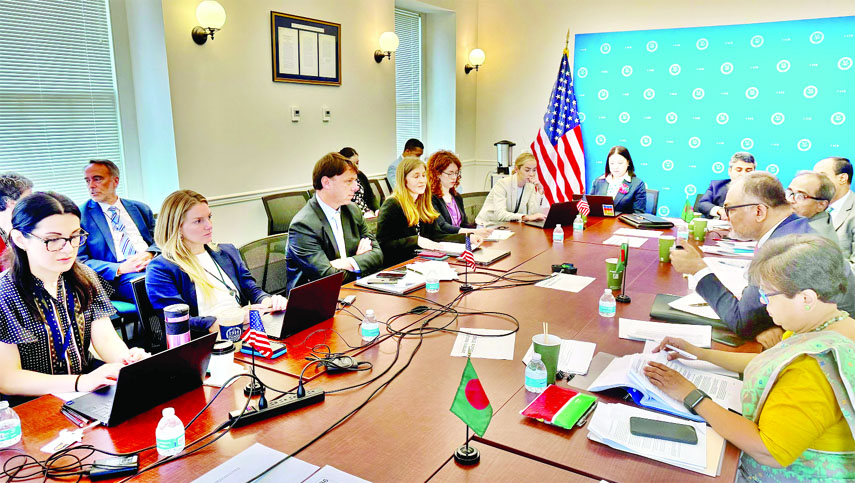
The third and final day of the Bangladesh-U.S. three-day tariff negotiations concluded on today in Washington, DC, with Dhaka expressing optimism about receiving a favorable response from the US side.
As part of the second round of bilateral trade discussions, the meetings covered a comprehensive range of topics, including tariff structures, trade facilitation, non-tariff barriers, and broader economic cooperation. Officials from both sides engaged in detailed exchanges to resolve key issues affecting market access, investment climate, and export competitiveness.
Earlier, the second day of the three-day tariff talks between Bangladesh and the United States concluded on Thursday in Washington DC, with discussions spanning a wide range of bilateral trade and strategic issues.
The meetings are part of the second round of negotiations aimed at addressing trade barriers, tariffs, and enhancing economic cooperation between the two countries.
According to sources, despite two days of extensive discussions, neither side has issued an official statement regarding any tariff reduction or the
conclusion of a formal agreement.
The day featured a key one-on-one meeting between Bangladesh’s Commerce Adviser Sheikh Bashir Uddin and US Trade Representative (USTR) Ambassador Jamieson Greer, a senior figure who served at cabinet level during the Trump administration.
The meeting, held at 11 am local time at Greer’s office, focused on tariff-related matters and broader trade and commerce issues of mutual interest.
Discussions took place in a cordial and constructive atmosphere, with both sides expressing willingness to deepen economic engagement.
Sheikh Bashir Uddin highlighted Bangladesh’s current economic outlook and reiterated Dhaka’s commitment to not only expanding exports to the U.S. but also to increasing imports – a shift that has already begun. He emphasized Bangladesh’s expectation for equitable and competitive treatment in tariff policies.
Ambassador Greer assured comprehensive cooperation from the U.S. side and acknowledged the significance of continued bilateral collaboration.
Led by Commerce Adviser Bashir Uddin, the Bangladeshi delegation included high-level officials such as National Security Adviser Dr. Khalilur Rahman and the Chief Adviser’s Special Assistant on ICT and Telecommunications, Faiz Ahmed Tayeb – both of whom joined virtually from Dhaka.
Commerce Secretary Mahbubur Rahman and Additional Secretary Dr. Nazneen Kauser Chowdhury were present in person, along with other senior officials. US participants included representatives from USTR, departments dealing with agriculture, labor affairs, environment and natural resources, treasury, investment, and intellectual property.
Meanwhile, the business community in Bangladesh is anxiously waiting for a resolution that would prevent long-term damage to Bangladesh’s export competitiveness in the US market.
The tariff discussions come at a time of heightened global trade tensions. On the same day, U.S. President Donald Trump announced a 35 per cent tariff on Canadian imports starting August 1 – up from the current 25 per cent – and signaled his intention to impose blanket tariffs of 15 per cent to 20 per cent on most trading partners.
Although goods under the USMCA are expected to remain exempt, the announcement has sent shockwaves across global markets, potentially affecting trade negotiations worldwide.
In his letter to Canadian Prime Minister Mark Carney, Trump cited concerns over fentanyl trafficking and trade imbalances, warning that tariffs may be adjusted depending on bilateral relations. Trump has recently extended similar tariff measures to countries like Japan and South Korea, escalating concerns over a widening trade war.
While Bangladesh was not directly mentioned, the developments raise questions about how smaller economies can navigate U.S. trade policies amid global shifts. Analysts suggest that Dhaka’s approach of proactive engagement, strategic import-export balancing, and emphasis on fair treatment in tariff structures could help mitigate potential shocks.
As the final day of the Bangladesh-US tariff talks approaches, observers are watching closely to see whether the two countries can translate dialogue into concrete outcomes, particularly in an increasingly protectionist global trade environment.