
Dev spending slumps to 67.85pc in FY25
Muhammad Ayub ALi :
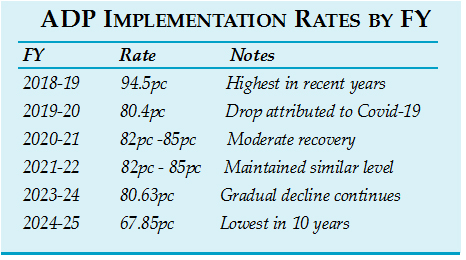
In a concerning development for Bangladesh’s economic trajectory, the implementation rate of the Annual Development Programme (ADP) for the fiscal year 2024-25 has declined to 67.85 per cent – the lowest level recorded in the past decade.
Data released by the Implementation Monitoring and Evaluation Division (IMED) show that only Tk1.53 lakh crore was spent from the revised ADP allocation of Tk2.26 lakh crore during the fiscal year. This marks a sharp drop from the 80.63 per cent implementation rate in FY2023-24, when Tk2.05 lakh crore was utilised.
Officials at IMED have linked the slowdown to a combination of political instability and macroeconomic challenges, which have collectively impeded the timely execution of development projects across several ministries. The situation has also been exacerbated by delays in fund disbursement and persistent bureaucratic inefficiencies.
A review of ADP performance over the past five fiscal years reveals a downward trend. The implementation rate stood at 94.5 per cent in FY2018-19, dropped to 80.4 per cent in FY2019-20 due to the Covid-19 pandemic, and remained between 82 and 85 per cent in FY2020-21 and FY2021-22. The further decline in FY2024-25 points to mounting structural constraints in the public investment management system.
Commenting on the issue, Dr Zahid Hussain, former lead economist at the World Bank’s Dhaka office, noted that the initial months of the current government have been particularly difficult for advancing development priorities, owing to heightened political unrest and economic pressures.
While many projects are still underway, Dr Hussain observed that several are facing scrutiny over their relevance and implementation effectiveness. Additionally, a notable shortfall in revenue collection has created significant fiscal constraints, hampering the timely execution of development initiatives.
To improve future outcomes, Dr Hussain emphasised the importance of comprehensive reforms. These include robust feasibility assessments before project approval by the Executive Committee of the National Economic Council (ECNEC), greater transparency throughout the project lifecycle, and stringent oversight of data collection practices. He also underlined the need to evaluate project outcomes post-completion to ensure sustained impact and improved accountability.
The sharp decline in ADP implementation highlights the urgency for institutional strengthening and strategic reforms to enhance public sector delivery and support Bangladesh’s long-term development goals.