
Dengue deaths hit record high
Abu Jakir :
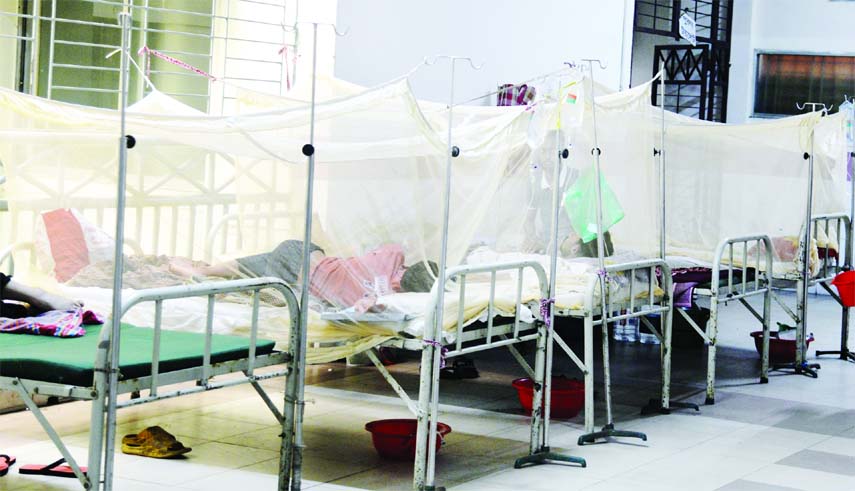
Bangladesh on Sunday recorded the highest number of dengue deaths in a single day this year, with 12 fatalities reported in the past 24 hours, underscoring the worsening public health emergency as the mosquito-borne disease continues to spread far beyond the capital.
According to the Directorate General of Health Services (DGHS), the latest toll pushed this year’s total deaths from dengue to 179, while the cumulative number of confirmed cases climbed to 41,831.
In the past 24 hours alone, 740 patients were admitted to hospitals nationwide, including 444 men and 296 women. During the same period, 683 patients were discharged after treatment.
The surge in deaths was particularly acute in Barishal Division, where five patients died within a single day—three at Sher-e-Bangla
Medical College Hospital and two in Barguna.
The remaining seven deaths occurred in hospitals under Dhaka North and South city corporations, as well as in Chattogram and Mymensingh.
Victims included both children and elderly patients, highlighting the disease’s indiscriminate toll.
Public health experts warned that the situation has become “alarming.” Dr. Mushtaq Hossain, a former chief scientific officer of the Institute of Epidemiology, Disease Control and Research (IEDCR), told that the outbreak has now reached a critical stage.
“The indications are clear that infections may rise further. The tragedy is that no new initiatives have been introduced so far—everything is running along the same outdated track,” he said.
Although dengue traditionally peaks in July and August, experts noted that this year’s trend has extended unusually into September.
Until now, the previous highest daily toll in 2025 had been six deaths, recorded on September 11.
Data from the DGHS show that the largest group of patients falls within the 21–30 age bracket.
The disease, once largely confined to Dhaka when it re-emerged in 2000, has now entrenched itself across the country.
Strikingly, more than 30,000 of this year’s infections were reported outside Dhaka, while only around 11,000 were within the capital.
This shift reflects both the nationwide spread of Aedes mosquitoes and the uneven preparedness of health systems.
While Dhaka’s two city corporations have carried out limited mosquito control drives, such initiatives are either weak or absent in most municipalities across the country.
Moreover, the lack of structured treatment facilities outside major cities has heightened risks.
The DGHS recently disclosed that nearly half of all dengue deaths this year occurred within 24 hours of hospital admission—an indicator that many patients are reaching medical care at a dangerously late stage.
“This tells us that community awareness, early diagnosis, and accessible treatment remain major gaps in our dengue response,” a senior DGHS official told The New Nation.
Health professionals have also pointed to systemic failures in municipal governance and public health planning.
Reports in several newspapers this week highlighted severe shortages of testing kits, delayed fumigation drives, and inadequate training of rural medical staff.
Civil society groups have urged the government to declare dengue a “national health emergency,” calling for a unified strategy that extends beyond Dhaka and targets rural districts now bearing the brunt of the epidemic.
With hospitals in Barishal, Chattogram, Mymensingh, and Khulna struggling to cope with patient surges, the DGHS has instructed medical college hospitals to open special dengue wards.
Yet health workers warn that bed shortages, insufficient intravenous fluid supplies, and inadequate monitoring equipment are already hampering care.
As the country braces for further rains in late September, the crisis threatens to intensify.
Unless comprehensive measures—ranging from aggressive mosquito control to rapid treatment access—are rolled out nationwide, experts fear the country may be heading toward one of its deadliest dengue seasons in recent memory.