
Dengue claims 6 lives in 24 hrs
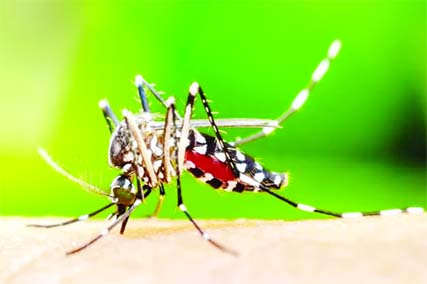
Staff Reporter :
The mosquito-borne disease dengue fever continues to take a heavy toll in Bangladesh this year.
According to the Directorate General of Health Services (DGHS), six more people were died of dengue in the 24 hours between Sunday 8 a.m. and Monday 8 a.m, bringing the total fatalities for the year thus far to 269.
During that same 24-hour period, 983 new dengue patients were admitted across the country.
The DGHS breakdown shows that of those 983, 227 were admitted in the DNCC area, 133 in the DSCC area, and a further 141, 111, 171, 62 and 41 in specified areas outside other city-corporations or divisions.
At the same time, 970 dengue patients were discharged during the period; this year so far a total of 63,414 patients have recovered and been released from hospital.
City people expressed anxiety over the long term sufferings from mosquito born diseases like dengue and chikunguniya despite spending huge public money through budgeting the two city corporations of Dhaka.
Public health experts also worried over continuity of fatalities from dengue.
When contacted former Adviser of World Health Organisation (WHO), Professor Dr. M. Muzaherul Huq told The New Nation, “Lack of coordinated efforts are mostly responsible for the spreading of dengue.
As the Aedes mosquitoes are now spread across the country, the fatalities turned worse situation.”
The expert urged the people to be more aware of keeping surrounding clean and clear.
Contacted, Eminent public health expert Dr. Lenin Chowdhury told The New Nation, “Intermitted rain is responsible for keeping the dengue fatalities on rise.”
He also focused on coordinated efforts from all stakeholders including government agencies, non-government organisations and the common people to erase the mosquitoe born diseases.
The public health experts also suggested early diagnose for recovering the patients.
Many of the city dwellers shared their opinions saying the fatalities figures reveal as a disturbing trend.
They said despite substantial public investment, dengue continues to spread actively and cause serious illness and death.
In the capital city area, the two city corporations – Dhaka North City Corporation (DNCC) and Dhaka South City Corporation (DSCC) – have allocated sizeable budgets for mosquito control, but results so far remain inadequate.
In the case of, the DNCC 2025-26 approved budget sets the total at Tk 6,069 crore, with the mosquito-control allocation alone at Tk 187.75 crore (approximately 3 % of the total budget).
The allocation marks a significant increase compared with previous years. For example, in the 2023-24 fiscal year, DNCC allocated around Tk 122.84 crore for mosquito control – a rise of 64 % compared to the previous fiscal year. However, despite these increased allocations.
the dengue and mosquito-borne disease burdens continue unabated. Experts have pointed out that oversized reliance on chemical insecticides, weak monitoring of their effectiveness and under-investment in community participation have undermined impact.
Indeed, research by the International Centre for Diarrhoeal Disease Research, Bangladesh (icddr,b) found that adulticides used by the city corporations are becoming ineffective as mosquitoes develop resistance to permethrin and other active ingredients.
For DSCC, the 2023-24 budgets was announced at Tk 6,751.56 crore, of which Tk 46.75 crore (about 0.69 pc) was earmarked for mosquito-control activities.
Within that allocation, Tk 38.50 crore was set for purchasing mosquito medicines/insecticides, Tk 3.75 crore for foggers, wheel machines and transport, and about Tk 4.5 crore for new mosquito-control equipment; additionally, around Tk 30 crore was earmarked for cleaning canals, water bodies and sewers as part of the broader vector-control effort. Yet despite these efforts the mosquito menace remains.
A recent survey showed many wards in both city corporations remain at high risk: for example, 40 wards in DNCC and 57 in DSCC were flagged as high-risk for dengue due to high prevalence of Aedes breeding.
The weak performance of both corporations can be attributed to several factors:
Outdated methods and insecticide resistance: As noted, adulticide resistance has been documented. Without a shift to more modern, integrated vector-management (IVM) approaches – such as larval source reduction, biological controls, community engagement, environmental sanitation – chemical spraying alone will not suffice.
Overemphasis on chemical control rather than source elimination: The budgets show large shares directed toward insecticides and foggers, with proportionally smaller investment in cleaning breeding grounds, drainage clearance, public awareness and mobilisation of local communities to remove stagnant water.
Weak community participation and limited ward-level awareness programmes: Experts have observed that the city corporations’ awareness activities are limited, mostly to ad-hoc raids and fines, rather than sustained behaviour-change campaigns that enlist residents to remove breeding sites in homes, rooftops, containers, drains.
Lack of coordination and monitoring: Surveys undertaken by the DGHS, icddr,b and others show large numbers of wards still are high risk; the corporations’ own monitoring systems appear weak.
For example, drones introduced by DNCC to identify breeding grounds represent a positive step, but effective follow-up action remains uneven.
Budget versus effective spending gap: Even when allocations are large, the actual outcome remains sub-optimal. One headline noted that in the past nine years the two corporations spent around Tk 707 crore (approx. Tk 464 crore by DNCC, Tk 243 crore by DSCC) on pesticides, weed-clearing and equipment, yet dengue continues to ravage the city.
In summary: the rising death toll from dengue and the heavy burden of hospitalisations underscore an urgent public-health crisis in Bangladesh.
While DNCC and DSCC have allocated visibly greater resources for mosquito control, the return on investment has thus far been limited.
The evidence suggests that large spend on insecticides and equipment – without matching investment in integrated vector-management, community engagement, environmental sanitation, reliable monitoring and resistance management – is insufficient.
If Bangladesh is to stem the tide of dengue, the city corporations must shift from reactive spray-driven approaches toward year-round, evidence-based, community-centred programmes that tackle Aedes breeding at its root.