
Demand for Cumilla Division: Declaration and Implementation
Dr. Forqan Uddin Ahmed :
The background of the demand and call for the declaration of Cumilla Division has developed over a long time due to regional, administrative, economic, and cultural reasons.
Cumilla is geographically, demographically, and historically an important area of Bangladesh. It is known as a center for trade, agriculture, and industry in East Bengal.
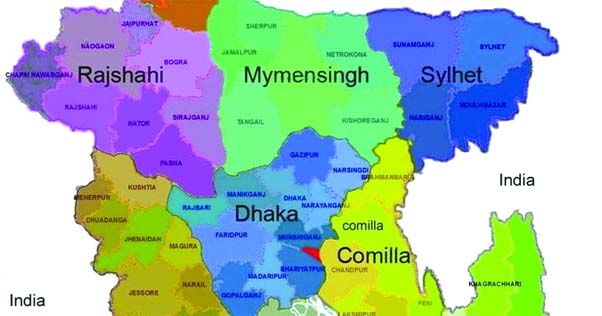
For a long time, being under the Chattogram Division, Cumilla and its surrounding districts have been in a marginal position in terms of administration and development activities, for which the local people have had to travel long distances to receive government services.
This gap and suffering gave rise to the demand for a separate division among the local population.
Alongside increasing administrative efficiency, the demand for declaring Cumilla Division has grown stronger for regional recognition and the welfare-based development of the people.
Locals believe that if there is an independent administrative structure, services related to education, healthcare, roads, agriculture, industry, and commerce will reach them more quickly and effectively.
Particularly, the people of Cumilla and neighboring districts feel that if government offices, divisional commissioner’s office, education board, and other important departments are established in their own area, citizens’ wastage of time and money will decrease, and local problems can be solved more quickly.
The historical basis of Cumilla Division can also be presented as a strong argument. It was in Cumilla that the then Chinese traveler Xuanzang (Hiuen Tsang) came.
Even during the British period, all administrative activities of the Tripura State were conducted from Cumilla as its capital. In addition, Cumilla’s BARD (Bangladesh Academy for Rural Development) is renowned as the cradle of national development.
In fact, Cumilla has long carried special importance in social, cultural, economic, and historical terms. On one hand, this region is a lifeline of eastern Bangladesh; on the other, it is also prosperous in business, education, healthcare, and agriculture.
Yet for a long time, being under Chattogram Division, Cumilla has been deprived like a marginal region. For administrative work, public services, or development activities, people had to travel far to Chattogram or Dhaka, wasting time, money, and effort.
In such circumstances, declaring Cumilla as a new division has become important not only administratively but also from the perspectives of public interest and regional equity.
The population density in Cumilla and surrounding districts is high, making a separate administrative structure essential to fulfill people’s basic needs.
With a new division, work in health, education, law and order, land services, and development projects will become much more dynamic and accessible.
People will no longer have to suffer from the complications of central administration. Moreover, Cumilla is also recognized as a historic and cultural capital.
Just as Begum Rokeya, Nazrul, Lalon, or Baul traditions symbolize cultural heritage, Cumilla too has its unique cultural identity—Roshmalai, Mainamati archaeology, and folk culture are matters of national pride.
Recognition as a separate division will give this cultural heritage more dignity and open the doors of potential in the tourism industry.
At the same time, the local economy will grow further, investment in industries will increase, and employment opportunities will be created.
Therefore, the justification of Cumilla Division is not confined only to administrative decentralization.
It is essentially an indispensable demand for easing public service, eliminating regional disparities, affirming cultural identity, and accelerating overall development.
Currently, as Cumilla and surrounding districts are under Chattogram Division, citizens face problems of distance and time in accessing government services.
With the establishment of a new division, healthcare, education, land, law and order, agriculture, and social services will directly reach the local level.
This will reduce citizens’ wastage of time and money and make the process of receiving services simpler and faster. Secondly, government institutions and departments will expand locally.
The divisional headquarters, deputy commissioner’s office, education board, healthcare centers, and other government offices will be concentrated in Cumilla and related areas.
As a result, ordinary people will no longer need to travel far to Dhaka or Chattogram. The transparency and monitoring of service delivery will become more effective.
We can say that the declaration is today’s demand, a demand that existed even in the 1960s when Bangladesh was beginning various struggles and movements for independence across the country.
At that time, the people of Cumilla and its surrounding regions had this demand. Keeping that in mind, the people of Cumilla and nearby areas played an active role in various movements and struggles.
For instance, during the language movement, Dinendra Nath from Cumilla was the first to deliver a protest speech at the Parliament House.
Moreover, in student movements and uprisings, the people of this area played significant roles. Even during the anti-British movements such as the Non-Cooperation Movement, the spontaneous participation of Cumilla residents was evident.
Most recently, in the July 2024 Mass Uprising, the politically conscious people of Cumilla, along with farmers and workers, played an immense role.
Their names were widely known among the masses during leadership and struggles.
At present, even in the post-uprising government, capable people from Cumilla are serving in various ministries, departments, and directorates, giving multifaceted contributions.
Therefore, we do not expect that this government will disregard or neglect the declaration and implementation of Cumilla Division. If excuses such as budget or infrastructure are used to undervalue the demands of the people of Cumilla, it will be an injustice and an insult to them.
Hence, our appeal to the post-uprising government is that they urgently consider this heartfelt demand of the people of Cumilla and declare the division and implement it as soon as possible, thereby demonstrating sincerity in the interest of the state and government.
We are hopefully waiting for fulfilling the expectations of the people of Cumilla and their today’s demand.
(The author is a former Deputy Director General, Bangladesh Ansar and VDP, Rotary Learning Facilitator, Rotary Club, Dhaka Elite)