
Delayed ballot, divided nation
Abu Jakir :
Bangladesh’s political future hangs in the balance as the country’s interim government, led by Nobel laureate Professor Dr Muhammad Yunus, nears nine months in office with no definitive date announced for national elections.
The interim administration, established following a mass uprising that led to the ousting of the long-standing Awami League government last year, is facing mounting pressure from opposition parties and growing public concern over the nation’s democratic trajectory.
The Bangladesh Nationalist Party (BNP), the country’s largest opposition group, has reiterated its demand for elections to be held no later than December.
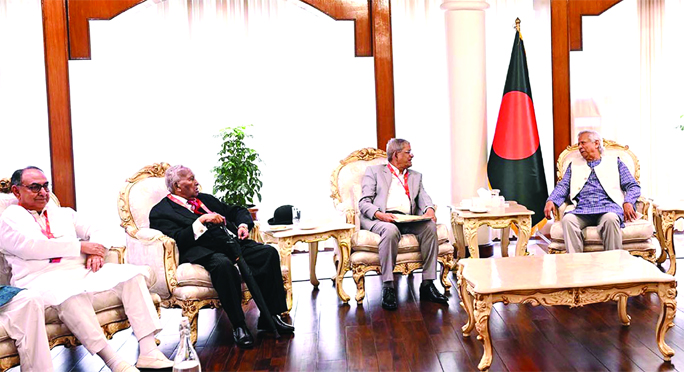
“We are not at all satisfied with our discussion with the Chief Advisor,” said BNP Secretary General Mirza Fakhrul Islam Alamgir, following a high-level meeting with Dr Yunus at the state guesthouse, Jamuna, on Wednesday.
“We made it clear – if elections are not held by December, the political, economic, and social fabric of the country will only worsen,” he added. Mirza Fakhrul, who led a seven-member BNP delegation, stressed the party’s demand for a definitive electoral roadmap, warning against further delays. “The only path to stability is through a credible, inclusive election.”
While the BNP supports structural reforms, it has accused the interim government of using reform efforts as a pretext to stall the electoral process.
Jamaat-e-Islami has also expressed its position on the timing of the elections. The party has made it clear that it does not support the government’s proposal to hold elections as late as June 2026. Instead, Jamaat wants the election to take place before the upcoming Ramadan, which is expected to begin in late February.
Speaking to reporters on Wednesday, Jamaat Ameer Dr. Shafiqur Rahman outlined the party’s stance following a meeting with a U.S. delegation in Gulshan earlier in the day.
“The U.S. delegation asked us when we believe the election should be held,” said Dr. Rahman. “We told them that the interim government’s Chief Advisor has suggested elections might take place either in December this year or June next year. Our view is that elections should be completed before Ramadan.
Waiting until June risks overlapping with the monsoon season, storms, and other natural disasters, which could create uncertainty surrounding the election.”
Dr. Rahman emphasised, “That uncertainty is exactly why we believe the election should be held before Ramadan. That is our position.”
The political deadlock has also begun to fracture the alliance of civic and political groups that had once united to overthrow the Awami League administration during the protests of July and August last year. The National Citizens’ Party (NCP), formed by student leaders who played a pivotal role in the uprisings, is calling for elections to a Constituent Assembly and a clear reform roadmap before parliamentary polls are held.
Tensions escalated over the weekend during a “March for Yunus” demonstration in Narayanganj, where a coalition of youth activists demanded the extension of the interim government’s tenure to three years to allow time for institutional reforms. Placards at the rally read: “Reforms First, Election Later.” Several participants had reportedly been injured in the 2023 protests.
Adding fuel to the political fire were controversial statements by two government advisors. Farida Akhter, Advisor for Fisheries and Livestock, rejected claims that the interim government lacked legitimacy. “Who said we’re unelected? It’s the students and the people who formed this state.
We were chosen by them to deliver on their demands,” she stated in a recent speech in Mirpur.
Meanwhile, Home Affairs Advisor Lt. Gen. (Retd.) Md Jahangir Alam Chowdhury claimed that many citizens had urged the interim government to remain in office for up to five years.
“People on the streets are telling me: ‘You should stay longer,'” he said, later clarifying the remark to reporters at the Secretariat.
These comments have triggered speculation that the interim administration may be positioning itself for a prolonged stay, fuelling online debate and public uncertainty. While the NCP continues to advocate for elections following reforms, several of its top leaders have openly expressed support for extending Dr Yunus’s tenure as Prime Minister for another three to five years.
Sarwar Tushar, the party’s joint convenor, downplayed such remarks, saying, “These are personal opinions, not party policy. We believe reforms must precede elections – but within a reasonable timeframe.”
Left-leaning political forces, including the Revolutionary Workers Party and the Revolutionary Communist League, have firmly opposed any delay beyond December. Saiful Haque, General Secretary of the Revolutionary Workers Party, stated, “There’s no room to push the elections past December. Any further delay risks undermining the public’s trust.”
The confusion was further compounded by a press release from the Chief Advisor’s office, which initially stated that elections were expected in December. The statement was later revised, offering a broader timeline of “December to June,” raising further concerns over the government’s intentions.
“This inconsistency has created public doubt,” said Haque. “We urge the Chief Advisor to make the roadmap clear.” Iqbal Kabir Zahid of the Left Democratic Alliance echoed the warning: “If there’s any conspiracy to delay the vote, the people will rise and resist. The Chief Advisor must keep his word.”
As political divisions widen and deadlines loom, the central question remains: Will the interim government deliver a timely and credible transition to democracy – or will growing dissent and indecision derail a fragile national consensus?