
Rohingya crisis: Decisive action inside Myanmar necessary: UNHCR
Staff Reporter :
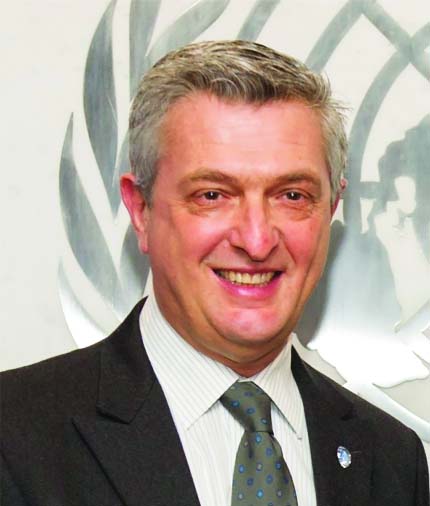
UN High Commissioner for Refugees Filippo Grandi warned that the plight of the Rohingya will not end without decisive action inside Myanmar, stressing that the roots of the crisis and its solution lie there.
“This crisis originates in Myanmar. And that, Madam President, is where the solution lies,” he said at the UN General Assembly High-Level Conference on Rohingya Muslims and Other Minorities in Myanmar in New York on Tuesday.
Grandi recalled how eight years ago, brutal military violence forced 750,000 Rohingyas to flee to Bangladesh, while many others were displaced within Rakhine State.
But even with the Arakan Army now controlling most of the state, he said, their conditions “have not improved.”
Rohingyas, he noted, still face arbitrary arrest, restrictions on movement, denial of healthcare and education, forced labour, and forced recruitment. “Their lives are defined every day by racism and fear,” he said.
The UNHCR chief expressed deep gratitude to Bangladesh, which is hosting nearly 1.2 million Rohingya refugees, including 150,000 who arrived since renewed fighting in 2024.
“Despite enormous challenges Bangladesh continues to host them, showing that compassion is still possible at a time when indifference is fast becoming the norm,” he said.
Grandi acknowledged support of more than $1.25 billion from the World Bank and Asian Development Bank but underlined that the humanitarian response in Bangladesh remains “chronically underfunded.”
Without additional resources, he warned, aid agencies will be forced to cut life-saving assistance, pushing children into malnutrition and driving more refugees to risk dangerous sea crossings.
He urged countries to step up with funding, resettlement opportunities, education, and labour pathways but cautioned that aid alone cannot resolve the crisis.
“We cannot keep going down the path of inertia while an entire population continues to waste away,” he said, calling the recommendations of the Rakhine Advisory Commission “as relevant as ever” for ensuring safe and voluntary return.
Grandi pressed governments with influence to intensify engagement with Myanmar’s authorities and the Arakan Army to restore humanitarian access and build confidence toward durable solutions.
Drawing on lessons from other conflicts, he argued that sustained political engagement and innovation can shift even entrenched crises.
He closed with a call for principled yet pragmatic action: “If we want to chart a new course for the people of Myanmar, one that is forward-looking and lasting, we have no other choice.”
“UNHCR stands ready,” he added, pledging to work with states, regional bodies, civil society, and refugee-led groups to mobilize resources and strengthen protection and resilience for all displaced people from Myanmar.