
DCCI seeks master plan to boost Bangladesh’s logistics sector
Staff Reporter:
Dhaka Chamber of Commerce and Industry (DCCI) President Taskeen Ahmed has said Bangladesh must adopt a long-term, integrated master plan for its logistics sector to remain globally competitive and improve trade efficiency.
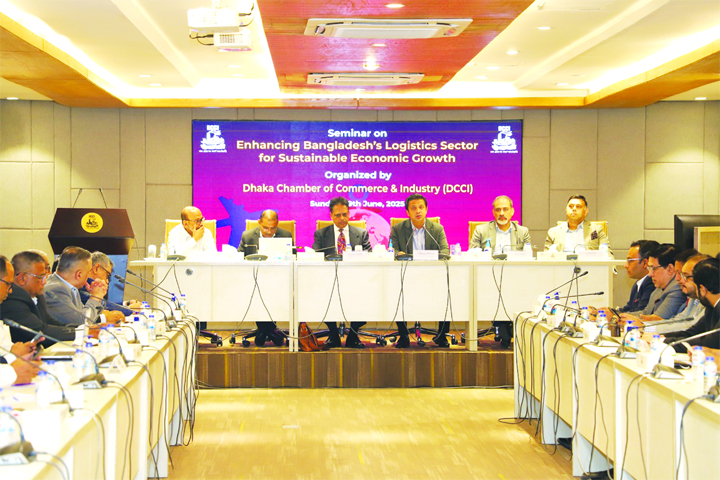
Speaking at a seminar titled “Enhancing Bangladesh’s Logistic Sector for Sustainable Economic Growth” on June 29, 2025, the DCCI president emphasized that logistics costs currently amount to 15-20percent of GDP-far exceeding the global average of 8-10 percent-due to chronic port congestion, customs delays, and inadequate infrastructure.
Bangladesh ranks 88th out of 139 countries in the Logistics Performance Index 2023, reflecting these inefficiencies.
Ahmed stressed the strategic importance of Chattogram and Mongla ports, which manage 92percent of the country’s trade and contribute nearly 30percent of GDP.
He called for modernizing port infrastructure through container scanners, AI-based traffic management, off-dock automation, and flexible port charges.
He also advocated for digital platforms to connect shippers and transporters, along with widespread deployment of warehouse management systems, cold-chain logistics, and robotics. Integration of platforms like ASYCUDA and the National Single Window was recommended to reduce bureaucracy and corruption while facilitating faster cross-border movement.
Dr. M. Masrur Reaz, chairman of Policy Exchange of Bangladesh, underscored the limitations of relying on readymade garments (RMG) for 82percent of export earnings.
He highlighted Bangladesh’s weak standings in global competitiveness, innovation, and skills indices compared to regional rivals such as India, Vietnam, and Cambodia. Reaz pointed out that reducing logistics costs by just 25percent could boost exports by 20percent.
He urged immediate action on a sub-sector-specific development roadmap aligned with the still-pending National Logistics Policy and proposed shared bonded warehouse facilities for SMEs to improve export capacity.
Dr. Sheik Moinuddin from the Ministry of Road Transport and Bridges called for a multimodal transportation network encompassing road, rail, river, air, sea, and digital infrastructure to enhance trade competitiveness in the post-LDC era.
He criticized the lack of a long-term, unified logistics strategy and stressed inclusive policymaking with stakeholder engagement. The government, he said, is planning a 25-50-year integrated transport system and seeks greater private sector involvement.
Md. Salim Ullah, chairman of BIWTC, revealed that BIWTA is preparing a dedicated master plan for inland water transport logistics, while a committee has been formed to review the current logistics policy.
Abul Kasem Khan, chairperson of BUILD, stated that progress in logistics is stagnant, noting the sector needs $20 billion in annual investment-8-10percent of GDP-to meet development targets. He proposed creating a separate ministry and declaring 2026-2035 as the “Logistics Decade.”
Md. Habibur Rahman from the Chittagong Port Authority projected port capacity reaching 10 million TEUs by 2030 but warned of underutilization unless trade volume grows.
He emphasized rail as a cost-effective transport solution and suggested a truck-only expressway from Chattogram port to Sitakunda.