Culture Reflects the Soul of Our Lives: Quader Gani Chowdhury
Staff Reporter
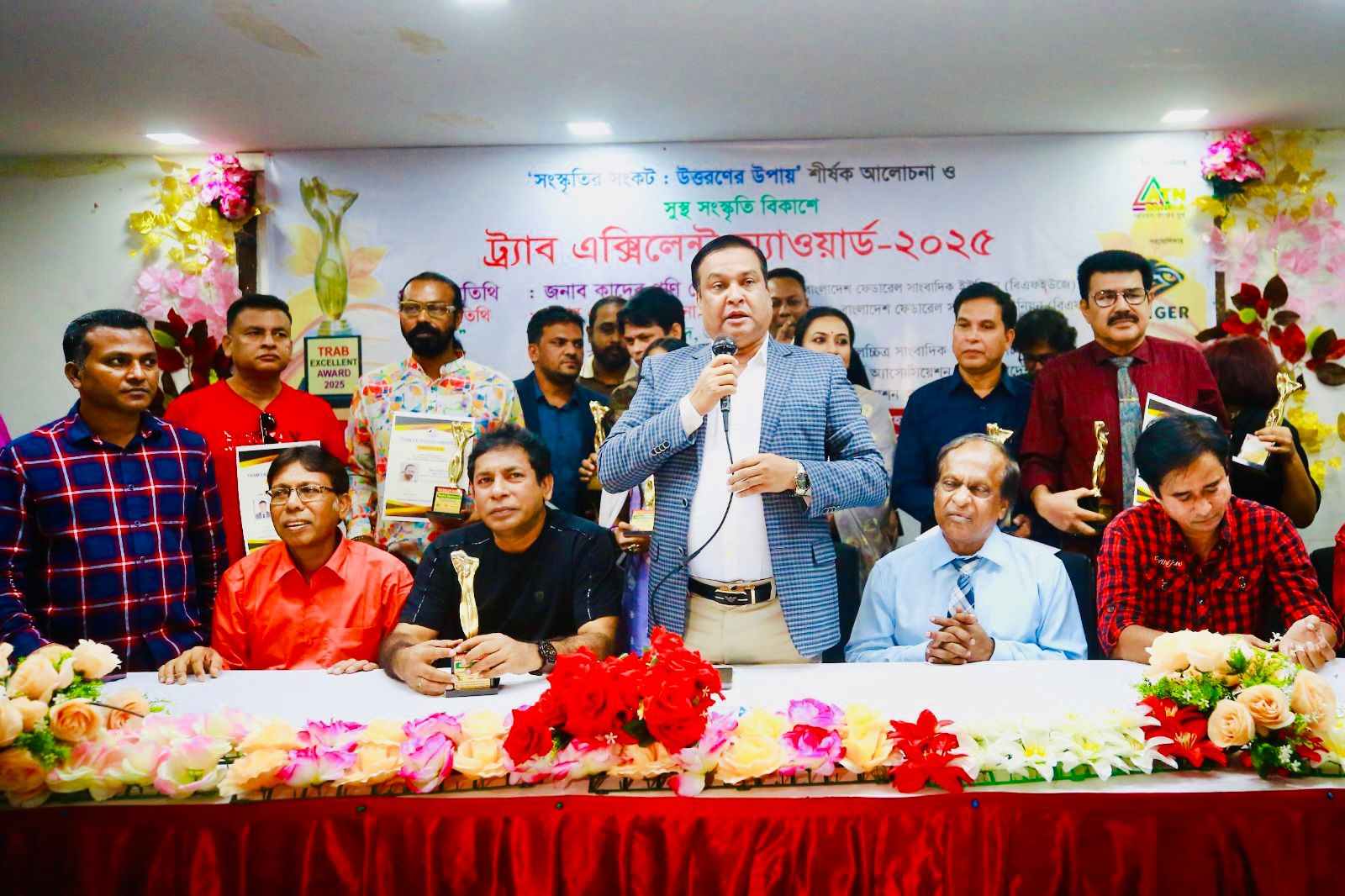
Bangladesh Federal Union of Journalists (BFUJ) Secretary General Quader Gani Chowdhury has said that culture is the lifeline of a society, one that gives meaning to human life and helps establish discipline within communities.
“Culture shapes an individual into a complete human being and makes them truly social. The degree of civilization or advancement of a nation can be measured by its culture. Most importantly, culture carries the essence of a civilization,” he remarked.
He was addressing a discussion titled “Cultural Crisis: Ways of Overcoming” and the TRAB Excellent Award 2025 ceremony, organized by the Television Reporters Association of Bangladesh (TRAB) at the National Press Club on Saturday evening.
TRAB President Kader Monsur chaired the program, where speakers included BFUJ Organizing Secretary Erfanul Haque Nahid, filmmaker and playwright Chotku Ahmed, ATN Bangla Adviser Tashiq Ahmad, BACHSAS President Kamrul Hasan Darpan, TRAB General Secretary Suhrid Jahangir, actor Mosharraf Hossain, actress Farzana Chobi, and singers Nadia Dora, Sumon, and Sharmin Ahmed Minni, among others.
Quader Gani Chowdhury said Bangladesh boasts a glorious cultural heritage, rooted in thousands of years of tradition. “The culture of Bengal is our true identity. In this land live Muslims, Hindus, Buddhists, Christians, and many other groups. Each celebrates their festivals and rituals freely, while others join in the joy. This spirit has united our nation in the language movement and in the liberation war of 1971,” he added.
Citing examples from folk traditions, he recalled how Baul, Bhawaiya, Bhatiali, Jari, and Pala Gaan once flourished in every corner of the country. “But today, our folk and spiritual songs are disappearing, replaced by foreign heavy-metal music that has no roots in our soil. Instead of the soulful artistry of Abbasuddin, Abdul Alim, Lalon Fakir, or Shah Abdul Karim, loudspeakers blare imported tunes at every event,” he lamented.
Chowdhury criticized the influence of politics and commercialization on culture, saying: “Culture helped us win independence through non-communal spirit, but now destructive politics and religious extremism are tearing apart that harmony. Attacks on shrines and temples, restrictions on Pahela Baishakh, and even corporate capture of our folk festivals are signs of this crisis.”
He added that many traditional practices like village fairs, Jatra, puppet shows, and folk debates have faded. “Our culture has slowly slipped into the hands of the powerful. What remains is just formality, without soul,” he observed.
The journalist leader further expressed concern that today’s younger generation has moved away from libraries, literature, and music. “Our children no longer read Tagore and Nazrul or listen to meaningful songs. They only chase professional degrees. Nobody dreams of becoming an artist or joining cultural organizations. Yet, culture is essential to make life truly beautiful,” he said.
Emphasizing the transformative power of music, Chowdhury concluded: “Songs can illuminate the darkest corners of the mind, heal depression, and bring joy. Without culture, life becomes mechanical. To live beautifully, we must bring culture back into the center of our lives.