‘Consider women as stakeholders in energy sector’

City Desk :
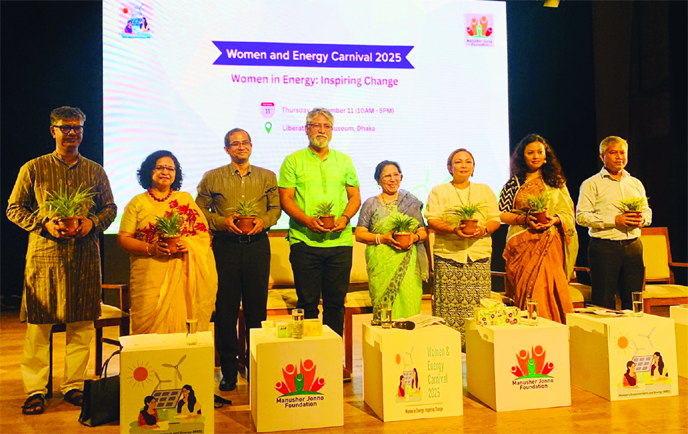
The Women and Energy Carnival 2025, organised by Manusher Jonno Foundation (MJF) under its Women’s Empowerment and Energy (WEE) Project, brought together policy influencers, innovators, development partners, youth leaders, and grassroots women to celebrate and recognise women’s leadership in Bangladesh’s renewable energy sector, reports UNB.
The daylong programme was held in the Liberation War Museum in Agargaon, Dhaka featured exhibitions, cultural performances, storytelling sessions, and policy dialogues on how to make Bangladesh’s renewable energy transition more inclusive, sustainable and gender-responsive.
Delivering the keynote presentation, Banasree Mitra Neogi, Director – Rights and Governance Programmes, MJF said, “It is very important to see whether everyone’s participation in inclusive energy is being ensured.” Equitable fairness is required.
Mentioning the hilly areas as example, she said not all areas of the country have access to electricity.
Due to the lack of renewable energy in women’s work, a lot of time is wasted. So it is high time to adopt the renewable energy, she added.
Shaheen Anam, executive director of MJF, who chaired the opening session, said the Women and Energy Carnival reflects their commitment to amplifying women’s voices and ensuring they are central to Bangladesh’s sustainable and green transition.
“Gradually all the conventional fossil fuel-based energy sources will be finished. I can’t see other alternative source of electricity other than the renewable energy,” she said, reports UNB.
She emphasised and congratulated on recognition of unpaid care work of women.
Speaking as the Special Guest, Nayoka Martinez-Bäckström, First Secretary (Environment & Climate Change) and Deputy Head of Development Cooperation, Embassy of Sweden in Bangladesh, highlighted the importance of ensuring women’s equal participation in policy and decision-making around climate and energy.
She emphasised on advocating for sustainable energy solutions. Because of technological advancement, now is the time for us to think sincerely about renewable energy. she added.
Md. Mahbubur Rahman, deputy secretary of Sustainable and Renewable Energy Development Authority (SREDA) said, “If we talk about climate, women have a significant role there. In areas like green finance, women’s role is often greater than men.”
He emphasised on considering women’s participation as stakeholders.
Dr. Khondaker Golam Moazzem, research director of the Centre for Policy Dialogue (CPD), said, “Currently, electricity is produced in one place and distributed elsewhere – this is called centralized production. But in the future, this will change, as electricity will be generated in many different locations. Women’s role in maintenance will be undeniable.
He emphasised the urgent need to integrate gender perspectives in the renewable energy policy framework to achieve a JUST transition.
Sharif Jamil, member secretary of Dhoritri Rokhhay Amra (DHORA) and coordinator of Waterkeepers Bangladesh, said, movements should not be viewed only in the form of projects. Women’s participation must be increased.
“We often do not even consider women as stakeholders. Work must be done inclusively – public representatives should not be the only stakeholders,” he said.
Tanzina Dilshad, program manager (Environment & Energy) at the European Union Delegation to Bangladesh, said women’s participation in leadership roles is still low.
However, in the case of renewable energy, women’s involvement is higher – and this is a positive sign.
She reaffirmed the EU’s commitment to supporting initiatives that ensure women are not left behind in the energy transition.
The event concluded with reflections from development partners and private sector leaders.
The Women and Energy Carnival 2025 stands as a milestone in Bangladesh’s journey toward a just and sustainable energy future.
It is a reminder that empowering women is not only a matter of rights but also a powerful driver of innovation, resilience, and progress.