
Consensus Commission recommends July Charter implementation process

Staff Reporter :
The National Consensus Commission has submitted its set of recommendations for implementing the July National Charter, outlining strict parameters for the upcoming constitutional reform process.
The recommendations, handed over to Chief Adviser Professor Muhammad Yunus on Tuesday, emphasize that any constitutional amendment must strictly adhere to the framework laid out in the July Charter, said Commission Vice President Professor Ali Riaz.
Speaking at a press conference at the Foreign Service Academy after submitting the report, Ali Riaz stated that although the next parliament will act as a Constitutional Reform Council with “constituent power,” it will not have unrestricted authority to amend or modify the constitution at will.
“They will be guided by the July National Charter. Having constituent power does not mean they can write whatever they wish,” he told reporters in response to a question.
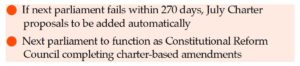
According to the draft “July National Charter (Constitutional Reform) Implementation Order 2025,” the Constitutional Reform Council — comprising elected members of the next parliament — must complete its work within 270 days of its first session. After that period, it will dissolve into a regular parliament.
The Commission’s recommendations specify that the next parliament, while performing its regular legislative duties, will also function as the Constitutional Reform Council during its first nine months.
Within this time, all proposals approved through referendum must be incorporated into the constitution.
If the parliament fails to do so, the Commission has proposed an alternative mechanism: the government will prepare a draft constitutional amendment bill and put it to a referendum.
If approved by the people, the Reform Council will be bound to ratify the proposals without altering their essence. If the council fails to do so within 270 days, the approved provisions would automatically become part of the Constitution.
Ali Riaz also clarified that the Commission has not set a specific timeframe for holding the referendum.
“It can be held anytime between the issuance of the implementation order and the national election day,” he said, adding that the referendum will take place in a single-question, package format — asking whether voters support both the Charter and the accompanying draft bill.
Responding to a question about “notes of dissent” from political parties, Riaz said the Commission has advised the government to take these issues to the public.
“After receiving the people’s verdict, political parties will decide their stance. We have prioritized people’s consent or disapproval on 48 key issues,” he added.
Alongside Ali Riaz, Commission members Justice Md Emdadul Haque, Iftekharuzzaman, Badiul Alam Majumdar, Safar Raj Hossain, Md Ayub Mia, and Special Assistant to the Chief Adviser Monir Haidar were present at the submission ceremony.
The Commission identified nine recommendations that can be implemented through executive orders, including the expansion of subordinate courts at the upazila level, increased judicial manpower, digitization of court management, enforcement of a code of conduct for lawyers, establishment of an independent commission to investigate officials involved in genocide or electoral fraud, creation of two new administrative divisions — Cumilla and Faridpur — formulation of an anti-corruption strategy, automation of service sector operations and data systems, and Bangladesh’s accession to the Open Government Partnership.
Ali Riaz noted that recommendations unrelated to constitutional provisions could be implemented through ordinances or government directives.
“The Commission has urged the government to implement these swiftly. On these two categories of recommendations, there was no disagreement among political parties,” he said.