
Cold wave grips Ishwardi, mercury drops to 11°C
Pabna Correspondent :
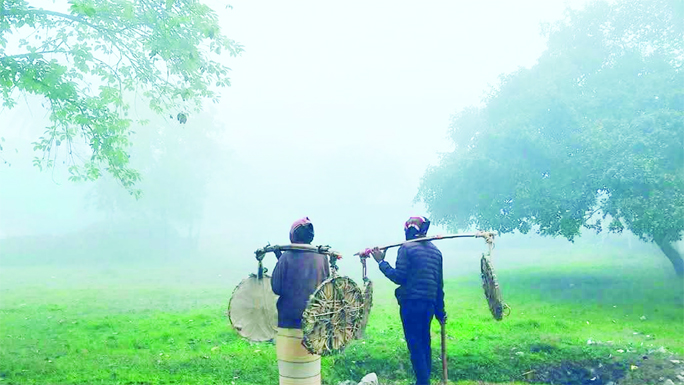
With the onset of the Bengali month of Poush, a severe cold wave has gripped Ishwardi in northern Bangladesh, causing widespread hardship in daily life. The impact has been particularly severe on day laborers and low-income people, whose livelihoods have been significantly disrupted. For the past four days, dense fog combined with cold northerly winds has intensified the chill. The sun remains hidden until noon, leading to a noticeable decline in activity at markets and on roads. On Wednesday , the lowest temperature of the season was recorded in Ishwardi at 11 degrees Celsius.
From Wednesday morning until 12 noon, visits to areas including Railgate, Alhajh Mor, the local markets, and the station area revealed that many working-class people were sitting idle due to the intense cold and thick fog. In several places, people were seen lighting small fires with straw and dry leaves to keep warm. Although the fog thinned slightly as the day progressed, the severity of the cold did not ease.
Nazmul Haque Ranjon, Assistant Observer at the Meteorological Office, said the day’s minimum temperature on Wednesday was 11 degrees Celsius-the lowest recorded this season. Previously, minimum temperatures were recorded at 12.8 degrees Celsius on Monday and 12.7 degrees Celsius on Tuesday.
At the Railgate area, Riyazul, a resident of Bilmari village in Lalpur upazila, waits daily at the labor market in search of work. He said, “I come here early in the morning hoping to get work. But due to the heavy fog and cold, no one is coming to hire workers. I’ve been sitting here for two days without any work.” At the wholesale vegetable market in Ambagan, Alif Hossain from Joynagar village, who sells red spinach in large bundles, said trading has dropped sharply due to the cold and fog. Public turnout outside has also been very low. Sekendar Ali, a rickshaw puller from the Rahimpur area of the municipal town, said, “I usually go out by 7 or 8 in the morning. But today, visibility was extremely poor due to the fog. Seeing the intensity of the cold wind, I went out after 9 a.m. Still, there are hardly any passengers on the roads.
It has become very difficult to earn a living.”
In the station and goods yard areas, homeless people were seen spending their days in extreme hardship due to the cold. They tried to keep warm by lighting fires with collected straw and debris. The lack of warm clothing has further worsened their suffering.
Due to dry weather and cold winds, air pollution has increased, causing children and the elderly to suffer from various cold-related illnesses. As a result, the number of patients seeking treatment for cold-related diseases has also risen at the Upazila Health Complex.